So who is the dude in the suit?
Okay.... self sensoring prevailed.
Figured out who the dude was.
Post deleted.
Okay.... self sensoring prevailed.
Figured out who the dude was.
Post deleted.

You have been an aidworker for too long...
...if you can sum up the names of all political parties in Zambia, but can't remember which parties formed the government in your own home country. (*)
(*) which is not valid for Belgian aidworkers, as we haven't had a government for almost a year.

You have been an aidworker for too long...
...if you can curse fluently in Pashtu, Swahili and Urdu but forget the translation for the word "assessment" in your own mother tongue.
The family of a 24-year old Peace Corps volunteer from Atlanta, Kate Puzey, says agency personnel set her up to be murdered by revealing her role in the dismissal of an employee she accused of sexually abusing children at a school in the African country of Benin.(..)Watch also part 2 and part 3 of the video.
As part of the report, Chief Investigative Correspondent Brian Ross also talked to a half dozen female volunteers who said that after they were sexually assaulted the Peace Corps response was incompetent and insensitive.(..)
(Source article and followup article)

The list of blogging aidworkers grows. Here are my latest additions:

Just read this on Itinerant and Indigent, one of the aidblogs I following. Phil, an aidworker in Afghanistan, writes about his struggle to continue believing in the "Cause". The "raison d'être" of an aidworker:
Why do we keep trying here? I am less and less sure that we achieve anything. I know, I know now that this work is not about us feeling good, or developing our CVs. And I am not an aid junkie, living on the high of the emergency, the thrill of saving lives. But I would like to see permanent progress here in some form, in my lifetime. I am less convinced that will happen, or at least less convinced that there is much I can do to expedite it.
It seems I follow a God of lost causes. I am not sure how I feel about that. As Nathan says, ‘I have joined the long defeat’.
This is a post I wrote three years ago. It seems the subject is still ever so close to the hearts of many, so I brought it onto the foreground again.
There are several excellent insights people posted in the comments. I'm interested to hear your point of view.
 In the previous post, Shylock explored, in a ironical, cynical, self-criticizing way, what personal future we, aid workers have. We wonder the earth, gradually getting used to travel all the time, often in harsh places, and very often in search of a thrill. Gradually we get addicted to it all.
But is there life after this.. after this life of a gypsy? Do we become gypsy disasters after years of behaving like a disaster gypsy, roaming from one emergency to the next?
No matter how much we chuckle reading the previous post, in the end, it is not funny. Far from it. Many humanitarian workers have a problem to find 'a life after this'.. But it is even more sad to realize how few actually "have a life even now"... Even now, many forget, or at least compromise, their personal life because of their addiction. The addiction to the horizon, to the adrenaline.
And now I want to you stop for a moment, no matter what you are doing. What I am going to tell you, is very close to my heart...
 No matter how you twist and turn it. The professional world is still a man's world. This world in general is still a man's world. It has been for hundreds of centuries. From the time men dragged women into their cages by their hair, we have come a long way, but we are not there yet. "There" being "offering equal chances, and equal opportunities to women".
Here is how I see it. (and don't forget I am a man, and no matter how hard I try, I will always be a man, even if I try to look at things from a woman's perspective):
 I look around me, and see people -men and women- alike, with loads of personal challenges through the work they do... But then I look again, and see that in most management functions in this business - the humanitarian world -, men hold the key functions (and most of them come from the first world, but let's leave that aside for a moment). I look once more, and see most administrative support positions are filled by women. Many women in this business are strong, well educated, hard working people. Many of them are young, full of energy, inspiration and aspirations. The new generation of women have been encouraged (and enabled) by their parents to get a good education. They are ambitious to develop themselves personally and professionally. Many of these young women whizz through their twenties like a breeze, and some climb up (if all goes well), the professional ladder.
All of a sudden they find themselves in their mid thirties, somewhere in the professional chain and ask "hey where is my personal life gone to?". And that is where the challenges start.
 If all goes well, they find a partner. If all goes well. As we - men - are not always too happy to live with a partner who has a demanding career. Even fewer like it when that career takes 'our woman' away on duty travel. Heaven forbids that 'her career' would even have her live far away from us, in some dark and remote humanitarian crisis area.
"If all goes well" they find a partner, as too often at their mid thirties, what men are "available" on the "partner market"? Those coming out of their first long relationship, and not looking for something long term. The 'celibataires eternelles' or 'commito-fobes'. Those who have not made up their mind what the hell they want. The 'players'. And those already in a relationship. Or those who have failed in relationships so far.. (and all of that is a whole different discussion which I would love to have over a glass of Prosecco).
 So "if all goes well", a partner is found. And then? "A career" you say? In this world where, no matter what, a woman is still supposed to not only bare the children, but also spend most of her time raising them? Where a woman is still supposed to do most of the household stuff? [if you are a man, think about it... If you don't agree with me, think again... Who spends most of the time with the kids, working for/in the house? You or your partner?].
So, what then? Most women are the ones making the compromise then.. Either give up their career, or work part time, etc...
If they don't, the juggle of kids, house, husband and career becomes a full time challenge.
The other evening, I went with E. over all the women we knew. And we tried to flag those we thought had found a good balance between kids, house, husband and career. And are successful in all. We found one. One woman out of the dozens of women we know, we found one.
That is a sad observation. And even more sad, when we realized that lady does not work in the humanitarian "business".
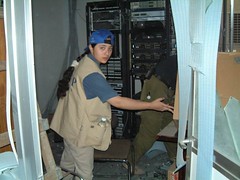 So, all you ladies out there. And specifically those of you in the humanitarian world! In my "The Dudettes" short story I tried (in my cynical and ironical way) pay a tribute to you all. But come and have your say too. Am I seeing things in a too dark, negative way? Am I seeing things too much from a "male" perspective? You tell me.
On August 19 2003, the UN headquarters in Baghdad was bombed, killing 22 people and maiming others for the rest of their lives. Humanitarian aid would never be the same after that.
To remember this event, the humanitarian community decided to call August 19 "World Humanitarian Day". This year is clearly in a lighter note, celebrating "us", and the work we do while still remembering the hundreds that died while trying to help others... (More)


You've been an aidworker for too long...
..if pictures from your first missions are on black and white print.
(for the aid connoisseurs amongst you: where was that picture taken?)

You've been an aidworker for too long...
..when you come home after a six month's mission in Asia and your three year old hugs the taxi driver, crying "Daddy, I missed you so much".

You've been an aidworker for too long...
..if you know the different tribal chiefs in Kandahar but don't believe people claiming "East" and "West"-Germany are no longer separate states.

You've been an aidworker for too long...
..if after one minute of speaking your mother tongue with a colleague, you switch back to English.

You've been an aidworker for too long...
..if you know the fifteen guards at the UN club in Islamabad by name, but forget how to drive to your brother's house.

You've been an aidworker for too long...
..if you have 20 "best friends". Who live in 19 different countries.
The last time you saw any of them must have been... ooogh.. seven years ago?

You've been an aidworker for too long...
..if your memory is indexed refering to the different humanitarian emergencies:
- "My oldest daughter was born the year after Angola"
- "I got married three years before Bosnia"
- "Just after the Tsunami, my parents finished building their new house"
- "I bought that car the third month after the start of Rwanda"
- "My brother started his company the year before the Iraq war"


You've been an aidworker for too long if...
Half of garderobe consist of Tshirts from past emergencies.

UN - Afghanistan 2002/Iraq 2003

UNHCR - Goma 1995

UN - Lokichoggio 1996
PS: Top Tshirt was IFRC Angola 1994


When I started blogging back in January 2007, I discovered a number of blogs from fellow humanitarian. One of them was "Frida", who - at that time - worked for the UN in Afghanistan.
Over the years, I followed her road to (self-)discovery, until she ended up in her new life, and on her new site, under her own name "Marianne Elliott".
Marianne actively shares her experiences as a person, in the humanitarian world, enticing others to do well. For the world, and for themselves. Recently, she interviewed me about my experiences as a person, in this roller-coaster of a life as an aidworker. The interview, you can read here.
Yesterday, we did an interactive Q&A session via Twitter, together with some like-minded people. You can read through the trackback here.
Both the interview and the Twitter session made me think how often we ignore many things in life that should be important to us, getting too sucked up into the whirlpool of work. Particularly in the type of work we, aidworkers, do. Often in all of it, we forget life is more than work, and while our time on this planet is limited, we'd better make good use of it.
The timing of it all came just right. In two weeks time, I will wrap up my mission here in Santo Domingo, and since a few weeks I've been thinking what to next. I thought the time was right for yet another sabbatical. Another breath of life, before embarking in the next adventure.
Sabbaticals are not new to me. I took the first one back in 1993, where I decided to go to the Antarctic. I took another break in 1997, to go to the Antarctic again. And yet another one in 2006, for 13 months, to sail across the Atlantic, and start writing down some of my past adventures, both for work, and in my free time.
So, as of mid June, I am off again, for 6 months. No clear clue yet as to what I will do. Spend more time with the family, that is for sure. Shuttling between Rome and Belgium, as I want to continue being connected to work. I also want to have more time to experiment with social media and see how far I can push the Web 2.0 tools for the humanitarian cause. We will see what we come up with, and where we will end. Destiny has always been good to me, so I not worried. We will see... Life is too short to be boring. And a bit of a breather will be good.
Picture of Marianne in Afghanistan, courtesy of Marianne Elliott

I cleaned up my list of aidworkers' blogroll in the sidecolumn. Blogs with irregular updates and those from aidworkers who moved on, I moved to the archive.
I also added my latest aidworker blog finds:

Once the French actor Jean Gabin made a song "Maintenant je sais", "Now I know". He tells a story that when he was young, he always thought he knew everything, and as he grew up, he started to doubt what he really knew, what he really understood of life. He concludes saying as a 60 year old, his life is mostly behind him and "there is only one thing I know for sure: I never know".
Maybe as you are young and are trying to find your way in life, you need to reassure yourself not to be swept off your feet by everything happening in life. And as years go by, you learn about your own strengths and weaknesses, so you no longer need to hold on to the straws of false assurances... So you can give yourself the liberty or privilege of doubting.
Another way to look at it, is: when you are young, 8 or 10, you look up to adults as if "they know what they are doing". A job, kids, house, financials, life in general. As you grow into an adult yourself, you start to see the doubts and struggles that also your parents have experienced: they did not know neither, but tried their best.
I will turn 50 this year, believe it or not. When I was young I always said I would die falling of a tree, a cliff, freeze to death on some mountain top, crash in a remote area in Africa before I turned 50... I never believed I could turn 50, me, who was always the youngest and the wildest in the bunch...
But now I do turn 50, I also learned that struggles and doubts continue if you live life intensively and to the fullest. I know these internal battles will never stop. I learned that bit, and came to terms that "I will never Know"... I will continue to doubt whether the choices in life I am making, are the right ones for me, for those around me. Whether the choices I make at work are the right ones, whether I do things right. And somewhere that is the beauty of life. And maybe it is the strength of a person: the strength to dare to doubt. The strength of understanding you will never know.

Last night I arrived back in my apartment near Rome. As I opened the door with a key I had not used for almost three months, the familiar smells and sights engulfed me. It felt as if I had just walked out of the door for a few minutes, to buy a pack of cigarettes in the shop downstairs.
A pair of shoes stood under the small table in the hallway, with next to it some spots of volcanic sand from the previous stroll on the beach now ten weeks ago. I walked into the kitchen to unlock the backdoor, switched on the boiler, picked up a glass on the way back, hooked up my iPod to the sound system, selected Italian opera, checked messages on the answering machine, drew the curtains aside and opened the living room windows.
The smell of distant sea-silt, the fresh breeze, the trees waking up from a winter sleep, the laughter of the kids playing below in the street, the dog from the house across the street barking, and the meshed conversations from the people coming out of the ristorante on one corner, with the those sitting on the terrace of the coffee shop on the other corner.
All of it made it feel as if I only left for a few minutes. But it did not feel this was the place I missed during my travels to the Dominican and Haiti. It did not feel this was the place I dreamt of. It felt as if I wasn't really gone. A piece of me stayed here. A big piece of my heart never left. Coming back felt like two pieces of my heart were joined again, making it skip a beat for a second. I smiled when I realized my heart pounded faster. I felt happy. "Honey, I am home"..!
But what is "home" for a wandering aidworker? I will be here for four days, then off to the North for a few days, followed by another plane ride to Belgium, my other home, for a week. Then I will drive off for a week of skiing, and back. Plane back to Rome for a day, and then to my other home, in the Dominican, for a few months.
What is home really? What defines home? The pillow I lay my head on? The hands I held in thoughts? The smile of my girls?
In thoughts, I pushed my travel bags in a corner, sat down, and opened a bottle of Prosecco, realizing this life I lead is a weird life. But it is the life I conscientiously had chosen since I left for a war-torn Angola back in 1994. Sixteen years I have been on the road, and made my home in dozens of places. What? Hundreds of places! From the hotel room in Georgia where the wind would swing the electrical wires on the street until they shortened with a bang, waking me up every night. To the apartment in Tajikistan where the tap water was as black as ink. To the bed and breakfast place on the border of Cambodia and Vietnam where I had to pick the leeches off my legs each time I walked in the garden. To the underground bunker in Kabul. The humid guesthouse in Islamabad shared with cockroaches. The Out-of-Africa villa in Lilongwe and the house on the hill in Kampala, known as "the house next to the big mango tree", until the transformer next to it went up in flames, burning down the tree while it was at it, then to be known as "the house next to the big charred mango tree"...
This morning, before even taking a shower, I wanted one of the things I missed about this place: A Cafe Latte with a cornetto. As I got out of bed, I put on some clothes - realizing I forgot my jeans in my Domingo home, and went down. Laura, behind the counter as usual, said 'Ciao, Peter!", as if I'd never left. I sat on the terrace tasting the coffee as if it was my first. Looking at the blue sky lined with palm trees as if it was the first time I saw it.
I thought a shower might be a good idea, but, as I went through the last piece of the croissant, I realized I took my electric shaver with me, but forgot my charger in Santo Domingo. Strange how you realize things clearly sometimes, but at the moment where you should have remembered, you forget. I dug out the keys to my car, brushed the pine tree needles off the wind shield, and went to buy a razor. Got distracted by the early spring flowers on the way back. Conscientiously took a different turn, and drove off to the sea. Locked the car, and walked up the beach.
It was then I saw a large piece of driftwood. It was then I realized my life was as if it were driftwood. Floating from one place to the other. Each place left marks on me, in me. And as time went by, each place sculptured me bit by bit, making me who and what I am.
It was then I realized this is the life I like. Drifting from place to place. Not rooting in any, but loving all. And particularly loving this beach where I was pulled ashore, right here in Italy.

"Mañana, por favor!", I answer when housekeeping knocks on my door. Mañana, please, I am working...
I sit, computer on my lap, on my bed reading through a backlog of emails, catching up on work done, being done, and work to do.
I just got back from two days in Port-au-Prince, Haiti. It has been almost two months since I landed in Santo Domingo to coordinate the support functions for the Haiti crisis, out of the Dominican Republic. My days are full. My attention is switching from a meeting with one of the ministers, staff recruitment, debugging a cash advance problem, a meeting on limiting the overtime the drivers can do, a shipment which seems to be lost but really is not, stamping the numbering on the food coupons, staffing contracts and a security incident.
It is not the amount of work that tires me, it is the intensity in which issues come, and need to be dealt with. Not that I don't like it, but in the evening, I pass out on my bed...
After two days in Haiti, I wonder how my colleagues can deal with their work, which is a ten fold more complex than mine. They don't have a comfortable hotel room, five floors up and 1 minute away from the office. They either live in Camp Charly, the tent camp for the humanitarians, or have to shuttle to the boat anchored off shore, to spend the night. Given, the boat is more comfortable, but it takes anything between one to two hours to get there. Some of the staff pitched their tent in the back of the container park, in "Log Base", right next to the airport, where most UN agencies set up tents, tarps and office containers, making it the "humanitarian nerve center" of the operation.
The humanitarian part of Log Base is nothing but one narrow road, lined with parked vehicles, crowded with people moving around between the offices, and filled on either side with "offices".
The fortunate have a 20 foot office container, some with airconditioning, with tarps over them to avoid water sipping through the joints. The less fortunate have massive tents to work in. Meetings are held in open spaces covered with tarps, or half open shelters. Lack of working space is common with most containers cramped with four people, hardly fitting the make shift desks, filled with files and folders hardly leaving space to fit their legs inbetween.
The noise is constant, mostly from planes and helicopters taking off or landing on the airstrip a few hundred feet away. During the meetings, when the screaming noise of yet another Ilutsin taking off builds up, people just stop their sentence for thirty seconds, and then continue as if nothing happened. Like pushing the 'pause' button on a video.
Most of the containers are now properly wired up onto the generators, and have network connections to the servers and satellite links. Nothing much we can do these days anymore without connectivity, be it for emails, telephone calls, or registering all procurement or logistics transactions onto the central servers in HQ.
Luckily, during my two days, it was neither hot, nor raining, and many staff commented "this weather is as good as it gets". I can imagine the dust, humidity or mud on other days.
There is a constant flow of visitors. Army personnel, staff from the other agencies and NGOs, civilians, people from the government and local communities, people coming back from assessment missions or distribution points. It makes it hard to keep concentrated to the task at hand, as people get interrupted every other minute.
And although the spotlight of the world's cameras is no longer focused on Haiti, the humanitarian operation is still to peak. While during the first six weeks, the utmost urgent needs were being met with loads of cargo being flown in, the steady massive flow of the aid cargo coming in per ship has started. While one plane can bring in up to 100,000 kgs of aid supplies, a ship can bring in 400,000,000 kgs in one go. So the logistics and distribution challenges are only starting now.
On top of it all, the rainy season has begun, making the need of the bringing in supplies even more urgent. And we have the hurricane season just around the corner.
So, sitting back in my hotel room on this Sunday, I can not have but admiration for the staff working in Haiti. Many of them were present during the earthquake. They have lost their homes, suffered from loosing family or friends, scarred by seeing the human misery day by day.
I wish anyone criticizing the humanitarian agencies on the ground in Haiti, could spend a week there, working with them and feel what it is to be faced with the daunting tasks ahead, where "Mañana" might not be an option.
Pictures from my visit to Haiti, and random snapshot from day to day life here, can be found on Shot from the Hip.

For almost 9 years, I headed different emergency response teams while I was based in Uganda (the Great Lakes emergency), Kosovo, Pakistan/Afghanistan and later out of Dubai. Back in 2006, I took a sabbatical and after that worked for three years in Italy, outside of the emergency response scene.
The Haiti operation is my first emergency since four years. Just before leaving Rome, on my way to the Dominican Republic, I wondered by myself, if I still had it in me. If the tools I built for myself over the years were not rusty. But already the first day on the ground in Santo Domingo, it was clear the past experience I was able to build up, did not fade. I felt -once again- as a fish in the water.
In our office, we manage about 80 people, most of them coming from different operations all over the globe. People were picked from other offices, all over the world. From North Korea to Ecuador, from Rome to Indonesia and Malawi. I think they must come from 50 odd different offices. Some are experienced staff, and for some, this was their first emergency response. Some are logisticians, others finance officers or procurement staff, others are administrative assistants, fleet managers, air operations specialist, counsellors, warehouse managers or nutritionists.
How, as a manager, do you make these people fold into one team? I often think about what makes a team work. And the role of a manager in a team. Off the top of my head, let me sum up some points I find crucial.
1. Give direction
Define the team goals from the beginning. It gives people a sense of direction, it helps turning the faces of all different units in the same way.
2. Care
As a manager, your staff is your main asset. Your staff will make or break an operation. Be sensitive to the individuals in your team. Debug conflicts right at the start, before they become major issues. Ensure your staff keeps healthy, care for their wellbeing. A fruitbasket a day sometimes makes all the difference. Mind their energy levels. Chase them out of the office when needed, so they don't burn out.
3. Give feedback
Tell your staff when things are not done well, knowing they do their best, and have the best intentions. Praise when praise is due. An occasional pad on the back does not cost anything.
4. Structure
Draw up the team organigram from the start. People need to know who they report to, and what unit they belong to. Put a person in charge of each unit. Ensure the reporting structure is respected, and assist the unit heads where needed.
Brief new staff as they arrive. Explain the team goals, the organigram, the way the office is run.
5. Smile
Everyone has a bad day once in a while. I for one, never hide it when I am in a pissy mood. But I also love to walk around my team and hand out a friendly word and a smile from time to time... Amazing how much difference it makes sometimes.
6. Enable
As a manager, you are an enabler. You have to give the people the tools they need. Be it the budget, connectivity, a decent office space, or equipment. Without their tools, the best team members will not be able to function.
7. Debug
After defining the initial team structures, the basic systems and procedures are put in place, and giving your team the tools it needs, one of the main tasks of a manager in emergency operations, is to be a debugger. Ensure people come to you with their issues, and help them on the spot. Don't let problems 'breed' or 'simmer'... Keep your door open.
Often people ask me what I do, as a manager. Apart from my task in linking the teams to the 'outside world', be it the government, the UN system or our HQ, my main day-to-day task is "debugging". I see myself as the guy who walks around with a toilet plunger -the stick with a large rubber suction tab- sticking it into the lavatories and going 'Zwonk-Zwonk', until the garbage is gone, and the water flows again. I am a professional toilet-declogger.
8. Involve
Teams working in emergencies tend to become very focused, which is good. Well-functioning units concentrate on their task at hand. All OK, but also ensure they maintain the overall focus and the context of the operation. Even after the first month in this emergency, I still have an all-team meeting once per day. It gets people from behind their desk for a few minutes while I can give some information on what is going on beyond our office, within the emergency. Everyone likes to feel part 'of the big machine', feel their work makes a difference. Certainly important for humanitarians!
9. Delegate
In a fast evolving emergency, it is impossible to micromanage. Ensure you have staff you can entrust with the task at hand. Empower the supervisors within their own team, and delegate the tasks. Pass through the supervisors rather than tasking people directly. Often one of my big challenges, by the way.
10. Spot check
It is impossible to check everything going on. But random spot checks on what's up, gives you as a manager a good idea what's going on. Read the signs. Sloppy expense reports might point to a sloppy finance officer. Delayed attendance sheets, might point to a sloppy HR officer...
And now I am thinking "Where did I sin against my own rules, today?" :-)
Picture courtesy Jonathan Thompson

Eight days ago, which seems a lifetime ago right now, we were meeting in Rome, with the operational group, briefing about the Haiti earthquake emergency. The initial response teams had already been deployed, and the reports we got from the ground gave us a clear view of the enormity of the catastrophy, and the size of the humanitarian response it would require.
During the meeting, we realized that the destruction of the infrastructure inside Haiti would not allow us to bring humanitarian aid straight into the country, neither by air or sea. I stressed the need to beef up the logistics and support capacity we had in the Dominican Republic, Haiti's neighbour. While we were discussing the possibilities, my boss bent over to me, and asked: "Would you want to run that part of the operation". And I said "Yes".
That was at 10 am. Two hours later, senior management had agreed, and I got my "marching instructions": set up the logistics and support "pipeline" in the Dominican Republic. I asked to leave on Tuesday, so I had time to define what I would need in terms of people and structure, and to prepare myself.
On the Tuesday, I flew into Santo Domingo, the capital. As I walked into the office, I saw 30 people cramped into a space, suitable for maybe 10 people. Staff was working with 6 at a table of one.
The same day, we negotiate office and accommodation space at a local hotel, and the next day, we moved. Staff kept on flying in, either to work out of our "Dominican hub" or in transit to Haiti. This evening, I checked, and we already had 67 rooms occupied in the hotel, meaning 67 people were already working in our Santo Domingo office, excluding the logistics hubs we are currently establishing in Barahona and Jimani.
Our operation is supporting the food "pipeline" into Haiti, transporting 40 trucks of food per day, soon to be increased to 60 trucks per day. We also have two passenger planes and one cargo plane which fly into Haiti twice or three times. We don't only transport food, but also ferry people and humanitarian aid into Haiti for other agencies. And it is only the beginning.
Since I landed, the operation has rapidly increased in size, and will continue to do so. Days and nights fade into one. I concentrated in organising the office structure, and creating an environment where my staff could work. We are working out of two converted conference rooms in the hotel, squatting with our laptops at conference tables with admin staff, procurement people, the air operations officers and the logistics group. As I walk around the rooms, I overhear conversations about flight and cargo bookings, people negotiating warehouse space, deals being made about jet fuel, travel bookings, offloading planes, security clearances, the purchasing of drinking water, and situation reports. It is a positive, 'we-can' atmosphere. I can see people smile, and enjoy the work the do. This is the stuff they like, the core of a humanitarian aid spirit.
And I have great staff. They know their work, I don't have to do much, other than a bit of guidance here and there, and for the rest, just be the "oil in the machinery". Each group, be it the logisticians, air ops people, procurement staff, or the travel people, all know what to do and how to do it. I see small teams working on the deployment of the helicopters, the flight schedule of the next days, the increase of our trucking capacity or simply putting together the contact list of those operating in the country. I am proud of them.
And inbetween all of it, Jayne stands up and shouts "Quiet everyone, who has bloodtype B+"? One of our staff member in Haiti dug his two children out of the rubble of what once was his house, and we evacuated them into Santo Domingo. One of the children was going into shock and the hospital lacked B+ blood. A staff member raised her hands, and she was driven to the bloodbank. Meanwhile the hotel staff started an SMS campaign to find more B+ blood and in one hour came up with a list of 8 donors. The child was saved. For now that is, he remains in critical condition.
Meanwhile we continue to get 'shopping lists' from our people on the ground in Haiti. The need instant coffee, sun screen, water, toilet paper... I admire them. In between the trauma of having experienced the quake, they continue to operate for 18 hours a day. With a complete lack of any basic comfort. Living and working in temporary tents. I think of them, as I am sitting in my comfortable hotel room, one hour's flight away. I wish them well. They have a daunting task ahead of them. I wished they could see how dedicated we are to serve them, and their work. We, our office, is committed to keep "the pipeline" going. The virtual flow of humanitarian aid, and survival assets.
We are committed.


There is another aspect which niggles slightly and that is the deafening silence that generally meets the news of aid workers being killed or taken hostage. There is not only a relative silence from governments, media or the public but even from the humanitarian sector itself. Compare the death in Afghanistan of aid workers to that of soldiers who, by and large, are armed to the teeth and sent to Afghanistan to kill or be killed. I don't dispute military interventions - not my business - but it is quiet incredible that the media is so keen to eulogize the military as 'fallen heroes' and ignore those who risk (and give) their lives desperately trying to make a difference on the human level without resorting to state of the art munitions and military occupation.But I want to make it even more black and white: We, the aid community are left clueless what to do with this increased risk we face. The only thing we seem to be doing is piling up those sandbags even higher. Buying more bomb-blast film, bullet-proof jackets and mine-resistant Kevlar layers for our vehicles. Measures which should be taken, but proven to be insufficient.


The guests were still sleeping when the gunmen, dressed in police uniforms, arrived early Wednesday. In the dark, they shot the guards, scaled the front gate of the guest house and began firing grenades, the beginning of a terrifying two-hour siege that showed just how little it takes for the Taliban to trap foreigners in central Kabul.
By the end of the siege, at least five United Nations employees, two Afghan security officials and the brother-in-law of a prominent Afghan politician were dead, as were their three attackers. (Full)
It is strange.. It is only after the hours go by that the cruelty and the reality of the act today really seeps through... And the consciousness that if we are to work in a higher risk environment, there actually is not one place, where one is totally safe. Where would that be? In the office? They drive a truck through the gates and blow it up. In the guesthouse or the hotel? Same thing...(Full)

I am shaken and traumatized after the yesterday’s blast which took place inside my office building only a few paces away from my glass-cabin. The blast was so sudden and strong that it took me some time to register what actually had happened there with all of us. It was so strong that I was thrown from my chair to a few feet away on the floor.
Everything was shattered into pieces only in a matter of seconds. When I tried getting up from the floor, I had broken wooden pieces in my hair, my head and body were aching badly as something had hit me severely. I was not in my senses and my whole body was shaking badly, the sound of the deadly blast was resonating in my ears and I was so shocked that I could not move a step. There were injured colleagues lying on the floor. My room was on fire and pieces of paper, broken pieces of doors, broken pieces of my glass cabin, windows and tables were lying here and there. I was looking at my injured colleagues in a state of shock and horror. “Vacate the building immediately”, I heard one of my colleagues saying. But I could not move till the time one of my colleague dragged me outside the building. But that was not the end of it.
The real horror started when my colleagues started taking the dead and injured bodies outside the building. Yes, bodies drenched in blood of people I worked and used to spent a major part of my day on regular basis… It was such a heartbreaking scene……We had tears in ours eyes. We were horrified and traumatized…
None of us in the office had ever imagined that this Bloody Monday will change our lives for ever and we will be left with haunted memories of the incident. I have not recovered from the shock yet, the whole scene is playing back again and again in my brain, even the sedative pills failed to calm down my nerves. None of my other colleagues are out of trauma yet. Those innocent souls who died in the blast would never be there in our office again and our office would never be the same place again….. I pray for all the departed souls (Gul, Farzana, Wahab, Abid Rehman and Udan) and I am going to miss them forever …
My mother says that it is a miracle that I have only minor injuries and I survived despite the fact that the bomb blasted only a few paces away from where I sit But I am thinking why this miracle did not happen in case of Gul, Farzana, Wahab, Abid Rehman and Udan. Why these innocent people lost their lives?? What will become of their families now?? What was their fault or What was our fault that all of us became victims of a bomb blast and are left with haunted memories ??

 Peter. Flemish, European, aid worker, expeditioner, sailor, traveller, husband, father, friend, nutcase. Not necessarily in that order. Peter. Flemish, European, aid worker, expeditioner, sailor, traveller, husband, father, friend, nutcase. Not necessarily in that order. |


© Blogger template The Business Templates by Ourblogtemplates.com 2008
Back to TOP


The Road's Dashboard
Log in
New
Edit
Customize
Dashboard