Showing posts with label Sudan. Show all posts

MSF: Top 10 humanitarian crisis of 2009

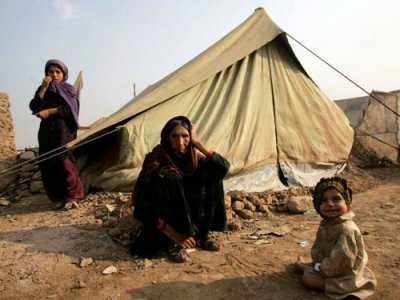
MSF: Afghan elder with child

Just like Christmas carols, pennies in the Salvation Army collection tin, loads of booze, turkey experiments in the oven, and presents you never asked for, MSF (or "Doctors without Borders" for the Anglophones) has its annual traditions too: Every year-end, them release theirs "Top Ten Humanitarian Crisis of 2009".

On The Road, we have the tradition of summarizing this Top 10 of "world shame" (see our 2008 and 2007 posts).

Top 10 humanitarian crisis of 2009MSF began with the "Top Ten" list in 1998, when a famine in southern Sudan went largely unreported in the US media. Maybe due to the CNN effect ("no media attention, no aid pesos"), MSF went a more commercial course last year, converting "the most Underreported Crisis" list, to "the Top 10 Humanitarian Crisis".

This year, MSF reports in their top 10:

  • Unrelenting Violence Stalks Civilians Throughout Eastern DR Congo (Tell me something new, DRC tops the list every year)
  • Somalis Endure Violence and Lack of Access to Health Care (been in the top list since.. well, since for ever)
  • Precarious Situation for People in Southern Sudan and Darfur (tell me something new)
  • Thousands Injured during the Final Stage of Sri Lanka's Decades-long War (ok, the Sri Lanka government topped themselves this year, I have to admit. They deserved a special mention for nearing genocide this year.)
  • Civilians Suffer From Violence & Neglect in Pakistan (Mjah... More than last year, I agree. But mostly over-reported news this year.)
  • Politics of Aid Leaves many Afghans Cut off from Humanitarian Assistance (On the hit list since the 70's, but US violence in Afghanistan definitively increased, I agree. Hardly underreported news, though).
  • Civilians Trapped in Violent War in Northern Yemen ("North, South, Left, Right:Yemen is always in the Fight. North, South, Left, Right...." Now that the US and Saudis start bombing Yemen rebels, all will be over soon. Rrright.)
  • Woefully Inadequate Funding Undermines Gains in Childhood Malnutrition Treatment (True. No change.)
  • Funding for AIDS Treatment Stagnating Despite Millions Still in Need (True. No change)
  • Lack of R&D and Scale Up of Treatment Plagues Patients with Neglected Diseases (True. No change).
For as far as I am concerned, the 2009 list could just have been a cut and paste from the 2008 list. Except that for one reason or the other, Zimbabwe was dropped from "The List". Maybe it was considered a hopeless case anyway. How about including violence in South Africa, tribal turbulence in Kenya, sexual violence and child labour in many parts of Africa, increased hunger and malnutrition in the US, large scale displaced people in Colombia, the increase of urban poverty, inaccessibility to food rather than unavailability of food....

Guess MSF might have been a bit short of inspiration and imagination this year. But then again, in all due fairness, their "Top 10 List of Shame" is a must-read. Check out the excellent pictures list which goes with the Top 10.

How about this, why don't we start our own "2009 Humanity's Shame Top 10" list? Stay tuned, will announce it soon.

Update:
1. We kicked off our "Humanity's Shame Top 1o". Accepting nominations on this post.
2. Nominations are closed. You can vote for your "Humanity's Shame" on this post.
3. The poll results are out. Check out this post for our "Humanity's Shame Top 10"

Picture courtesy Jobi Bieber/MSF

Read the full post...

The LRA: unresolved questions

LRA child soldiers

Lord's Resistance Army (LRA) was founded back in 1987 as an armed opposition against the Ugandan government. At that time they based themselves in South Sudan, but operated mainly in Uganda.

They became mostly known through their numerous abuses and atrocities against civilians, including the abduction, rape, maiming, and killing of defenseless people. They regularly kidnap children to enslave them as child prostitutes and soldiers in there so-called "army".

Since they were pushed out of North Uganda in 2005, the LRA has been terrorizing civilians in the DRC (Democratic Republic of Congo), South Sudan and Uganda, hopping over the borders.

In February this year, the Ugandan army - apparently aided by the US - tried to root out the LRA from DRC. The LRA retreated, killing 900 civilians in the process (Full)

Even just a few days ago, the LRA kidnapped around 135 villagers, including children, during two attacks in DRC's North East. (Full)

I invite you to look at this excellent video, one of the very few interviews ever made with Kony, the LRA's leader.
It stroke me how the LRA seems to be mostly a loosely knit group of bandits, clearly with a wide network of informants, held together by the Thuraya telephone network. There is no clear goal nor ideology behind the LRA. When Kony was asked "why are you fighting?", he answered "for democracy", but it did not go any deeper than that.

Add to these impressions that their overall troop strength is estimated anywhere between 500 and 3,000 soldiers (half of them estimated to be women and children), I am left with only two, but fundamental questions:
  1. How come nobody has been able to smoke out this gang of bandits (wanted by the ICC - International Criminal Court by the way)? In this day and age where technology exists and is routinely used to track the movement of people using satellite phones? Why is there an apparent unwillingness of the international community to make an end to these atrocities, which, to top it all up, continue to contribute to the instability in Eastern Congo, one of the longest lasting conflicts in Africa?

  2. Who supports these rebels? They would not be able to operate without the financial and logistics backing of an entity. What entity? Who would contribute to an instable South Sudan, Uganda and DRC? Khartoum?
Picture courtesy Jacob Gelt Dekker

Read the full post...

Marriage, the Sudan way.

Ladies in Bor South Sudan

Another story by Enrico, a fellow aidworker in South Sudan, who wrote several short stories on The Road.

Late evening, I step out of our compound with a Ugandan colleague for a last (walking) meeting, when we're approached by a man wearing an military uniform, visibly eager to chat with a Kawagia ("white man" in the local language).

Despite their past bellicose nature, the locals here in Jonglei, South Sudan are usually friendly and discrete. After the usual how-are-you question, he uncommonly ventures a bit further by inquiring for my name and my nationality, and abruptly asks:
- “What’s marriage like in Europe?”
- “I beg your pardon?”, I say doubtfully.
- “I mean, do you pay the brides by cow or by cash?”, he specifies.
- “Well, neither of the two.”, I respond casually to hide my amusement
- “So what’s the advantage for the owner of the girl then?”, he replies with a big smile and looks at me as if I’m coming from outer space. He chuckles and as he walks away he turns to my colleague and says:
- “Hey, black brother, you’d better tell your friend how it works!” still smiling and mulling over the funniest thing that ever happened to him.

Picture courtesy Ulrik Pedersen

Read the full post...

Excuses...

Bor South Sudan

Enrico, a fellow aidworker in South Sudan, wrote several short stories on The Road.

He just told me this story:

I was waiting for a convoy to come back from Panyagor to Bor town, the capital city of Jonglei State in South Sudan. The convoy comprising of two 4x4 Landcruisers arrived at the compound. One of the vehicles was badly damaged.
I approached one of the drivers and asked him how the journey was.
- “Very bad”, the driver replied.
- “What happened?”, I asked.
- “A python capsized my vehicle”, the driver continued in half English.
- “How big could it have been?”
- “Very big, indeed”, he concluded and entered his tent.

In French, they say "Les excuses sont faits pour s'en servir"... If you want to find an excuse for something, you can always find one.

Picture courtesy Ulrik Pedersen

Read the full post...

A bridge being built in Sudan

A Sudan bridge being built

I just came across an interesting blog, Unity Bridge, about a development project in Yabus, Sudan.

Yabus is home to five tribes and 60,000 people, divided by a river that is impassable for up to six months every year.

The blog follows the project to build a 74m bridge which will unite the town so that both sides will enjoy access to the clinic, market, and schools all year long. The small and big hurdles, success stories and setbacks so typical for development work in Africa.

Picture courtesy Unity Bridge

Read the full post...

Jihad on horseback

Two years ago, Al Arabiya producer Nabil Kassem was asked to put together a documentary film on Darfur.

What he witnessed there, and recorded in this film, were scenes of unspeakable brutality and untold suffering.

The movie never made it to the airwaves. That is why we publish it on our blog.


If you are interested in Darfur, check out Darfur Now!

More on The Road about Darfur, Sudan and genocide

Video courtesy europenews.dk

Read the full post...

Worrying events...

swat valley refugees

There is always something going on, somewhere in the world, that keeps us, aidworkers, busy. Here is what is on our mind these days:

  • 8,000 Somalis are displaced in one day of fighting around Mogadishu (Full)
  • A rebellion seems to be on the raise in Nigeria (Full) and Niger (Full)
  • Relief agencies still don't have full access to the displaced civilians after the Tamil was defeated in Sri Lanka. (Full)
  • Southern Sudan seems to fall back into violence (Full)
  • ...while in Darfur, the war is flaring up again (Full)
  • Pakistan's offensive in the Swat valley displaced 2.3 million people, with aid agencies scrambling to cope. (Full)
Items discovered via International Aid Workers Today and AidNews.

Picture courtesy Reuters

Read the full post...

As I am leaving Sudan.

bor south sudan

In the past, I published several stories written by Cyprien, one of my friends and colleagues.

Cyprien is originally from DRC but worked with us, based in Kosovo, Pakistan, Afghanistan, Mozambique, Senegal and Sudan. He is about to be reassigned to the Somalia operation and wrote this story reflecting on his time in Sudan. It is both a tribute and an emotional good-bye to a country he got to love during the past years.

As far back as primary school, I heard about Sudan. I do not remember very well in what context, but I am sure it was during our geography courses. Later I learnt more about Sudan over the news. I remember the days when every evening my father used to call me to sit with him and listen to the radio.
Almost, everyday there was news about Sudan then, just as there is today. I can't remember what it was all about, but I remember that the name John Garang was mentioned often.
As I grew up, my interest to Sudan became even greater as I realized that this country was one of our neighbors.

In 2005, when I got an assignment with the UN in Senegal, I hired a driver. During the interview, I requested his papers to learn more about him. In the paper he gave me I could read : " Ethnie (Ethnic group): Soudanais (Sudanese)".
I asked him how come he was of Sudanese ethnic group. This man did not go to school at all, but he gave me a clear answer: "Sudanese is a nationality, but it is also a race, and a ethnic group that migrated from Sudan to the Senegalese coast. These are often the taller and darker people you see in Senegal."
From then on, when they spoke about Sudan, I kept in my mind the idea of a country, a race and ethnic group.

In 2006, there was extensive media coverage on Sudan (or may be it was my feeling), some people talked about something similar to a genocide happening in Sudan. I heard about the Janjaweed militia, about Darfur, about the "South Sudan" issues. I remembered the pictures showing the UN planes flying in the Sudan skies airlifting food aid assistance. I saw the pictures of people suffering, I saw a picture of a child abandoned by its parents, struggling to walk as a wild bird waited for the child to die so it can eat him.
I felt a call to assist. I decided to search for an opportunity to go to Sudan and bring my small contribution.

By February 2007, I joined the Sudan relief operation. As I landed in Khartoum, I could count the few number of trees per square kilometer on the fingers of my hands. The city was brown. Its layout and geometric design reminded me of Islamabad, in Pakistan, where I had lived before.
As I walked the street of Khartoum, I did not feel like I was in a country at war or where ethnic groups were fighting against each other. Khartoum is rather a city where I found Sudanese of all origins and color all leaving together, even though I noticed some jobs were done only by one "category" of Sudanese.

I proceeded to the South days later. I slept in a tent. The only luxury I had was my ventilator which blew fresh air but also new dust. And dusty it surely was in the months of February and March.

In the South, you could find signs of heavy fighting that took place in the recent years, but all was relatively calm and people felt proud to enjoy peace. I travelled across the country and I could see the sign of hopes everywhere. Roads bridges being built, schools opening, some times even under a tree. The WFP Humanitarian Air Service flights which used to be the only ones in the sky, were joined by the commercial flights.

Slowly tents shelters that were used as accommodation by hotels, UN and NGOs were replaced by prefabs, and later on by durable structures. This, to me, was a signal of the progress, and all of this brought me hope about the Sudan that I got to love.

On a bright Sunday of Easter 2008 I went to pray in a local church. The priest started preaching about how to preserve the peace dearly acquired. He linked the suffering of Christ to the suffering of the people of South Sudan. He went to explain how after the suffering, Jesus rose high and enjoys great times at the Right of the Holy Father and he linked it on how south Sudanese are now enjoy life after the sad days.
One thing is missing, he explained: "I have seen hotels and restaurants opening from Juba Bridge (the south side of Juba town) to Gudele (the north side), but I have not seen one kindergarten being built!". "Can we develop a country with hotels and restaurants only? We need to build educational institutions if we want to establish ourselves as a nation", he continued. "I would like those who are in charge of issuing licenses to stop issuing licenses to open new restaurants, bars, and clubs and promote business related to education", the priest concluded.
The audience stood-up and exploded in a huge applause, but it got me to think about the institutional progress in Sudan.

UN agencies, INGO and donors have done a great job in South Sudan, where I have witnessed changes happening at a very high speed. One should be proud and happy for having contributed in a way or another to this, but how much of this progress was durable, and not superficial?

My worries grew bigger over the past months, as I am about to leave Sudan for Somalia. The ICC decided to issue an arrest warrant for the President of Sudan. I will not get involved in mitigating the collateral damage this is likely to have on the peace and development in the South. Specialists have already commented on that.
I will not talk about what will happen to millions of people who were surviving on aid, including food and medical supplies, distributed by the expelled NGOs.

I also do not want to think how much the Sudanese work force will survive with their families in the new global economic recession. A Sudanese friend who runs a car workshop, told me yesterday, both hands in his pocket: "Juba fell into a recession. I need to lay off some of my technicians. There are no more customers coming in anymore since few weeks now." Anybody in South Sudan is feeling business slowed down.

Economic recession, the repercussions of the ICC indictment, the superficiality of the economic development... These are the thoughts I have when I leave Sudan after two years.

Picture courtesy Ulrik Pedersen

Read the full post...

More micro finance loans

susan edward

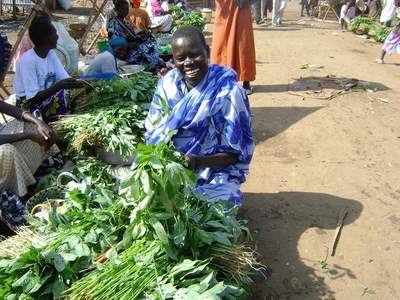
Susan Edward from Juba in Southern Sudan is 28 years old and married to a teacher. She has two children who are in school. Susan sells green vegetables at the market and is requesting a loan to open a shop.

We gave her a micro finance loan of $50.

This is one of the new loans we gave as part of $400 raised at the birthday party of my friend "E", who also wrote this short story on The Road.

"E" preferred not to receive gifts for her birthday, but asked for people to donate to our Change Starts Here project.

Ester was one of the people who stepped forward.

Thanks to Ester and "E", we financed these projects:
- Grace Elunai in Sudan: $50
- "Women in Need" group in Sierra Leone: $100
- Mimania Edward in Sudan: $50
- Susan Edward in Sudan: $50
- Rena Hasanova in Azerbayijan: $25
- Enero Women in Paraguay: $75
- Rubelyn Lumanta in Philippines: $50

Follow the progress of our project on our scorecard

With a big thanks again to Ester and "E"!

Read the full post...

What if a genocide indictment would lead to another genocide?

darfur refugee

The Sudanese president Al-Bashir got indicted by the International Criminal Court (ICC) on charges of war crimes and crimes against humanity in the country's western Darfur region. By now, everyone knows.

The international community, and the aid organisations working inside Sudan were weary of upcoming indictment since months.

Now the Sword of Damocles has fallen, they are dealing with the consequences: Sudan accused aid agencies of passing on information to the ICC and first expelled 10 NGOs (Non Governmental Organisations), followed by another three.

The impact goes beyond the expelled Darfur-based aid agencies themselves and their relief programmes. Many of these NGOs are implementing partners of other -often larger organisations-, who themselves were not expelled.

Concretely, this means that for non-expelled organisations, providing aid relief in Darfur will become even more challenging than it already was, with the security problems and logistical problems. More challenging, if not impossible for what is the largest humanitarian operation in the world.

So no wonder the aidworkers' blogosphere has been abuzz today on the ICC indictment and its consequences for the humanitarian relief efforts in Darfur. Check what Michael, Harry, Thirsty Palmetto, Paul, Scott, Peter and Rob have to say. (and check AidBlogs for more).

Add to that, what Rob Crilly, a reporter currently in Darfur, wrote on his blog a few days ago:

Today I met families who fled the fighting in Muhajiriya (..) One of them was Mariam Ahmed Abu. (..) She had survived six years of war but left when she realised she no longer had any children left to care for her. (..)

She hadn't heard of the ICC until I asked her about it and I'm starting to think that taking Bashir to the Hague will be more of a victory for activists far away from Sudan than for the people stuck in this miserable war.
All of that combined makes me think in how far the ICC indictment by itself will not cause a new genocide. Not one executed by AK47s and bombs dropped from helicopters, but a hidden genocide caused simply by blocking aid to flow to Darfur... Would we then have killed in the name of justice? Murdered those we should have protected?

More on The Road about Darfur and Sudan.

By the way, if you have a high bandwidth Internet connection, you can watch "Darfur now", the movie online, right here on the The Road.

Picture courtesy Britolam.org

Read the full post...

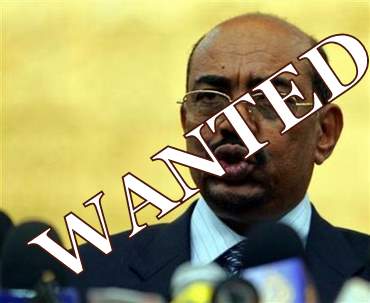
Wanted for war crimes: the Sudanese president.

bashir:wanted for war crimes

It's done. The International Criminal Court (ICC) in The Hague has issued an arrest warrant for Sudanese President Omar al-Bashir.

Al-Bashir is charged on two counts of war crimes and five counts of crimes against humanity. This makes him a suspected criminal wanted in the 108 nations who ratified the ICC's Rome Statute. The US is not one of them, by the way, since Bush "unsigned" the US back in 2002.

Bashir is the first head of state to be indicted by the ICC while still in office. (Full)

ICC Prosecutor Moreno-Ocampo said Bashir masterminded and implemented a plan to destroy in substantial part the Fur, Masalit and Zaghawah groups, on account of their ethnicity. "His motives were largely political, his alibi was a ‘counter-insurgency’, his intent was genocide". (Full)

While this is bad news for anyone in the world trying to get away with genocide, even within their own national territorial borders, here is a dark after-thought: Why would this happen for the Sudanese president and not for the leaders of Hamas and Israel who caused the suffering of Gaza civilians. Israel surely scored extra points for a criminal case due to its use of phosphorous bombs and targeting aid convoys, UN facilities and civilians.

How about indicting Bush and his gang on the basis of crimes against humanity? After all, they invaded a country causing thousands of deaths, millions of displaced, and dragging a whole region into violent turmoil? Unilaterally and on basis of forged evidence.

PS: Keep an eye on my predictions on how the situation will evolve inside Sudan.

Update March 5: Trouble already starts: Sudan expels 10 aid agencies
(more updates in the side column)

Discovered via The Road Daily.
Picture courtesy Antony Njuguna/Reuters

Read the full post...

Heading for trouble in Sudan

Sudan's Bashir soon to salute to the ICC?

Judges at the International Criminal Court have decided to issue an arrest warrant for President Omar Hassan al-Bashir of Sudan, brushing aside diplomatic requests to allow more time for peace negotiations in the conflict-riddled Darfur region of his country, according to court lawyers and diplomats.

It is the first time the court has sought the detention of a sitting head of state, and it could further complicate the tense, international debate over how to solve the crisis in Darfur.

Ever since international prosecutors began seeking an arrest warrant last year, opponents have pressed the United Nations Security Council to use its power to suspend the proceedings. But a majority of Council members have argued that the case should go forward, saying Mr. Bashir has not done enough to stop the bloodshed to deserve a reprieve.

Many African and Arab nations counter that issuing a warrant for Mr. Bashir’s arrest could backfire, diminishing Sudan’s willingness to compromise for the sake of peace. Others, including some United Nations officials, worry that a warrant could inspire reprisal attacks against civilians, aid groups or the thousands of international peacekeepers deployed there. (Full)

While Sudan still plays down reports on al-Bashir arrest decision for the moment, there was plenty of press in the past months where Sudan claimed indicting their president would risk bloodshed.

And then there is of course the statement of the UN envoy to Sudan saying Bashir's government warned the UN of "serious consequences" for its staff and facilities if the International Criminal Court issues an arrest warrant.
This resulted in the Sudanese government denying such threats (Full), and the UN denying it was to evacuate its staff in view of the upcoming arrest warrants (Full).

All politics and maneuvering... My predictions:
- Sudan will not surrender its president to the ICC
- UN and the powers-that-be will further pressure Sudan
- Masses will come onto the streets in all major cities, attacking UN and NGO facilities, causing the latter to seriously reduce staff.
- Darfur rebels and South Sudanese fractions will see a potential vacuum, and will renew military actions.
- ..causing the Sudanese military to respond more violently than before
- UN and NGOs evacuate
- ...giving either warring fractions enough space to do whatever they want in a free-for-all genocide.
- and by the time all of this is finished with a political compromise, Sudan will have one million people less. And the world will have one more genocide to justify.

But that is just me and my cynical mind, of course.

Picture courtesy AFP/Getty Images

Read the full post...

Did we forget these humanitarian crisis?

sudanese girl

With the international (press) spotlights on Gaza, one would forget these -ongoing- humanitarian hotspots:

Sri Lanka:
The Red Cross appealed to both the Tamil Tigers and the government to allow what they estimated at 250,000 people trapped in the northern war zone to flee to safety.
"People are being caught in the crossfire, hospitals and ambulances have been hit by shelling and several aid workers have been injured while evacuating the wounded," according to the ICRC.
"It's high time to take decisive action and stop further bloodshed," he said, warning there could be "countless victims" if nothing is done.
The government has called on civilians to gather in a small "safe zone" on the edge of rebel territory, but a health official said at least 300 civilians were wounded and scores feared killed by army artillery shells fired into the zone. (Full)

Somalia:
The United Nations will be forced to end food distribution in Somalia unless armed groups stop attacking U.N. staff, the World Food Programme (WFP) said.
Humanitarian workers have been targeted during a two-year-old rebellion by Islamist insurgents that has killed more than 16,000 civilians and uprooted one million others. Four WFP staff have been killed since August last year. (Full)

Kenya and Horn of Africa:
Large areas of Kenya and the Horn of Africa are facing "an exceptional humanitarian crisis" that requires "urgent food assistance and other interventions to combat high malnutrition levels", according to the IFRC's appeal.
The combination of high world food prices and a crippling drought is endangering as many as 20 million people in both rural and urban communities. (Full)

Sudan:
Clashes in Southern Sudan's Warrap state have left 41 people dead and displaced hundreds of others from their homes in the past two months. (Full)
Sudan's government accused Darfur rebels of planning to launch attacks if President Omar Hassan al-Bashir is indicted for war crimes and said that would bring a new round of bloodshed. (Full)

Philippines:
Flooding in some parts of Mindanao has exacerbated the humanitarian situation on the island after nearly five months of deadly fighting between government troops and the separatist Moro Islamic Liberation Front (MILF). Floods affected 40,000 people. More than 300,000 people remain displaced in the conflict-affected areas, many of them living in shelters or with relatives outside government-designated evacuation sites. (Full)


News discovered via AidNews

Picture courtesy Finbarr O'Reilly (Reuters)

Read the full post...

11 million people on the run in Central and East Africa alone

Congolese on the run

A sad start-of-year balance: violence, wars, political turmoil and natural disasters forced 11 million people in Central and East Africa out of their homes.

9.1 million became refugees within their own country ("internally displaced persons (IDPs) in humanitarian lingo). Half the IDPs 4,576,250 are in Sudan. 2,700,000 of them in the war-torn Darfur region.

1.8 million people were forced to seek haven outside their homelands, most of them hosted by Chad, Tanzania and Kenya.

Displacement in the region is triggered mainly by armed conflicts and natural disasters such as floods and drought. Frequently, several of these hit a country at the same time, creating complex humanitarian emergencies. Scarcity of resources, limited access to land and inconclusive peace and reconciliation processes create multiple challenges blocking the return home.

Humanitarian response to both acute and long-term displacement is often hampered by lack of access to the affected people due to ongoing conflict and persistent high insecurity including the targeting of humanitarian workers. (Full)

There are a total of 26 million internally displaced people throughout the world, and approximately 13.9 million refugees are forced to live in a country other than their own. (Full)

Picture courtesy ABCNews

Read the full post...

MSF's Top Ten Humanitarian Crisis

MSF crisis in DRC

At the end of the year, MSF (Doctors Without Borders) used to publish their "top 10 under-reported crisis". Now, their hit list is called plainly "Top 10 Humanitarian Crisis".

No "under-reporting" this year. Guess there were sufficient press spotlights turned to the humanitarian aspect of any crisis:

Myanmar's cyclone emergency was an excellent opportunity for the West to wedge some cracks in the Generals' totalitarian regime and the press was present.

Zimbabwe got its fair share due to the West's tendency to collectively sideline 'no-longer-wanted' leaders from African countries. And the press was present.

Somalia got floodlights due to the piracy plague. Sexy subject, and the press was present.

I still think a full blown crisis was avoided in DRC when the media jumped onto the plane direction Goma real fast. Fast enough for the different warring parties to sit around the table and go chest-thumping. A million people affected by the crisis.

So no "under-reporting" this year. MSF still wanted their top 10. And no surprises as to who got listed. Some of them have been in there for years: Somalia, Ethiopia, DRC, Pakistan, Zimbabwe, Sudan and Iraq. With a special emphasis for TBC/HIV co-infection and malnutrition. (Full)

Picture courtesy Sven Torfinn (MSF)

Read the full post...

Rumble: Darfur Now!


"Darfur Now" is not just a factual movie. It is an in-your-face call to action for people everywhere to help end the crisis in Darfur. For the first time in history, the US Government has declared a genocide while it is ongoing, and that is a bad sign.

The movie shows the struggles and achievements of six very different individuals who bring to light the situation in Darfur and the need to get involved:
A UCLA graduate in Los Angeles (CA), a Darfurian woman who joined the rebel forces, the Prosecutor of the International Criminal Court in The Hague, a UN humanitarian on the ground in Sudan, an internationally known actor and activist, and finally to a community leader in a West Darfur refugee camp.

The film portrays the heroic efforts of six people responding to a humanitarian tragedy unfolding before our eyes. (More)

The official trailer can also be found on YouTube

If you have a high bandwidth Internet connection, you can watch the full movie online here.

More on The Road about Darfur, Sudan and genocide

Read the full post...

Rumble: The river Nile, a darned good place to land a plane

Plane in the Nile

In The Road's Ebook short story "Italians, the Art of Flying and the Laws of Probability", I quoted an anecdote by a friend describing how a pilot once mistook the river Nile near Khartoum for the runway, and landed the plane onto, err.. INto the river.

Just by coincidence I came across pictures of this incident. According to airliners.net, it happened on Sept 10 1982. The plane was a Sudan Air 707 purchased from Air Lingus (ST-AIM - cn 19410/599). The pilot mistook the moonlit river for the nearby runway.

Plane in the Nile

Soon after this accident, staff of Sudan Airways tried to remove the company's titles and logos but could not get any closer to the tail. While the plane rested on a sandbank on the river, locals stripped it bare within days after the accident.

Plane in the Nile

More posts on the road about flying, aircraft and airports.

Data and pictures courtesy airliners.net, Chris Wells and Linze Folkeringa

Read the full post...

Rumble: "Saying Good-bye Sudan, Good-Bye Darfur"

Colleague and fellow blogger Worldman is retiring. In this must-read post, Peter is saying good-bye from Darfur and Sudan.

He writes: "I have been living and working here for 4 years. In a few days I will leave. It is very hard to go. But a big part of my heart will stay behind."

Why do I call it "a must-read" post? Because it shows the heart and the essence of an aid worker.

Read the full post...

News: The Forgotten Wars...

The War in Darfur: All forgotten?Most people in the UK are unaware of major conflict zones around the world, according to a new survey by the British Red Cross.

The survey was carried out to discover how much the British public knows about armed conflicts ahead of the Red Cross’ Civilians and Conflict Month, which launched this week.

Respondents were able to name Afghanistan and Iraq as war zones, most probably because that's where British military are stations.

However less than one per cent identified the Democratic Republic of Congo (DRC), where an estimated 5.4 million people have died as a result of the country’s long-running conflict.

Less than one per cent of respondents were able to identify countries such as Sudan, Somalia, and Central African Republic.

Almost one in five (18 per cent) could not name five countries experiencing conflict. (Full)

I would add that in the case of Chad and DRC, the media is partially to blame as the crisis in those countries hardly ever gets the spotlights. Which is not the case for Somalia, and certainly not for Sudan.

If you look at all the campaigning which has been done around Sudan and Darfur, one would then ask, what it really takes to ensure the forgotten wars are brought back into the spotlight? Reuters Alertnet runs a survey on this topic.

Via The Other World News

Read the full post...

News: Sudanese ex-commander speaks up about Darfur crimes

This video shows former Sudanese Commander Arbab Idries admitting to arming and leading Janjaweed milita attacks on civilans in Darfur in order to "rid the land of blacks." The former commander says he believes he committed war crimes in Darfur.


More posts on The Road about Darfur

Source: Genocide Intervention Net

Read the full post...

Picture of the day: A Thin Coat of Blue

darfur-un-peacekeepers

Despite the newly painted blue helmets, after six months on the ground, the United Nations-African Union peacekeepers in Darfur have yet to make an impact. (Full)


More Pictures of the Day on The Road.

Picture courtesy Alfred de Montesquiou (AP)

Read the full post...

News: US presidential candidates united in support of Darfur

candidates

There don't seem to be many issues that the US presidential candidates Clinton, Obama and McCain agree upon, but one which caught my eye: their stand against Sudan and the genocide in Darfur.

Extract from their statement:
After more than five years of genocide, the Sudanese government and its proxies continue to commit atrocities against civilians in Darfur. This is unacceptable to the American people and to the world community.

We deplore all violence against the people of Darfur. There can be no doubt that the Sudanese government is chiefly responsible for the violence and is able to end it. We condemn the Sudanese government’s consistent efforts to undermine peace and security, including its repeated attacks against its own people and the multiple barriers it has put up to the swift and effective deployment of the United Nations-African Union peacekeeping force. We further condemn the Sudanese government’s refusal to adhere to the terms of the Comprehensive Peace Agreement (CPA) that ended the conflict in southern Sudan. (Full)


More posts on the Road about Darfur

Picture courtesy Save Darfur

Read the full post...

Rumble: Translator of Nightmares

I read hundreds of articles and blog entries about Darfur. Few have impacted me as much as this article, covering a book, "The Translator: A Tribesman's Memoir of Darfur" written by Daoud Hari.

Daoud Hari is a Dafur tribes man who assisted journalists travelling in his region as a translator. A translator of horror stories.

Sleepless during nights of exile in Chad, Daoud Hari stared at cracks in his room's mud walls. The lines formed random shapes that reminded him of drawings from thousands of years ago -- of horned beasts, of women, men and children. He had seen them in the cool mountain caves of Darfur, where he played as a boy. They triggered an urge to sketch scenes of the savagery and starvation he had witnessed in the once-tranquil lands of his childhood.

During those uneasy nights, he picked up pencil and paper to turn his torment into tolerable numbness.

He drew the woman who had hanged herself from a tree with her shawl because she could not feed her children. Hari had found their tiny corpses around her, their skin like "delicate brown paper, so wrinkled."

He drew the story he had heard of a militiaman lowering his bayonet into the belly of a 4-year-old girl as she ran toward him, impaling her. The gunman pranced around as her blood drained down upon him.

He remembered the girl's father, his sobbing, his horror, his shock: "What was he? A man? A devil? He was painted red with my little girl's blood and he was dancing. What was he?"

His wakeful consciousness felt the pain of these images. His drawings, he says, were "stick pictures of scenes I needed to get out of my head. History. History. History. The people. The little girl. The woman," he says in his memoir, "The Translator: A Tribesman's Memoir of Darfur." (Full)

Here is an interview with Daoud Hari on BBC:


More posts on The Road about Darfur.
More recommended books from The Road.

Picture courtesy Jahi Chikwendiu (The Washington Post)

Read the full post...

News: Sudan - From the 1994 famine to five years of Darfur. What is the solution?


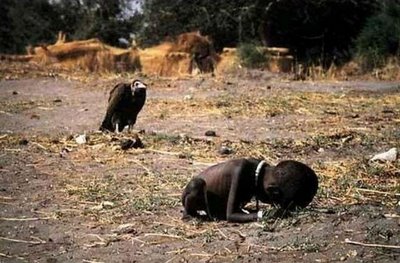
This photo by Kevin Carter won the “Pulitzer Prize” in 1994 and became a symbol of the Sudan famine at the time. The picture depicts stricken girl crawling towards an United Nations camp, located a kilometer away. The vulture is waiting for the child to die so that it can eat her.
This picture shocked the whole world. No one -including the photographer- knows what happened to the child.

Here is the story behind the picture:

In 1993 Carter headed north of the border with [his colleague] Silva to photograph the rebel movement in famine-stricken Sudan. To make the trip, Carter had taken a leave from the Weekly Mail and borrowed money for the air fare. Immediately after their plane ) touched down in the village of Ayod, Carter began snapping photos of famine victims. Seeking relief from the sight of masses of people starving to death, he wandered into the open bush. He heard a soft, high-pitched whimpering and saw a tiny girl trying to make her way to the feeding center. As he crouched to photograph her, a vulture landed in view. Careful not to disturb the bird, he positioned himself for the best possible image. He would later say he waited about 20 minutes, hoping the vulture would spread its wings. It did not, and after he took his photographs, he chased the bird away and watched as the little girl resumed her struggle. Afterward he sat under a tree, lit a cigarette, talked to God and cried. "He was depressed afterward," Silva recalls. "He kept saying he wanted to hug his daughter." (Full story)


Three months later Kevin Carter committed suicide.

This was Sudan in 1994. We are now 2008. Five years into Sudan's Darfur conflict. The humanitarian situation is just as desperate. Maybe with less famine, but with just as much despair, as I wrote in several posts about Darfur over the past year.

Many, including celebrities like George Clooney (watch his video diary), Mia Farrow (Pictures and video), Angelina Jolie (Articles), Steven Spielberg (Article) and others have done efforts to raise the awareness over the problems in Darfur.

There are groupings like the "Save Darfur Coalition", an alliance of over 180 advocacy and humanitarian organizations representing 130 million people, and the Darfur Genocide movement. Amesty International created Eyes on Darfur.

Numerous fundraising websites (like The Darfur Wall), campaigning, video advocacy and education , awareness sites and Online Info Centers were created.

Musicians made songs like Living Darfur. And there is even a game (Darfur is Dying) created to advocate the Darfur issues.

Public pressure was raised against the countries in alliance with the Sudan government, focusing lately on China and its hosting of the Olympics.

Athletes, normal citizens, students, food lovers and bloggers on a global and a local level united to raise awareness and increase pressure on the Sudanese government.

You can buy items online through Yahoo! to show your support and you can even see how each US legislator scores on his or her support for Darfur.

Many governments responded with pressure on Sudan and several UN resolutions condemned the Darfur genocide (Overview).

The African Union sent troops, and UN Peacekeepers were deployed, eventually merging into one, called UNAMID.

And still, despite all of this, peace talks have failed to get off the ground, the United Nations-African Union peacekeeping mission will not be fully deployed for months to come, and two-thirds of Darfur's population is dependent on the world's largest aid operation.

"The situation is not better than it was five years ago," says Auriol Miller, head of Oxfam in Sudan. "We would still say the situation is getting worse. Humanitarian workers are being targeted and attacked (see this post) in a way that has got increasingly worse over the last few years."

A BBC reporter recently wrote:

"When I last visited the remote, arid region in November, destitute refugees lined up at the Abu Shouk camp, desperate to tell their stories so the world could find out what had happened to them.

They spoke of toddlers being burnt alive in villages as men on horseback razed their houses to the ground; of women being raped as they fled their homes looking for safety in the early stages of the conflict.

At night, people said they still found it hard to sleep - terrified of being killed while in their beds. (Full)

So, if everything else fails, what helps? What is the solution for Darfur? What is the solution for Sudan?

Darfur refugees

More posts on The Road, about Darfur and Sudan.

Pictures courtesy Worldfamousphotos.com and WFP.
What set me thinking: Iqbal Latif


Read the full post...

News: Darfur peacekeepers: UN-armed or unarmed?

On April 9th, gunmen have attacked a UNAMID (UN African Mission in Darfur) police patrol, two kilometres (one mile) from the Zam Zam camp for internally displaced persons.

The officers were ordered out of their vehicles and the four gunmen stole their personal belongings and official identity cards. One officer was repeatedly hit in the neck by the back of an AK-47 when he hesitated in obeying instructions to get back into the vehicle.

"UNAMID police do not carry weapons and Wednesday's patrol was operating without protection", according to Noureddine Mezni, the UN African Mission spokesman. He added that "this was for confidence-building purposes and for easier contact with the civilians they aim to protect". (Full)

More posts on The Road, about Darfur and Sudan.

Picture courtesy Reuters

Read the full post...

News: Five WFP drivers killed in Sudan

Food aid distributions in DarfurFive truck drivers delivering food for the U.N. World Food Program have been attacked and killed in Sudan over the past three weeks.
Four of the five were killed in southern Sudan and one was killed in the western Darfur region.
In the latest attack, two WFP-contracted drivers were shot dead in southern Sudan on Monday after returning from delivering food supplies.
Previously, three other WFP workers were killed in Sudan late March. (Full)

More posts on The Road, about Darfur and Sudan.

Update April 18 2008: "Attacks force U.N. to cut Darfur food relief": In the past three and a half months, 60 WFP-contracted food aid trucks have been hijacked in Darfur only. 39 trucks are still misssing and 29 drivers still unaccounted for.

Picture courtesy WFP

Read the full post...

Rumble: Talks with a security guard

A story from my friend Enrico, who works in Bor, South Sudan:

I was leaving the UN compound heading to the office. The security guard who had just opened the gate for me, asked me for a lift into town since his shift was over. He hopped in.
Even though the drive took just 10 minutes, but I felt obliged to keep a bit of a conversation going.

Me: “Have you received any security training?”
The guard: “Yes!”
Me: “Can you give me an example?”
The guard: “How to switch on the security lights”
…
Me: “What would you do if you saw a thief in our compound?”
The guard: It’s like when you hunt a wild animal: stalking and attacking”
Me: “What if he’s armed?”
The guard: “I’m not allowed to use a gun myself, it’s against the rules, but I have the stick I use to kill the snakes at night!”

Read more stories from Enrico about life in Sudan.

Picture courtesy Ulrik Pedersen

Read the full post...

Rumble: Water for the Toposa in South Sudan

Topohsa in South Sudan

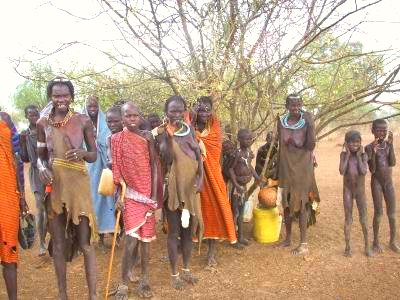
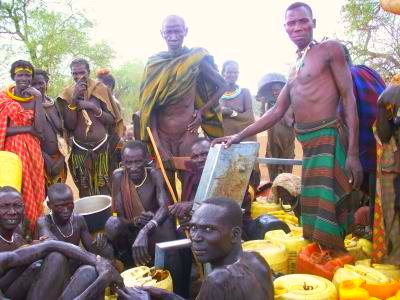
Meet the Toposa people. These traditional herdsmen live in a remote area on the shared borders of Uganda, Kenya and Sudan. Their tribe is called "Karamojong" in Uganda, "Turkana" in Kenya (an area stretching from the Rift Valley to Lokichoggio) and "Toposa" in Sudan (from Lokichoggio to Narus and Kapoeta, in the eastern Juba).

They live the life as it once was. Clothing is optional in their "country". If they have a cloth, serves the whole village, used when travelling outside the community.

Their life is centered in function of their cattle. Their cattle is their life. Traditional diet is cow blood mixed with a sort of cassava.

The family and tribe has a patriarchical system: Toposa men take decisions on behalf of the family or tribes in meetings where women and children are kept at a distance while the men discuss the people’s affairs. Tradition has it that important matters are decided in the early hours of the morning before sunrise.

Toposa in South Sudan

Last year, the Toposa in South Sudan faced drought, cutting not only their water supplies, but also their food production. Only delivering food aid was not enough, so we started trucking in water with the food.
It was clear that a more permanent solution was to be found, to provide them with water, a rare item in the Toposaland.

delivering water to the Toposa

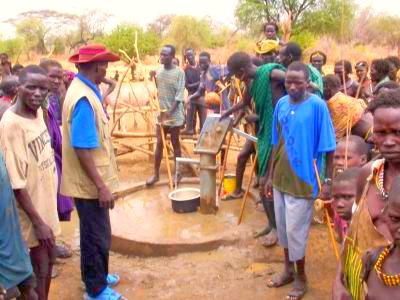
This solution was to dig a bor hole, where they could pump water from an underground well. We trucked in the mechanical pump, and connected it to a small plastic storage tank. A low cost, low tech but also low maintenance solution.

Offloading the storage tank
Installing a pump. Any work is a community affair, so loads of people are interested!
The borhole and pump are operational!

Aid with a permanent impact...

This post was written as follow-up to a previous one: World Water Day: One billion people without clean water.

Pictures courtesy Constance Lewanika (WFP), with a special thanks to Cyprien Hiniolwa.

Read the full post...

News: Sometimes I Am Ashamed to Work for the UN.

UNinvolved - From Die Burger; Advertising Agency: FCB Cape Town; South Africa; Creative Director: Francois de Villiers; Art Director: Anthony de Klerk; Copywriter: Marius van Rensburg; Photographer: Chad Henning

I am pissed off. Two articles were published in the last days that make me ashamed to work for the UN.

Before we start, let me make something clear: The "UN" is one "brand" consisting of several parts which have completely different goals, operational practices and funding mechanisms. In fear of over-simplifying, I would distinguish three main parts in the UN:

  1. "The Political Side", UN secretariat in New York and UN security council, are probably the UN's most visible side. In this large forum "where world issues are debated and decided upon", every nation has its vote and voice. The critics would say "all equal, but some have a bigger vote and a louder voice than others".
    This side of the UN is funded through direct contributions by the UN member countries, and as such by the taxes citizens like you and me pay.

  2. "The Peace Keeping Side", codenamed "UNDPKO", are the famous blue helmet-ed forces we see on TV. Stationed in conflict zones like Sudan, Eritrea, DRC etc... they often work hand in hand with the UN Department of Political Affairs in enforcing political and military stability in (potential) conflict zones. Just as "the Political Side", the "Peace Keeping Side" is funded by the UN members. Once again, your tax dollar "at work" (well.. "not at work" would sometimes be more appropriate).

  3. "The UN Humanitarians" are not one organisation, but a few hundred organisations. Well-known names in this branch are UNICEF, WHO, WFP, UNHCR, UNDP etc... Most of these organisations are "voluntary" funded. This means they do not receive annual funding from the UN headquarters, but they launch appeals for each of their projects, be it in the development or emergency relief sector.


The "voluntary funding" scheme the humanitarian organisations work under, is somewhat an insurance those organisations are "kept on their toes". If you screw up a project well enough, donors will be less eager to fund your projects next time. The "humanitarian market" (as I like to call it), is a competitive market. The need for funding exceeds the "capacity of the world to donate". So "competition" keeps the humanitarian organisations somewhat in line. "Somewhat", is the right term though, but we will expand on this another time.

Now, what pisses me off on a regular basis, is that the "UN number 2" from above, the "Peace Keeping Side", often gets involved in all kinds of bad press.
You still remember the reports about UN peacekeepers unable to prevent the Rwanda genocide? Or the Srebrenica massacres where the Dutch UN peace keepers "stood by". There were many reasons why these tragedies happened. And even more excuses.

Totally UNexcusable are, amongst others, the sex scandals (the whole works including pedophilia, rape and prostitution) by UN Peace Keepers in DRC and in Haiti. Or the gruesome stories of Belgian UN Peace Keepers "roasting" a Somali boy. (read also this this article).

Shame, deep shame, we should all have. All of us.

While most of the time, I can still tell myself, "Ok, this is not concerning the UN humanitarians, this is not 'us', this is the 'other UN arm'." Still, the criminals wore the same colour as I do: "UN Blue". They went into a country supposedly to help the population, and not to kill people and urinating on them afterwards, sexually abusing them.

I want to be able to keep my head up high, tough. Once of the reasons I continue to work for the UN (For a number 3, a UN humanitarian organisation), is to be able to say: "I not only criticize. I actually try to make a change."! And the best way to make a change is a "change from within". I try to speak up when confronted with any wrongdoing. While it gave me the reputation of being "difficult" (they say "a pain in the a**"), I do need to live with my conscience. I need to be able to say "I tried my level best". And to be honest, I feel people *do* listen. At least where *I* work!

But still, ... still, there are those days, like today, where I get frustrated, pissed off, wandering if all the fighting is worth it. Those are the days, like today, where I read that the audit of the UN peace keeping mission in Sudan wasted millions of dollars: (Below is an extract but the full post is here):

U.N. officers in Sudan have squandered millions by renting warehouses that were never used, booking blocks of hotel rooms that were never filled, and losing thousands of food rations to theft and spoilage, according to several internal audits by the U.N. Office for International Oversight Services. One U.N. purchasing agent has been accused of steering a $589,000 contract for airport runway lights to a company that helped his wife obtain a student visa, while two senior procurement officials from the United States and New Zealand have been charged by a U.N. panel with misconduct for not complying with rules designed to prevent corruption.
The U.N. procurement division "did not have the necessary capacity and expertise to handle the large magnitude of procurement actions" in Sudan, particularly during the early phases of the mission, according to a confidential October 2006 audit. Investigators also detected "a number of potential fraud indicators and cases of mismanagement and waste."

It pisses me off that millions of dollars are wasted through mere miss-management or for personal gain, in a country where millions fight to survive starvation every single day.
Also today, I read how the United Nations forces failed to help East Timor's president Jose Ramos Horta after he was shot in an assassination attempt in Dili this morning:
Mr Carrascalao told ABC Radio's PM that when UN police arrived at the scene of the attack they refused to help.
"I have to regret that we advised the United Nations Police who went to the scene but 300 metres before reaching there, they refused to proceed," he said. "The President was lying on the road and bleeding and already shot, and they refused to continue to give him assistance. It was finally the family and an ambulance from our hospital that went and rescued the President when he was more than half-an-hour bleeding and losing a lot of blood. The United Nations Police didn't take action until the Portuguese Generale got there. That's one of the worst things that could happen to this country; have police from everywhere, everyone within one system and mostly looking after themselves than looking after the situation here." (full article)

Those are the days I am ashamed. Ashamed to say "I work for the UN"!

Pictures Die Burger and Chad Hanning (UNinvolved), WhatReallyHappened and Gamma Liaison (Belgian Peacekeepers).
Source: The Other World News

Read the full post...

News: Sudanese Refugees Stranded in Israel

Some 1,000 African asylum-seekers, including over 200 women and children, are being detained in Ktsiyot prison in Israel's Negev desert. Some have been held for up to six months. In late September 2007, all newly arrived African asylum-seekers were moved into tents within the prison grounds. Activists from various Israeli advocacy groups have begun to look into prison conditions, being appalled by "harsh conditions" in the camp:

"The nights are extremely cold in the desert, yet there is no heating in the tents. The wind simply blows through them. There is no warm water to wash the children, whose ages vary from three weeks to 18 years. At least 16 are under two years old.

"The women and children are still being held separately from their husbands, despite the prison authority's claim that moving the asylum-seekers to the tent camp was intended to allow for family reunification. There are no social workers to supervise or assist the children, many of whom have undergone severe trauma". (Full)

Picture courtesy Tamar Dessler/IRIN. Source: The Other World News

Read the full post...

News: UN Peace Keeping in Darfur. A New UNStart?
A United Nations peacekeeping police officer, holds the babies handed to hear by two refugee women, while on patrol in the Abou Shouk refugee camp in North Darfur. The patrol was one of the first to re-enter Darfur's refugee camps since the United Nations took over peacekeeping in Darfur this month to try to end five years of violence. (full post)

I might sound largely cynical, but the way the UN Peace Keeping Operations works, with often a too limited mandate and an intrinsic bureaucracy, I would not be surprised if the same mothers would take a shot at the guy in the middle, one year from now. Mark my words.

Photo courtesy AP/Alfred de Montesquiou. Source: International Aid Workers Today

Read the full post...

Rumble: Darfur Now! - The Full Movie

Here is the full 1h37m "Darfur Now!" movie. This .wmv version is 426 Mbyte so - you need a highspeed Internet connection, and a bit of patience as the file downloads.
It requires the ActiveX plugin for your browser and is best viewed with Firefox.


Be patient as the file downloads! It might take up to 10 minutes before you see anything in the videoviewer


Movie courtesy GratefulChild.org

Read the full post...

The Driver's License

During my security briefing in Khartoum prior to my deployment into South Sudan, I was reminded that international staff are not supposed to drive and therefore no local driving licence is required. “Local drivers speak the local language. They know the local driving customs and terrain. They know where to run for help if need be.” This is what I was told. “Fair enough, something less to worry about,” I thought.

A few days later, I arrive in my new Southern Sudan duty station and receive a warm welcome from one of our local drivers…. For the rest of the week, I end up without any drivers. I am the only one in the office who knows how to drive. The nice chap who picked me up from the airstrip seemed to have disappeared and all other drivers are on field missions. I assume the policy “to always use a driver” was more of a “general guideline”. “Maybe I should start thinking of a driving licence. Just in case…”, I think.

It is a thought that recurs when one of the young drivers comes back from his walk-about. I ask him why he had disappeared for a week without permission:
- “Nothing special.” he tells me, “A chap wanted to marry my younger sister, but couldn’t afford the dowry of 35 cows we’d negotiated. So, he decided to kidnap my sister. My family and I chased them up. We –euh—‘renegotiated’ the dowry and they’ll soon be married,” he concludes, nodding with a satisfied smile.
- “So, do you have more unmarried sisters?” I ask.
- “Three more” he says.
- “Good for you. That is a lot of cows!”, I compliment him
As I walk away, I am thinking to myself: “I really, really need to get me a driving licence!”.

The next time I visit the regional capital, Juba, I fill in the application for a local driving license.
- “Not a problem, sir!” says our Juba head driver. “You only need to pass an eye test!”
He takes me to a place which looks nowhere like a hospital or even a place where they practice medicine... He explains this is where eye tests are carried out. A middle-aged lady takes me to an empty room. Our head driver and the lady exchange a few words in the local language. She fills in a form, stamps it and gives me the receipt.
- “Let’s go, sir!”, the head driver announces abruptly.
- “How about my eye test?” I protest.
- “It’s all done, sir! She looked into your eyes and didn’t see anything wrong.”

A few days later, I am the proud owner of a legal Sudanese driver’s license. Now I can drive legally, while my drivers are out chasing their future brothers-in-laws.. Procedures are followed, my eyes are fine and life is good.


Story by Enrico Pausilli. Edited by “E” and Peter Casier
Pictures courtesy Ulrik Pedersen


Continue reading The Road to the Horizon's Ebook, jump to the Reader's Digest of The Road.

Read the full post...

The Perfect Balance

Finding the right balance in life is so difficult to achieve that some people choose it as their sole undertaking in life. A common mistake made by many, though, is to think that the perfect balance is an absolute concept. It is not. The perfect balance is a moving target. That goal differs depending on where you live, what you do,.. Working in a remote location in South Sudan, today was one of those days where I felt that target was further away for me than ever.

Here is the deal: I am in charge of a humanitarian operation that covers an area in South Sudan which is five times the size of Denmark. The country is amazingly challenging with little or no infrastructure, and plenty of insecurity. Luckily, things only turn real bad during the rainy season. Unfortunately, the rainy season lasts an average of eight months a year.

The very few roads we have here are then impassable. The airstrips turn into mud and thus, become unusable. The country becomes one big swamp. It gets so bad, that one long sunny period is what most South Sudanese pray for. For those waiting for food aid and other relief items, it makes the difference between life and death. The floods destroy harvests and paralyze the little commerce that shyly emerges during the dry season. The conditions are so bad that some areas become impenetrable islands, with its inhabitants isolated for weeks on end. As a humanitarian worker it is already bad enough that you can not reach those in need, stuck on one of those “islands”. But it is even worse if you happen to be there during one of those rain storms. And you become one of the “Islanders” yourself…

This environment makes “finding the perfect balance” or rather “finding any form of balance” a daily challenge. Let me describe to you what happened today: “One day during the rainy season in Bor, South Sudan.”

You start your day by taking a radio call from one of your food monitors out in the field, informing you the airstrip where we were to pick her up is not landable. And that she runs out of food supplies and water.

Another staff member calls in via the radio, asking for a tractor to rescue his vehicle stuck in the mud a hundred kilometres from his final destination.

While organizing help for the teams in the field, one of your staff kindly reminds you that he hasn’t been paid for the past two months which is quite common in a place where banks do not exist. His gentle reminder is accompanied by a look of annoyance from your security guards, who are still waiting for their new contracts and never miss an opportunity to remind you how good they really were with those AK47 machine guns before the South Sudan peace treaty was signed.

The worry for your life becomes second priority when a kind man tells you there are only five drums of fuel left to run the vehicles and generators, without which your operation will stop. This reminds you, you should really start working on finally getting your administration, finance and human resources assistants recruited. If you could find some time to start the process.

Ten minutes later, a Director General from one of the nearby ministries drops by your office asking for tents so he can relocate his flood-affected family to higher grounds.

While still keeping a smile and dealing with some of these adversities, you are suddenly reminded of an urgent need to go to the bathroom. The nearest latrine is two kilometres from your office, though.
“Never mind” you think, “Lunch time is few hours away. I will go then.” Meanwhile you stay away from fluids. Especially from the murky river water someone poured into the office water dispenser. *%$$£ !

That is about the time, you hear shooting in the vicinity of the office. As the UN security area coordinator responsible for the security of all staff, you are compelled to “do something”. Not too sure what, though.

By 11 am, you remember the landlord wants to kick you out of your current office premises. And the governor wants to turn your best warehouse into a prison. Meetings must be held!

Just as you realize there is no vehicle to go for lunch (or the latrine!), you remember it’s Friday and your weekly reports are due.

While you try to forget the urgency of nature’s call, you are reminded by e-mail to do a bit of planning for the next food distribution. You are trying darned hard to figure out how on earth you are going to recruit forty people needed for that. Without administration, HR or finance assistants to help you out….

Before you know it, you realise it’s already six pm and mosquitoes will soon start looking for you. Then again, you remind yourself that as a humanitarian worker, suffering is part of the job. So you shrug and look one more time at your e-mail inbox trying to figure out which of the last fifty unread message deserves your attention.

Three of them catch your eye as the red exclamation marks indicate their high-priority. You open them up and they read:

  • “The time for submission for the peer support focal point is due today”.
    You think this would be ideal work for your HR assistant. If only you had one….
  • “The deadline for the UN Online Training Module on Prevention of Harassment, Sexual Harassment and Abuse of Authority in the Workplace is due by the end of the month and is mandatory for all staff.”
    You are glad that somebody reminds you of these important topics often overlooked by operational people. But then you remember that 60% of your staff is always in the field, distributing food in remote locations where even radio connectivity is a luxury. Let alone electricity or computers. So how can they do the training, which is only available online on the Internet? And what happens to the estimated 30% of your staff who only speak a local dialect, which unfortunately is not amongst the five United Nations’ official languages of the “Harassment Module”. And the remaining 10% of your staff are stuck in the mud of the rainy season somewhere waiting for you to pull them out.
  • “Next year’s budget submissions are due tomorrow.”
    You know that you’ll never make it and without it, you know you are doomed.

Your driver reminds you it is 8 pm and he is never been paid overtime. His calling awakens your bladder and reminds you of the curfew. You need to get going. You are cheerful, though, because tonight at least you have a driver. You get a lift to your living compound and are welcomed by a call for dinner. Ugali and beans. Again. You look at the food, take your plate to your tent, sit down and force down a few bites. You switch on your laptop, the custodian of hundreds of unread messages. Soon the frogs’ choir and bats hitting your tent imply that midnight is near… Yawn… You stand up and stretch.

Wait! One more message to read. Your wife and kids remind you how much they miss you and that your place is at home, in Rome, with them. You are about to reply, telling them that your supervisor asked you to postpone your leave due to an unplanned emergency but that would be too much in one day.

Just after midnight, you switch off the light and promise yourself that the following day you’ll figure out the meaning of all this… And that you will soon find “a better balance”.


Story by Enrico Pausilli, edited by “E” and Peter Casier
Pictures courtesy Ulrik Pedersen


Continue reading The Road to the Horizon's Ebook, jump to the Reader's Digest of The Road.

Read the full post...
.

  © Blogger template The Business Templates by Ourblogtemplates.com 2008

Back to TOP