Showing posts with label Afghanistan. Show all posts

US, UN and the Taliban: An invitation to dance.

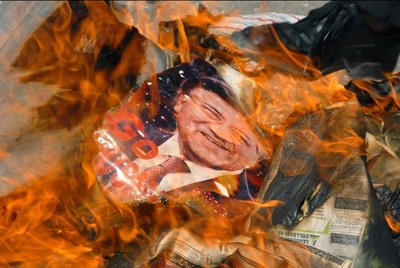
How many children have you killed today, Mr.President?

There are no coincidences in life. Certainly not if they concern politics. Once again, UN and US politics have only one letter of difference.

KABUL: The United States and other foreign powers are engaged in preliminary talks with the Taliban about a possible settlement to the near decade-long war in Afghanistan, Afghan President Hamid Karzai said on Saturday. (Source)

and on the very same day:
The UN Security Council has split the international sanctions regime for the Taliban and al-Qaida to encourage the Taliban to join reconciliation efforts in Afghanistan. (Source)

So, all of a sudden, the Taliban is no longer the arch-rival of neither US, UN or the Afghan government anymore...? All of a sudden, they are not the harbour of terrorism anymore? Is it because the Taliban have become good boys? Starting to behave, and wear suits and ties as they are now become devoted Catholics?

Or might we just have another Vietnam and "Black Hawk Down"-Somalia scenario, where the US is trying everything possible, to bail out of Afghanistan, using no matter what means. After all, why not? "If you can't beat them, you might as well join them (again)", the US will be thinking. What the flip to they care what happens to the country after they leave?

So Mr.USA: after a decade of war in Afghanistan, what will you have accomplished? Did the threat of terrorism get any less? Was the Taliban or Al Qaeda eradicated? Any less threat for another 9/11?
What have you accomplished Mr.USA, apart from having plunged yet another country into disarray, pushed it further down into poverty and insecurity, killing tens of thousands along the way, and causing suffering to zillions more? Did the women's right flourish? Burqa's being massively exchanged for bikini's? Every child now goes to school, and is properly fed? Open freedom of speech? Drug fields completely eradicated? None of the above, Mr.USA, so shame on you.

Shame on you.


Picture courtesy Free Republic

Read the full post...

Three cups of tea. And a lot of bullshit?

Greg Mortenson with AK47

Often I can't explain why I feel something about certain things. But there is not doubt I felt something strongly about "Three cups of tea". Now I might know why:

Greg Mortenson, the high-profile advocate of girls' education in Afghanistan and Pakistan, has been forced to defend his best-selling book "Three Cups of Tea: One Man's Mission to Fight Terrorism and Build Nations ... One School at a Time," against charges that key stories in it are false.

Mortenson shot to international fame with the book, which describes his getting lost in an effort to climb K2, the world's second-highest peak, being rescued by Pakistani villagers in the village of Korphe and vowing to return there to build a school for local girls.

He also claims to have been captured by the Taliban and held for several days before being released. (...) however -- Jon Krakauer of "Into Thin Air" fame -- told a CBS "60 Minutes" investigation that aired Sunday that the story is not true.(..)

Mortenson's record of charity and his tales of derring-do have helped fuel the Central Asia Institute. The organization recorded income of $14 million in 2009 (...) However, in 2009, less than half of that money -- 41 percent -- actually went to building schools in Afghanistan and Pakistan, according to the institute's board of directors.(...)

The institute also says $1.7 million went to promote Mortenson's books in the form of advertising, events, film and professional fees, and some travel. It said the contributions generated by Mortenson's promotional events "far exceed the travel expenses." (Source)

Over the past years, several people recommended I should read Mortenson's book, "Three cups of tea". A Friend lent me the book, saying "You might not like it". And I didn't.

I read the first twenty pages and had to put it aside. I tried to continue reading it several times, but I could not. I can't say why exactly. There was a fake ring to the whole story. There was a fake smile on the guy's face. And I surely have an issue if anyone promoting girls' education, likes to pose with his wife and kid, and a couple of AK47's... And proudly publishes the picture in one of his books.

Above all, I smelled "CIA" all over. Winning the hearts and minds of people. With loads of American dollars.

Next!

Read the full post...

Give up, bail out or continue running?

Afghanistan ruins

Just read this on Itinerant and Indigent, one of the aidblogs I following. Phil, an aidworker in Afghanistan, writes about his struggle to continue believing in the "Cause". The "raison d'ĂȘtre" of an aidworker:

Why do we keep trying here? I am less and less sure that we achieve anything. I know, I know now that this work is not about us feeling good, or developing our CVs. And I am not an aid junkie, living on the high of the emergency, the thrill of saving lives. But I would like to see permanent progress here in some form, in my lifetime. I am less convinced that will happen, or at least less convinced that there is much I can do to expedite it.

It seems I follow a God of lost causes. I am not sure how I feel about that. As Nathan says, ‘I have joined the long defeat’.

I wonder how many of the long term aidworkers have this struggle. How many years does it take before we let our shoulders hang down, or bail out, or stop caring, or continue running with our eyes closed, or invent the famous "signs of improvement"..

How many years have we been in Afghanistan? In Pakistan? In Ethiopia? Niger? DRC?

Add on top of the lack of progress, the security risks every single aidworker runs in some of these places, and you wonder...

I think the only way to cope in the longer run is to check out for a while and come back with new hope. In a different country. Another project. And for the rest, continue holding on, in the faith that humanity is basically good.


PS: If you know where the picture is taken, I guess you can call yourself an "ancien"... Start counting the days The Doubt will come.

PPS: Phil.. Hang in there, buddy!

Read the full post...

Breaking news: What? We are not winning the war in Afghanistan?!?!


Here is some breaking news, fresh from the presses... It seems we are not winning the Holy War on Terror in Afghanistan. Surprise-surprise... And even worse: we have not been winning it since end 2001 neither.

The timelapse video above is based on the famous WikiLeaks documents, listing military incidents. The darker the red, the more incidents..

Is it just my impression, but are those dark red blobs just getting bigger and bigger as time went by?
Wanna make predictions for 2011?

Video discovered via ReadWriteWeb

Read the full post...

The state of the world on Mother's Day

Hurricane Ike

Save the Children’s eleventh annual Mothers’ Index compares the well-being of mothers and children in 160 countries.

Norway, Australia, Iceland and Sweden top the rankings this year. The top 10 countries attain very high scores for mothers’ and children’s health, educational and economic status. Afghanistan ranks last among the surveyed countries. Seven from 10 bottom-ranked countries are from sub-Saharan Africa. The United States places 28th.

Conditions for mothers and their children in the bottom 10 countries are grim. On average, 1 in 23 mothers will die from pregnancy-related causes. One child in 6 dies before his or her fifth birthday, and 1 child in 3 suffers from malnutrition. Nearly 50 percent of the population lack access to safe water and only 4 girls for every 5 boys are enrolled in primary school.

The gap in availability of maternal and child health services is especially dramatic when comparing Norway and Afghanistan. Skilled health personnel are present at virtually every birth in Norway, while only 14 percent of births are attended in Afghanistan.
A typical Norwegian woman has more than 18 years of formal education and will live to be 83 years old. Eighty-two percent are using some modern method of contraception, and only 1 in 132 will lose a child before his or her fifth birthday.

At the opposite end of the spectrum, in Afghanistan, a typical woman has just over 4 years of education and will live to be only 44. Sixteen percent of women are using modern contraception, and more than 1 child in 4 dies before his or her fifth birthday. At this rate, every mother in Afghanistan is likely to suffer the loss of a child.

On the children’s well-being portion of the Mothers’ Index, Sweden finishes first and Afghanistan is last out of 166 countries. While nearly every Swedish child – girl and boy alike – enjoys good health and education, children in Afghanistan face a 1 in 4 risk of dying before age 5. Thirty-nine percent of Afghan children are malnourished and 78 percent lack access to safe water. Only 2 girls for every 3 boys are enrolled in primary school. (Full report)

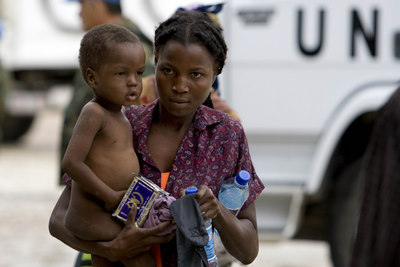
Picture courtesy Logan Abassi(MINUSTAH)

Read the full post...

Afghanistan: 6 mothers die for every 100 births


In Badakshan, the Northeast of Afghanistan, 6 women die in labour for every 100 babies born. That is almost four times the national average, in a country with the world's second highest maternal mortality rate...

Let's use Mother's Day weekend to think of those mothers in less fortunate countries. Maternal health continues to be a challenge for many in remote areas, where access to clinics or even primary care is non-existent. Or only exists only through WHO (the UN's World Health Organisation)mobile clinics as shown in this video. (More)

Read the full post...

Ending the year on a sad note: lost two more colleagues.

Liberia War

2007 was bad. 2008 was worse. 2009 topped them all. And the last week of the year was no exception to a very disturbing trend: the aid community lost two colleagues again. Ali Farah Amey was shot dead in Beledweyn (Somalia) and a 24 year national UN staff member was killed in a suicide bombing in Kandahar, Afghanistan.

Aidworkers become part of a free-for-all turkey shoot. I can't put it more blunt than that.

In a post reminding everyone on the plight of his two colleagues taken hostage in Darfur, fellow blogger Paul Conneally states:
There is another aspect which niggles slightly and that is the deafening silence that generally meets the news of aid workers being killed or taken hostage. There is not only a relative silence from governments, media or the public but even from the humanitarian sector itself. Compare the death in Afghanistan of aid workers to that of soldiers who, by and large, are armed to the teeth and sent to Afghanistan to kill or be killed. I don't dispute military interventions - not my business - but it is quiet incredible that the media is so keen to eulogize the military as 'fallen heroes' and ignore those who risk (and give) their lives desperately trying to make a difference on the human level without resorting to state of the art munitions and military occupation.
But I want to make it even more black and white: We, the aid community are left clueless what to do with this increased risk we face. The only thing we seem to be doing is piling up those sandbags even higher. Buying more bomb-blast film, bullet-proof jackets and mine-resistant Kevlar layers for our vehicles. Measures which should be taken, but proven to be insufficient.

I will make a prediction for 2010: there will be no end to the killing of aidworkers. And unless the aid community drastically changes its approach toward the risks now inherent to aidwork, one year from now, we will be looking back at the year 2010 and say "This was a bad year....".

My suggestions to any aid organisation who is concerned about security for their staff:
  1. Make it compulsive for all aid staff to follow a two-three days security awareness course. The course is to be re-done, as a refresher, every two years.
  2. Everyone going into high risk area, should get a separate and customized security briefing.
  3. Every agency and NGO should comply with the MOSS (Minimum Operational Security Standards), and ensure the MOSS guidelines are strictly adhered to. MOSS compliance is to be verified by an independent external team.
  4. Security compliance should become part of the normal audit cycle. Complaints about security deficiencies should be handled with the same priority as theft, harassment or embezzlement.
  5. Every agency and NGO should employ a "Dirty Harry" team, with one and only one task: to try and bypass the security systems in order to expose deficiencies.
  6. And most importantly: as you can not reduce the thread, but can only decrease the risk to your staff members: reduce the amount of people we employ in security-risky areas. Resist donor pressure and the aidwork-inherent-testosterone-craze by wanting to rush into any emergency operation, without thinking "are we really needed there?".
Picture discovered via War and Peace

Read the full post...

The US plan for Afghanistan. Page 22

US plans for Afghanistan - Click on image to enlarge

It's officially called "COIN" abbreviation for "COunter INtelligence".

Should probably be called WIN: "Without INtelligence".
Or HOTOSOFET: "HOw TO Stimulate Our Failing Economy Through foreign wars".
According to a recent figures, one gallon oil costs the invading troops $400. The annual expenditure of one soldier is almost one million US dollar. Yearly, the presence of US troops in Afghanistan costs $103 bn, including the troop surge recently announced by Obama.

According to the Sept 21 2009 Congressional Research Service Report, there are 73,968 private contractors working for the US military in Afghanistan. (Full)

Picture courtesy Incredimazing, discovered via Aidwatchers

Read the full post...

Why that damned war in Afghanistan is so complex

The Afghanistan conflict

No explanation needed.

Source: Ari Rusila

Read the full post...

2009 in pictures

Good Morning Afghanistan

It's that time of the year again, where we have "Top Ten's of the year" and "2009 in review" flying left, right and center.

Some good stuff, though: the Boston Globe released an excellent series "2009 in Photos", like this picture showing US troops receiving a "Good Morning, America" wake-up call from Taliban positions in Afghanistan's Kunar province.

Picture courtesy AP Photo/David Guttenfelder

Read the full post...

MSF: Top 10 humanitarian crisis of 2009

MSF: Afghan elder with child

Just like Christmas carols, pennies in the Salvation Army collection tin, loads of booze, turkey experiments in the oven, and presents you never asked for, MSF (or "Doctors without Borders" for the Anglophones) has its annual traditions too: Every year-end, them release theirs "Top Ten Humanitarian Crisis of 2009".

On The Road, we have the tradition of summarizing this Top 10 of "world shame" (see our 2008 and 2007 posts).

Top 10 humanitarian crisis of 2009MSF began with the "Top Ten" list in 1998, when a famine in southern Sudan went largely unreported in the US media. Maybe due to the CNN effect ("no media attention, no aid pesos"), MSF went a more commercial course last year, converting "the most Underreported Crisis" list, to "the Top 10 Humanitarian Crisis".

This year, MSF reports in their top 10:

  • Unrelenting Violence Stalks Civilians Throughout Eastern DR Congo (Tell me something new, DRC tops the list every year)
  • Somalis Endure Violence and Lack of Access to Health Care (been in the top list since.. well, since for ever)
  • Precarious Situation for People in Southern Sudan and Darfur (tell me something new)
  • Thousands Injured during the Final Stage of Sri Lanka's Decades-long War (ok, the Sri Lanka government topped themselves this year, I have to admit. They deserved a special mention for nearing genocide this year.)
  • Civilians Suffer From Violence & Neglect in Pakistan (Mjah... More than last year, I agree. But mostly over-reported news this year.)
  • Politics of Aid Leaves many Afghans Cut off from Humanitarian Assistance (On the hit list since the 70's, but US violence in Afghanistan definitively increased, I agree. Hardly underreported news, though).
  • Civilians Trapped in Violent War in Northern Yemen ("North, South, Left, Right:Yemen is always in the Fight. North, South, Left, Right...." Now that the US and Saudis start bombing Yemen rebels, all will be over soon. Rrright.)
  • Woefully Inadequate Funding Undermines Gains in Childhood Malnutrition Treatment (True. No change.)
  • Funding for AIDS Treatment Stagnating Despite Millions Still in Need (True. No change)
  • Lack of R&D and Scale Up of Treatment Plagues Patients with Neglected Diseases (True. No change).
For as far as I am concerned, the 2009 list could just have been a cut and paste from the 2008 list. Except that for one reason or the other, Zimbabwe was dropped from "The List". Maybe it was considered a hopeless case anyway. How about including violence in South Africa, tribal turbulence in Kenya, sexual violence and child labour in many parts of Africa, increased hunger and malnutrition in the US, large scale displaced people in Colombia, the increase of urban poverty, inaccessibility to food rather than unavailability of food....

Guess MSF might have been a bit short of inspiration and imagination this year. But then again, in all due fairness, their "Top 10 List of Shame" is a must-read. Check out the excellent pictures list which goes with the Top 10.

How about this, why don't we start our own "2009 Humanity's Shame Top 10" list? Stay tuned, will announce it soon.

Update:
1. We kicked off our "Humanity's Shame Top 1o". Accepting nominations on this post.
2. Nominations are closed. You can vote for your "Humanity's Shame" on this post.
3. The poll results are out. Check out this post for our "Humanity's Shame Top 10"

Picture courtesy Jobi Bieber/MSF

Read the full post...

US troops winning the hearts and minds of Afghans. Foxnews reports...


I love the scene where they use helicopters to stop guys on a motorbike. I guess its one way to deal with traffic congestion in the Afghanistan country side. Sigh.

Discovered via Transitionland and Wired

Read the full post...

Picture of the Day: Shot and Charred

UN flag jacket in burnt Kabul guesthouse

A charred bulletproof vest lays in the burnt-out UN Kabul guesthouse, which was attacked last week. (Full)

More Pictures of the Day on The Road.

Picture courtesy Peter Nicholls/The Times

Read the full post...

Attack us where we work, attack us where we sleep.

UN staff attacked in Kabul

After the devastating suicide bomb in our office in Islamabad three weeks ago, I knew it was going to be bad day when the first Twitter message I saw this morning was: "UN guesthouse in Kabul attacked, 5 staff dead".

From the NY Times:
The guests were still sleeping when the gunmen, dressed in police uniforms, arrived early Wednesday. In the dark, they shot the guards, scaled the front gate of the guest house and began firing grenades, the beginning of a terrifying two-hour siege that showed just how little it takes for the Taliban to trap foreigners in central Kabul.

By the end of the siege, at least five United Nations employees, two Afghan security officials and the brother-in-law of a prominent Afghan politician were dead, as were their three attackers. (Full)

2008 was a record year in terms of casualties amongst aid workers. 2009 promises to be even worse. I keep track of most of these attacks on The Road Daily.

It is only weeks ago I wrote:
It is strange.. It is only after the hours go by that the cruelty and the reality of the act today really seeps through... And the consciousness that if we are to work in a higher risk environment, there actually is not one place, where one is totally safe. Where would that be? In the office? They drive a truck through the gates and blow it up. In the guesthouse or the hotel? Same thing...(Full)

This is the dilemma we, aidworkers, face today: We are nowhere safe anymore. Terrorism, banditry, sheer violence. And we can not isolate ourselves from the communities we are suppose to serve. We can not lock ourselves up in fortresses, as the US did with their embassies worldwide after the bombings in Dar es Salaam and Nairobi. We need to be "there", we need to be where the aid is required. We need to do the assessments, we need to monitor to ensure the aid goes where it is supposed to go. But slowly, the violence makes it impossible to do our work properly. And who suffers? Those in need. As always.

Picture courtesy Altaf Qadri/Associated Press

Read the full post...

Afghan Women: The struggle goes on...

I worked in Afghanistan before the war, and went back into the country right after the Taliban left Kabul.

All in all, I spent quite a few months working with Afghan men and women, and got to appreciate them as people. They had been through hell in the decennia before the war, and when Western forces "liberated them from the Taliban", their hopes were high to have peace at last.

Unfortunately, this is not the case. Today, the insecurity and repression of individuals is probably even more precarious than during the Taliban times. Even more so for the women.

When I flew into Kabul two days after the Taliban left, I saw on Western TV station how news bulletins were announcing that the women finally threw off their burkas, I looked out of the window and saw no changes.

I left Afghanistan late 2002, and according to this video, things only got worse for Afghan women...


Discovered via One Peaceful World

Read the full post...

The story of Iran - Part III

In view of the recent happenings in Iran, here is the third series of BBC videos on the history of Iran's political relationship with the West.

This series of videos is a BBC documentary the marking the 30th anniversary of the Iranian Revolution. Inside stories are told by two ex-presidents of Iran, Hashemi Rafsanjani and Mohammad Khatami, by two founders of Iran's Revolutionary Guard, and by leading westerners including Secretaries of State George Shultz, Warren Christopher and Madeleine Albright..

Iran and the West - Part I:


Here is the rest of the documentary:
Iran and the West - Part II
Iran and the West - Part III
Iran and the West - Part IV
Iran and the West - Part V
Iran and the West - Part VI

The war in Afghanistan, the invastion of Iraq and the mixture of the Western press and politics. Enjoy...

Videos posted by Ali Sanaei

Read the full post...

Picture of the day: Humanitarian space

Humanitarian space in Afghanistan

Every Red Cross vehicle in the world is emblazoned with a logo of a Kalashnikov with a red line through it - No Guns on Board. The Red Cross symbol alone should - but alas is not - be the only protection aid workers need, as the Red Cross (or Crescent) symbol is enshrined in international law signifying that the bearer takes no part in hostilities. (Full)

More Pictures of the Day on The Road.

Picture courtesy Paul Conneally, a fellow aid worker and blogger

Read the full post...

Aidwork with a twist: Afghanistan bush pilot

Bush pilot in Afghanistan

Most of us aidworkers who have worked in the deep field, have once upon a time used a flight from UNHAS, the UN Humanitarian Air Services.

It has always amazed me how these people manage the fly to the most remote places, with little or no dependence on technical support or flight control. Often the places are so isolated from.. well from anything, the pilots have to fly low over an airstrip first, to check if it is safe to land: no "people with guns" around? No cattle on the earth strip?

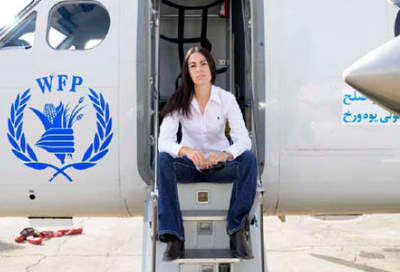
Marie Claire, a women's magazine, published an article about Danielle Aitchison, one of the female pilots of UNHAS flying in Afghanistan.

Take glimpse into an extra-ordinary life of a lady calling herself "just a regular chick".

Read the full post...

Picks of the week: From space to Afghanistan and back

park between the lines

Am at home, in bed with a sore back. I have some time to browse the web a bit. If you have five minutes, here are my picks of the week (eh.. day..):

  • What are the odds?
    British and French nuclear subs collide in Atlantic (Full).
    Maybe a confusion about the priority rules. Who goes first at crossroads? The one coming from the left or the one from the right?

  • What are the odds? - Part 2
    A Russian and US satellite collide in space (Full).
    Now what would be the "rules of the road" in space, hey?

  • Jean does it again.
    Zimbabwe’s President Robert Mugabe is "a mad dictator" who has lost all sense of reality, according to Jean Ziegler, a UN human rights expert (Full).
    I hope that was not part of his opening speech in a new round of negotiations!

  • Not too embarrassing
    A man walked into the EU parliament building in Brussels. And robs the resident bank (Full).
    He must have been desperate. At the rate the Europeans have been bailing out their banks, who would come to the bank at the EU parliament?

  • The only difference between men and boys
    Combat Outpost, a video from the Afghan frontline (Full)
    It makes me think of the times when we were kids and we were playing 'cowboys and indians'. Sad really.

  • Stephanie in Zambia.
    From Kala is the newest edition to my list of aid workers blogs (check out the full list in the side column). Stephanie just started her assignment in a Zambian refugee camp. It is always fascinating to read how others experience their first aid work assignment.

  • Oh, and..
    In between aaallll the fabulous sites I manage, you might have a stroll through The Signs Along The Road, my random Internet clips. I picked up some nice cool pictures along the way.

More Picks of the Week on The Road.

Picture courtesy Future Perfect

Read the full post...

The accountability of aid

kids in nicaragua

I came across an article in USA Today titled: "Audits: Afghan aid lacks accountability"
After seven years of work in Afghanistan, the U.S. government's premier development agency continues to pay hundreds of millions of dollars annually to private contractors that frequently fail to demonstrate results, according to aid workers, former diplomats and audits by the agency's [Ed: USAID] inspector general.

President Obama said last week he was "committed to refocusing attention and resources on Afghanistan and Pakistan." He named special envoy Richard Holbrooke to oversee aid and diplomacy in those countries. Secretary of State Hillary Rodham Clinton said she wants the U.S. Agency for International Development to assume development tasks ceded to the Pentagon.

Yet USAID's multibillion-dollar Afghanistan reconstruction effort continues to struggle. Of six different audits conducted in the last year by the agency's inspector general, only one found a program working largely as it was supposed to. (Full)

The article lists a summary of the different projects in USAID's $7.9 billion spending in Afghanistan since 2002 and links to the audit reports.

Apart from the fact this is rather bad news for USAID, and the beneficiaries - the people of Afghanistan-, it begs to question "what can be done to make aid more efficient"?

To me, the aid organisations function in an "aid market economy", with the same principles governing a market economy: reputation, marketing, reporting, performance, effectiveness, cost efficiency... Not -like the commercial market- with the goal to maximize profits, but the maximize aid efficiency.

You could apply the same principles from a commercial market to the "aid market": demand and supply. The demand being "aid organisations requesting funding" and supply being "the world's capacity to give".

As, the supply is limited to "the world's ability to 'give' ", say x billion USD per year, each development and aid organisation is competing for those funds, which are much more limited than the need.

What if we could instigate a bit more of the "market economy" dynamics to this equation? What if, just as a commercial company has to publish their net results at the end of the fiscal year, and has to prove its efficiency in its market to its stake holders, what if we institutionalize this better, and more transparently to the "aid business"?

What if we push more to have aid organisations concentrate on net returns: both short term and long term impacts of their programs? What if donors would push more for NGO's, UN organisations, IO's to have their operations surveyed by external auditors, and to have the reports made public (like this one from USAID)?

Would this not only ensure more efficiency of aid? Would this also not help donors assess where their 'aid funds' are better invested? And in the end, increase the net benefit to the stakeholders: the beneficiaries.

Otherwise the world can spend yet another century of aid. Ineffective aid.


Interested in aid and accountability: Check "Keeping a critical eye on aid & the UN" in the "Links: Aid Resources" header in the side column.
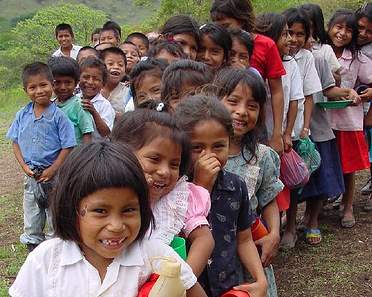
Picture courtesy Sabrina Quezada (WFP)

Read the full post...

Dark news from Afghanistan

Afghanistan dilemmas

Cat is a UN aid worker, based in Afghanistan. On her blog, she gave a dark report on the state of affairs in the country.

One passage gives a realistic, but at the same time also cynical, glimpse in the life of an aid worker, amidst security incidents and feeling hopeless:
Amidst feelings of guilt and general helplessness, I am also pondering my own safety.

Whilst staying on the military base the other day in Khost province for a conference, we were attacked. Three rockets were fired from the mountains close by and landed next to the base in a series of loud explosions which made my heart almost stop.

The whole place erupted into a frenzy of sirens - we were ordered to take shelter in our spartan military dormitories, donning our flak jackets and helmets and ordered to wait for further instructions from the base's loudpseaker. This is a vast US base, home to approximately 3,000 soldiers and thousands of metric tonnes of military equipment.

I sat on my little narrow bunk, everyone was quiet and the place was eerily silent except for the sound of humvees and tanks rolling past outside (they each weigh 35 tonnes, so the whole ground shook) and blackhawks and fighter planes overhead.

As we waited diligently for the all-clear, I read People magazine and caught up on Jennifer Aniston's latest news. Apparently she's really excited about turning 40 next month. (Full)
Picture courtesy Tom Hanson (AP/Canadian Press)

Read the full post...

Do you want to be my second wife?

Afghanistan

A bitter-sweet story from Pyjama Samsara, one of the blogs I follow:

Back in Australia, I have been regaling friends and family of tales of my (mis)adventures. There is one tale I hadn't blogged about at the time, as it was all a bit raw and close-to-heart. But now, three years later, with some distance, it's time to tell the tale.

It was early 2006, and I was in Afghanistan. My estranged husband had e-divorced me. No other relationship seemed to work. I was 32, and was convinced that I would never find love again. I would sit at my desk in the frigid office I shared with three Afghan staff, and tears would fall from my face. My colleagues were worried about me. "Is there a problem? Are you sick?", they would ask. "No", I replied. Trying to explain things in Afghan terms, I explained, "My husband left me, and I am growing old. I don't know if I will be happy again". News spread fast. Before I knew it, all the women in the office were praying for me. Much to my horror, others were trying to matchmake me to brothers or cousins.

One morning, when we were alone in the office together, an Afghan colleague came up to me and said, "I have spoken to my wife. We would like to propose marriage to you. You are a divorced woman, and are now too old to marry. You can be my second wife. My wife is pregnant, and will give birth in one month. We can give the baby to you because you are too old to be pregnant. Also, it's already her fifth child. We live on a hill and the well is at the bottom of the hill. But do not worry, we will not make you carry the water".

I only wish I was able to meet his wife to thank her for her generosity.

This story brings back memories from my time in Afghanistan. One of my most vivid recollections, I described in the short story In Pace.

Read the full post...

Picture of the Day: No Christmas Truce in Afghanistan

no christmas truce in Afghanistan

British troops in Helmand province (Afghanistan) return fire after an attack by Taliban during a Christmas carol gathering. (Full)

[Ed: To me, this picture is a symbol for the sad state of affairs in the world]

More Pictures of the Day on The Road.

Picture courtesy London Media

Read the full post...

Rumble: The horrors of war - Iraq and Afghanistan

Battlespace online: Iraq and Afghanistan - click for slideshow

If you know the enemy and know yourself, you need not fear the result of a hundred battles. If you know yourself but not the enemy, for every victory gained you will also suffer a defeat. If you know neither the enemy nor yourself, you will succumb in every battle.
Sun Tzu, The Art of War


Battlespace is a photo exhibition produced by November Eleven, an American charity supporting independent media, research, and humanitarian aid efforts.

The exhibition focuses on the war in Afghanistan and Iraq. Their site features an online slideshow of the key pictures.

Be warned,
some pictures are very graphic, and just as the war in Iraq and Afghanistan, thoroughly shocking.


More posts on The Road about Iraq, Afghanistan and war.

Picture courtesy Luke Wolagiewicz and November Eleven

Read the full post...

News: The State Of the World Today...

I might be bitching on the snowstorm or my flight delays yesterday, but this is nothing compared to the sad state of affairs in the world.

A grab out of the humanitairan turmoil today. Were you aware?

  • The crisis in Congo starts taking the shape of a genocide (Full)
  • Children dying in Haiti, victims of food crisis (Full)
  • 5 million people in Afghanistan now dependent on food aid (Full)
  • Jordan rings the alarm bell on the humanitarian crisis in Gaza (Full)
  • Zimbabwe is on the virge of collapse (Full)
  • 17 million people are in urgent need of food in the Horn of Africa. (Full)
Picture courtesy Logan Abassi (MINUSTAH)

Read the full post...

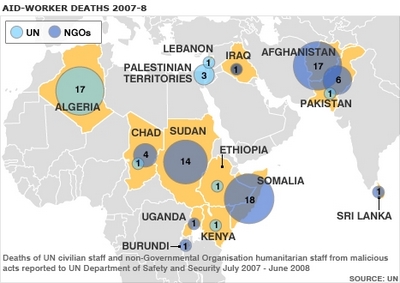
News: One more aid worker killed in Afghanistan

Killed aid workers statistics

The killing of a British aid worker in Afghanistan has again highlighted the dangers posed to humanitarian staff in many parts of the world.

Aid work is about helping those less fortunate than yourself, but for hundreds of humanitarian workers in the world's most dangerous countries the threat of violence goes hand in hand with their chosen path.

The shooting of aid worker Gayle Williams, who had dual British and South African nationality, adds to a death toll that has reached almost 30 in Afghanistan alone during the past year, according to the UN. (Full)

More on The Road about aid workers and Afghanistan

Illustration courtesy BBC.

Read the full post...

News: The Forgotten Wars...

The War in Darfur: All forgotten?Most people in the UK are unaware of major conflict zones around the world, according to a new survey by the British Red Cross.

The survey was carried out to discover how much the British public knows about armed conflicts ahead of the Red Cross’ Civilians and Conflict Month, which launched this week.

Respondents were able to name Afghanistan and Iraq as war zones, most probably because that's where British military are stations.

However less than one per cent identified the Democratic Republic of Congo (DRC), where an estimated 5.4 million people have died as a result of the country’s long-running conflict.

Less than one per cent of respondents were able to identify countries such as Sudan, Somalia, and Central African Republic.

Almost one in five (18 per cent) could not name five countries experiencing conflict. (Full)

I would add that in the case of Chad and DRC, the media is partially to blame as the crisis in those countries hardly ever gets the spotlights. Which is not the case for Somalia, and certainly not for Sudan.

If you look at all the campaigning which has been done around Sudan and Darfur, one would then ask, what it really takes to ensure the forgotten wars are brought back into the spotlight? Reuters Alertnet runs a survey on this topic.

Via The Other World News

Read the full post...

News: Watch Pakistan

Warning. This piece is opinionated and reflects my personal views.

musharaf's gone

Pakistan has kept up a fragile balancing act between democracy and despotism, between the US and its Muslim roots, between being the Taliban's friend or foe. I lived in Pakistan for a number of years before and during the 9/11 crisis and always found it quite an inflammable country, which could ignite with the slightest spark.

The country's leader after the 1999 coup d'etat, Pervez Musharraf, who resigned as the Commander in Chief of the armed forces a few months ago, just stepped down as the country's president amidst an increased campaign of terrorist attacks and worsening civil unrest.
Musharraf might not have been the school example for democracy but it seems that he was able to keep the fragile balance the country needed in a turbulent region, and neighbouring its arch-rival India.

With the Taliban's power yet again on the raise in Afghanistan and in Pakistan's -almost self ruling- tribal areas bordering Afghanistan, one should worry if this country, a nuclear power, can continue to please the West, its population, and the extremists.

The more a worry because while Pakistan was -officially- an US ally in the war against terror, it is now said its intelligence service, the ISI, always 'tolerated', if not supported and even trained, the Taliban in the recent years.

Matthew Cole wrote an interesting article "Killing ourselves in Afghanistan" which gives a must-read insight in the balancing act Pakistan's military have performed before, during and after the 9/11 crisis. The article features the intriguing story of a defunct Taliban officer.

My prediction: the current ruling frail coalition might find it difficult to fill the power vacuum of the post-Musharraf era. Either extremists will go for the throne or will plunge the country in chaos. If Pakistan tumbles, the whole region might go up in flames again. OR, of course, the country rulers might go for the classical political solution: deviate the public's attention from the real problems, and start a "whag the dog"-war. India? Either way, it makes the events in Pakistan a worrying spot in the spectrum of world politics.

Update (less than a day after writing this post):
Pakistan's ruling coalition split after former premier Nawaz Sharif withdrew over differences on the restoration of judges sacked by ex-president Pervez Musharraf. (Full)
2nd Update (a few hours later):
An estimated 200,000 people from the tribal areas bordering Afghanistan have been displaced since the Pakistani army launched the Bajaur operation early this month in response to growing U.S. pressure to take action against the Taliban in the region, according to the International Committee of the Red Cross.(Full)
3rd Update (16-Sept-2008):
Pakistan's military has ordered its forces to open fire if U.S. troops launch another air or ground raid across the Afghan border, an army spokesman said. Pakistani officials warn that stepped-up cross-border raids will accomplish little while fueling violent religious extremism in nuclear-armed Pakistan.(Full)
4th Update (20-Sept-2008):
Suicide bomber blows up a truck full of explosives outside of the Islamabad Marriott hotel, killing at least 40 people (Full)
5th Update (2-Oct-2008):
UN orders staff families to evacuate Islamabad (Full)
6th Update (03-Oct-2008):
War has come to Pakistan, not just as terrorist bombings, but as full-scale battles, leaving Pakistanis angry and dismayed as the dead, wounded and displaced turn up right on their doorstep. (Full)
7th Update (09-Oct-2008):
Bombings killed 10 people and wounded at least four, including an attack on a heavily guarded Islamabad police complex. (Full)
8th Update (Nov-2009):
We are now one year later. Looking at the frequency of suicide bombings, attacks on civilians, the international community and the aid organisations, it seems my prediction was pretty spot on so far... Sadly...

Picture courtesy Khalid Tanveer/AP

Read the full post...

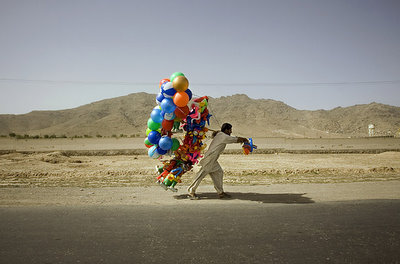
Picture of the day: Balloons

balloons

A street vendor carries a bundle of balloons as he walks along a street on the outskirts of Kabul.


More Pictures of the Day on The Road.

Picture courtesy Emilio Morenatti (AP)

Read the full post...

News: Afghanistan's poor. The Brick Maker.


A simple and down to earth video about life in Afghanistan, featuring the brick makers in the vicinity of Kabul.


More articles on the Road about Afghanistan.

Video via The Real News

Read the full post...

News: The World Press Photo of the Year 2007

World Press Photo of the Year 2007

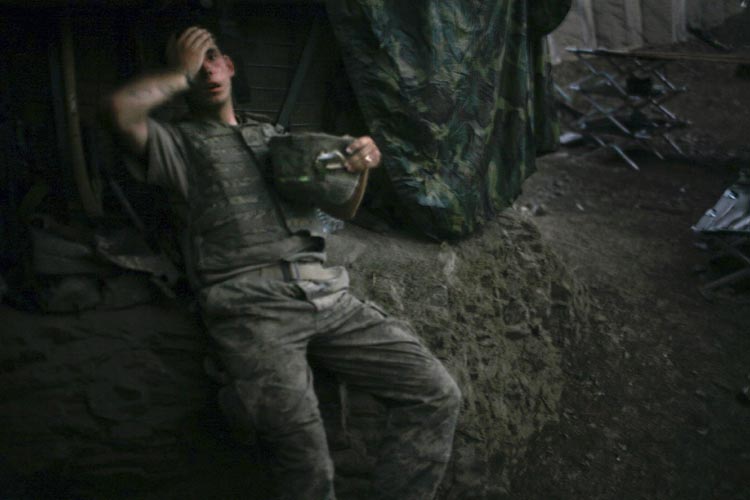
Tim Hetherington, a Vanity Fair photographer, won the "World Press Photo of the Year 2007" award with this picture of an American soldier resting at a bunker in Korengal Valley, Afghanistan taken September 16, 2007. The jury said "This image shows the exhaustion of a man and the exhaustion of a nation, we're all connected to this. It's a picture of a man at the end of a line".

Der Spiegel published the story behind this picture. An excerpt:
They barely slept that night. All of them crowded in the bunker, against the dirt wall "away from the other wall where they would come over. " says Hetherington, "they" being the enemy.

It was in that darkest hour that Hetherington took the picture that moved the world. A young soldier, leaning against the earth wall, his helmet off, arms smeared with dirt. He wipes the sweat off his brow, looking directly into the camera, his eyes foggy, his mouth ajar, part shocked, part weary, part desperate. He is wearing a large ring on his left hand.

The image is dark, blurry, lacking contrast. Some have criticized that now, arguing that a photo like that "was not appropriate to win," says Hetherington. But the shot captures the moment perfectly, and it works on two levels: It gives the viewer the sense of what happened then and there, and at the same time it has timeless, symbolic meaning.

Picture courtesy REUTERS/Tim Hetherington/Vanity Fair. - Source: The Road Daily

Read the full post...

Rumble: A Must Read: Khaled Hosseini - A Thousand Splendid Suns

A couple of months ago, I posted a review of the Kite Runner by Khaled Hosseini. In 2007, he published a new novel: A Thousand Splendid Suns. It is the best book I have read since... well, since the Kite Runner... As far as I am concerned, this is "The Book of 2007".

Hosseini takes his title from a 17th century poem by Saib-e-Tabrizi, which sings the praises of the ancient and cultured city of Kabul: “One could not count the moons that shimmer on her roofs, or the thousand splendid suns that hide behind her walls.” The lines are chanted by one of Hosseini’s characters as the bombs of the mujahideen are destroying Kabul. (Does this remind you a bit of the bitter contrast between war and poetry I described in "Lost Connection"?)

The book starts in the 1970's Afghanistan, and tells a story of Mariam and Laila over a period of three decades. In the background Afghanistan struggles from the rule of King Zahir Shah, via the Sovjet invasion, the civil war during the mujahideen, the ruling of the Taliban and finally the US invasion.

Initially, both main characters start with their own individual story.
The first story is about Mariam, Nana and Jalil's extramarital child (a harami). Mariam is only fifteen when her mother commits suicide. She is sent to Kabul to marry the troubled and bitter Rasheed, thirty years her senior, desperately hoping for her to bear him a son.
The second story follows Laila, born around the time Mariam moves to Kabul. Laila grows up as a beautiful and intelligent young girl, finding love with her childhood friend, Tariq.
As the Mujahideen start their battle for Kabul, tragedy strikes. Tariq flees to Pakistan and is thought to have died on the way. Laila's parents are killed in a bomb attack leaving orphaned, fifteen-year-old Laila, no other option but to marry Rasheed, as his second wife.

Here the two stories become one powerful stream of conflicts, love, violence, fear, shame and hatred. Laila and Mariam start off on the wrong foot, but slowly find consolation in each other, mainly rooted in what they have in common: their hatred and fear for their husband. With the passing of time comes Taliban rule over Afghanistan, and with it, life becomes a desperate struggle against starvation, brutality and fear. The women's endurance is tested beyond their worst imaginings. Yet love can move a person to act in unexpected ways, and it is love which leads them to overcome the most daunting obstacles.

"A Thousand Splendid Suns" is a jewel. An absolutely wonderfully told, heart-wrenching story of an unforgiving time, an unlikely bond and an indestructible love. It took me in from the first page until the last, and I just "could not put the book down". Khaled Hosseini's story-telling skills which I discovered in "The Kite Runner", blossomed and bloomed in this new book. I have lived and worked in Afghanistan and Pakistan for several years around 2000. I could just pick up the smells and sounds as I read through the story. An example:

Mariam had never before worn a burqa. Rasheed had to help her put it on. The padded headpiece felt tight and heavy on her skull, and it was strange seeing the world through a mesh screen. She practiced walking around her room in it and kept stepping on the hem and stumbling.
The loss of peripheral vision was unnerving, and she did not like the suffocating way the pleated cloth kept pressing against her mouth.
“You’ll get used to it,” Rasheed said. “With time, I bet you’ll even like it.”
They took a bus to a place Rasheed called the Shar-e-Nau Park, where children pushed each other on swings and slapped volleyballs over ragged nets tied to tree trunks. They strolled together and watched boys fly kites, Mariam walking beside Rasheed, tripping now and then on the burqa’s hem.
For lunch, Rasheed took her to eat in a small kebab house near a mosque he called the Haji Yaghoub. The floor was sticky and the air smoky. The walls smelled faintly of raw meat and the music, which Rasheed described to her as logari, was loud. The cooks were thin boys who fanned skewers with one hand and swatted gnats with the other.
Mariam, who had never been inside a restaurant, found it odd at first to sit in a crowded room with so many strangers, to lift her burqa to put morsels of food into her mouth. A hint of the same anxiety as the day at the tandoor stirred in her stomach, but Rasheed’s presence was of some comfort, and, after a while, she did not mind so much the music, the smoke, even the people. And the burqa, she learned to her surprise, was also comforting. It was like a one-way window. Inside it, she was an observer, buffered from the scrutinizing eyes of strangers. She no longer worried that people knew, with a single glance, all the shameful secrets of her past...


But it is not only in the long impressionistic descriptions that comes the full flavour of the book. It is also sometimes in passages, short and sharp as a razour:

Nana put down the bowl of chicken feed. She lifted Mariam’s chin with a finger.
“Look at me, Mariam.”
Reluctantly, Mariam did.
Nana said, “Learn this now and learn it well, my daughter: Like a compass needle that points north, a man’s accusing finger always finds a woman. Always. You remember that, Mariam.”


If you are still not convinced, read chapter one and chapter 11. (courtesy Amazon.com)

Update Jan 10: "A Thousand Splendid Suns" is Amazon's Book of the Year 2007.

As a note of interest:
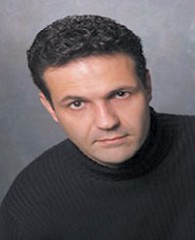
Khaled Hosseini is an Afghan born son of a diplomat and a teacher who now lives in the US. In 2006 he was named a goodwill envoy to UNHCR, the United Nations Refugee Agency. An author with a mission. Have a look at the video he made from a visit to the refugee camps in Chad.

More recommended books from The Road.

Read the full post...

Rumble: Book review - "Inside the Jihad"

One of the better books I read over Christmas: "Inside the Jihad" by Omar Nasiri.

Between 1994 and 2000, Omar worked as a secret agent for Europe's top foreign intelligence services - including France's DGSE (Direction Générale de la Sécurité Extérieure), and Britain's MI5 and MI6. From the netherworld of Islamist cells in Belgium, to the training camps of Afghanistan, to the radical mosques of London, he risked his life to defeat the emerging global network that the West would come to know as Al Qaeda.

In his book, Nasiri shares the story of his life -a life balanced precariously between the world of Islamic jihadists and the spies who pursue them. As an Arab and a Muslim, he was able to infiltrate the rigidly controlled Afghan training camps, where he encountered men who would later be known as the most-wanted terrorists on earth: Ibn al-Sheikh al-Libi, Abu Zubayda, and Abu Khabab al-Masri. Sent back to Europe with instructions to form a sleeper cell, Nasiri became a conduit for messages going back and forth between Al Qaeda's top recruiter in Pakistan and London's radical cleric Abu Qatada.

"Inside the Jihad" is well written, reads fluently as if it were a novel, despite its gruelling contents. As almost a case study by itself, the story shows how a "up to no good", drinking, womanizing, profiteering and drug dealing Moroccon youngster comes in contact with people supplying arms to an Algerian terrorist cell. What started as a profitable adventure, little by little, he gets drawn into the intrigues, and almost haphazardly, ends up going to the Afghanistan Al-Qaeda training camps, as if he had little choice.
Slowly, he gets a purpose in life, finds true camaraderie and despite his criminal and no-good past, he constantly swings between sympathies for "The Al-Qaeda Cause" and his conscience.

He ends the book with a rather insightful message:

I believe there are wars worth fighting for. I believe there are countries worth fighting for. But I also believe in laws. Maybe more than any other religion, Islam has strict laws about when and how to go to war. I learned these laws myself in the Afghanistan training camps. And I learned that these laws make us superior than the Americans, French, Germans, Russians, English and no matter who. They kill where possible. They throw nuclear bombs and kill millions of people in gas chambers, extinguish millions of people to get land and property. They kill women and children, and shrug about the collateral damage.

That is right, they do such things, and have done so for centuries. But we are Muslim, and the Koran does not allow to behave like this. This is the true Islam, this is the Islam I was thought in the training camps, all be it in theory. What I learned in practice was different.
This is the reason why I wrote this book. I did not tell the story to protect the West against terrorists, it never was my goal. Above all, I wish to protect Islam against the terrible excesses and new thinking.

(..) The fact that the Muslim world has become so degenerated that we were forced to fight wars with the weapons of our enemy has always bothered me. But what happens now is even worse: we fight our wars with the tactics of our enemy. Once we, fight our wars as they do, in other words as YOU do, then there is nothing left for us to fight for.


That is my Jihad..


Enjoy this book. More of my favourites, you can find in my online library.
More recommended books from The Road.

Read the full post...

Rumble: Lost Connection

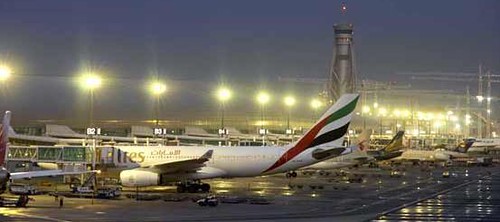
Dubai airport at night

Arriving at Dubai airport last week, reminded me of a story I had in my mind. I wrote it as soon as I got to the hotel, at 3 a.m.. It is called "Lost Connection". An extract:

I step out of the plane and look at my watch. 10 pm. Two hours to shop in the Dubai Tax Free before boarding my connecting flight to Islamabad, Pakistan.I follow the stream of arriving passengers moving along on the first floor of the airport, overlooking the shopping area. I look at the vast crowd below. A dense mix of every possible nationality, religion and ethnicity in the world, expressed through a myriad of dress codes. From formal western suites, the traditional Arab dishdashahs, women in mini skirts mixed with those fully veiled. Rough Afghani chupans, expensive Indian silk sari’s, Berber djellabas, Australian safari shorts, Sudanese turbans, American baseball caps and Arab hijabs. This crowd seems to represent the world within one space. But the crowd is not strolling along from one shop to another in its usual way. The people are talking in groups, some with raised voices and expressive hand gestures, and others whisper. There is no laughing, nor joy but a nervousness makes the tension in the air so thick one could cut it with a knife. You do not have to be a clairvoyant to feel something is wrong.

What was happening? Ah, for that, you'll have to read the full story!

Read the full post...

Rumble: Ham radio, anyone?

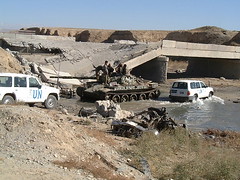
Bombed bridge and a tank stuck in the river on the road from Bagram to KabulA few months ago, I wrote an article for the year book of the Northern Californian DX Foundation. I edited it into a short story. Here are the first paragraphs:

I am not a happy camper. And that is an understatement. Before we left, I emphasized them to keep a watch for us on our monitor frequency. And now, I call them, and … nothing, nada, ziltch. The sun is already set behind the mountain tops. Even though the sky still has a hint of a dark-blue afterglow, it is already dark. And when I say dark, I mean pitch dark. There is not a single light. The headlights of the trucks in our convoy beam into a void as they negotiate twists and turns of this bombed road. They light up nothing but emptiness. And bomb craters. And little flags marked ‘Mines’. But for the rest, I can not describe it in any other way but “Void-ness”. Absolute empty-ness. There is nothing in this part of the world. There is nothing that grows. There are no houses. No-one lives here. There is only light brown dirt. Dirt and bits and pieces of mangled war-toys. A rusted tank, half buried in the sand. Or a rotor blade from a helicopter sticking from a pile of rubble. But for the rest, dirt. I can not believe this part of the world has been a battleground for the past twenty years.(full story)

Read the full post...

Rumble: As an Aidworker, What Right Do We Have to Be Privileged?

In quite a few of the short stories I published, and in those written by Enrico or Cyprien, we tried to draw a picture of how it is to live in the 'bush'. In what we call 'the deep field'. In the remote places of Africa or Asia.

Frida, working for a human rights organisation in Ghor, 'the deep field' of Afghanistan, struggles in a recent post trying to find a balance between finding healthy food, without depleting the scarce resources on the local market or flying in food, and trying to keep body and mind healthy. Or should we really eat what those we serve eat...

Comes with the ethical question 'what make us, the aid workers, different from those we are trying to help?' What right do we have to be more privileged? A feeling and a struggle - I must admit - has been pushed more and more on the background of my mind since I started to work from our Headquarters in Rome, even though I wrote about it at the end of my short story about working with the refugees in Goma.

I guess, the answer is: we are more privileged than those we serve. And as long as we realize that fact, and that we continue to be grateful for this privilege, the only thing we can do is to try serving those we help even better.

PS: Frida also has a photo blog with absolutely astonishing pictures of Afghanistan. Have look!

Picture courtesy Debbi Morello

Read the full post...

Ham Radio, Anyone?


November 2001. Somewhere on the road between Bagram and Kabul.

Bombed bridge and a tank stuck in the river on the road from Bagram to KabulI am not a happy camper. And that is an understatement. Before we left, I emphasized them to keep a watch for us on our monitor frequency. And now, I call them, and … nothing, nada, ziltch. The sun is already set behind the mountain tops. Even though the sky still has a hint of a dark-blue afterglow, it is already dark. And when I say dark, I mean pitch dark. There is not a single light. The headlights of the trucks in our convoy beam into a void as they negotiate twists and turns of this bombed road. They light up nothing but emptiness. And bomb craters. And little flags marked ‘Mines’. But for the rest, I can not describe it in any other way but “Void-ness”. Absolute empty-ness. There is nothing in this part of the world. There is nothing that grows. There are no houses. No-one lives here. There is only light brown dirt. Dirt and bits and pieces of mangled war-toys. A rusted tank, half buried in the sand. Or a rotor blade from a helicopter sticking from a pile of rubble. But for the rest, dirt. I can not believe this part of the world has been a battleground for the past twenty years. The last fierce battle was only four days ago. The Northern Alliance meets the Taliban. One-nil. Taliban lost and evacuated Kabul. And we moved in with the relief convoy.

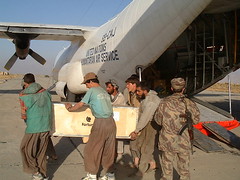
Offloading the C130 earlier that day.I curse, check another frequency they sometimes use, but still nothing. The radio room is not answering. It is Ramadan, and this time of the day, the radio operators in Kabul, twenty kilometers away, are probably gone praying, or are already at the Iftar, breaking their fast. We just flew in a C130 cargo plane full of food, and I went with a convoy to pick it up from Bagram airport, few hours truck-drive from Kabul. We can’t use Kabul airport yet, as a one ton unexploded bomb sticks out of its runway. And we don’t have any deminers in yet. Nobody is allowed to come into Kabul, except twenty expatriate aid workers. I am one of them. And the only one on this road. The only one outside the Kabul safe haven. I must be crazy to do this. At any time, I expect to see the flare of an RPG coming straight at us, as rumours say there are still rogue Taliban roaming in this area. We desperately need to get hold of "someone" in Kabul to inform them this convoy is on the move, and that "someone" needs to monitor us, just in case something would go wrong.

“What to do? What to do? How on earth can I get hold of Kabul.. Hmm let’s see.” I dial another frequency on the HF radio in the car. No UN frequency, but a ham radio call frequency this time. One push on the auto-tune button and in a few seconds, the radio beeps and displays: “14.195.0 – Antenna Tuned”.
I push the button on the microphone and ask “Frequency in use?” Not a beep. I wonder if this radio is receiving or transmitting at all. Maybe that is why the radio room did not copy me. Even though all worked well before we left.
- “Frequency in use?”. Nothing again. Hmm.. Ok, well… let’s try.
- “CQ 20, CQ 20, YA5T/m YA5T/m YA5T/m , CQ 20 and by.”, I launch my call. "YA5T is my callsign in Afghanistan. With the prefix "YA", the hams will know what country I am transmitting from.
And the world explodes on this tiny radio. Dozens of hams answer my call. From Europe, North America, Asia. Shivers run down my spine. I can not believe this. Here I am sitting in a car, driving on what once was a road, with probably dozens of Taliban waiting to take a shot at me, in the middle of bloody nowhere. And still, with this small piece of hardware, I have the world talking to me… You have no idea how this feels. YOU HAVE NO IDEA…!

It takes me one minute to get ‘ON4WW’-Mark, my friend in crime on frequency. He is at home in Belgium, I am in a car in Afghanistan, but his radio signal booms in. I pass him the satellite phone number of the control centre in Kabul –just in case something would happen- and he remains on standby for the next two hours until we safely reach Kabul.

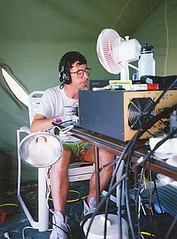
Even though in the middle of nowhere, we were not alone. I had hundreds listening in. From all over the world. Weird stuff, hey, ham radio? How do you explain that to outsiders? How do you explain not only what ham radio is, but also what it meant to you, in your life? How it changed the course of my life in many ways? Last year, I started to write down some of these stories in my eBook.


Ham radio. A sharp bend on the road of my life.

ON6TT at AH1A - Howland Island 1993 expeditionAs I wrote down these stories, I started to realize - it does sound rather melodramatic, but it is true to state - that “ham radio has changed my life”. If no ham radio, I would not have done the Clipperton expedition in 1992, I would not have experienced the adrenaline kick that operating from a remote Pacific island gave me. I would not have done the expedition to Howland the year after. Then I would not have met Paul, F6EXV. Paul as co-operator then, and as one of my ham contest partners at John-ON4UN’s home. He would not have received the telephone call –during that contest- offering him a job at the UN in Congo. He would not have explained me what that work was all about, which raised my interest.

Less than year and one expedition (Peter I island in the Antarctic) later, I flew to Angola, for the Red Cross, on my first humanitarian mission. My job had nothing related to my education – I am a graphical engineer – nor with my professional experience – I was an IT manager in my last ‘normal’ job-, but I was to install radios. I did work which was solely based on my experience as ham operator. In the end, there is no difference between going on an expedition, fiddling around with generators, debugging antennas and raising masts, if it was on Peter I island, or in the middle of Africa. Well, true, they did not shoot at us on Peter I… But for the rest, there was no difference.
Angola, where I operated as ham with the calls D2TT and D3T later on, was my first mission in the humanitarian world, to be followed by hundreds of missions, to over a hundred countries. Never kept count how many. I did keep track how many countries I operated from. 85 so far…

ON6TT as 5X1T in Uganda 1996-1999Over the past 14 years, there were many exciting and memorable moments. Many are explained in stories on my website, and often have a mix of an exotic location, work and ham radio. Being the first to transmit ham TV signals from Zaire (now DRC), during the midst of the Kisangani refugee crisis. And a few months later to be the first on ham TV from the Vatican City. Or the 60,000 radio contacts I logged from our home in Kampala as "5X1T", in between power cuts, baby sitting, bombings and evacuations. All the friends I made when on mission, and hooking up with people I have spoken with hundreds of times, but never met. I met them while on mission, and they welcomed me in their homes. Be it in El Salvador, Iran, Iraq, Pakistan, Nepal, South Africa, Tajikistan or dozens more)… And even more so, they often gave me a head start for my work, providing me with much needed connections to the local PTT officials or trustworthy local telecom repair shops where I could find that long-sought-for cavity filter…

There is not one single memory that stands out. They are all different in their own way. But if there was one time where I felt *really* lucky I was a ham radio operator, it was that one night, in the midst of nowhere, in Afghanistan, just a few weeks after 9/11 !

Peter, ON6TT

This is an edit from an article I wrote for the 2007 yearbook of the Northern Californian DX Foundation (NCDXF). Check out more ham radio related stories in my eBook.


Continue reading The Road to the Horizon's Ebook, jump to the Reader's Digest of The Road.

Read the full post...

Lost Connection

Dubai airport at night

Dubai International Airport - October 7, 2001.
I step out of the plane and look at my watch. 10 pm. Two hours to shop in the Dubai Tax Free before boarding my connecting flight to Islamabad, Pakistan.
I follow the stream of arriving passengers moving along on the first floor of the airport, overlooking the shopping area. I look at the vast crowd below. A dense mix of every possible Dubai Duty free shopping arenationality, religion and ethnicity in the world, expressed through a myriad of dress codes. From formal western suites, the traditional Arab dishdashahs, women in mini skirts mixed with those fully veiled. Rough Afghani chupans, expensive Indian silk sari’s, Berber djellabas, Australian safari shorts, Sudanese turbans, American baseball caps and Arab hijabs. This crowd seems to represent the world within one space. But the crowd is not strolling along from one shop to another in its usual way. The people are talking in groups, some with raised voices and expressive hand gestures, and others whisper. There is no laughing, nor joy but a nervousness makes the tension in the air so thick one could cut it with a knife. You do not have to be a clairvoyant to feel something is wrong.

Hundreds of people are lining up at the transit counters, below large displays listing numerous cancelled and delayed flights. The atmosphere is grim. Utter grim. I grab hold of someone in an Emirates Airlines uniform and ask her what is going on. She answers: “Have you not heard? The US started bombing Afghanistan a few hours ago. They closed the airspace above Pakistan, Afghanistan, Iran and all Gulf countries. No civil plane will be flying anymore for a while!”.
For a moment, I feel like the ground is pulled away from beneath my feet. “The US started bombing Afghanistan… This, we have feared since 9/11, a month ago. Retaliation. The beginning of the turmoil in the region, which will last for years. What will happen with Pakistan? How will the government react, how will the people react?”, thoughts flash through my mind as the lady explains the airline has booked hotel rooms, and buses are waiting outside.

I act like a robot: I walk through immigration, pick up my bags, and walk outside. The heat, humidity and mere mass of people crowded at the airport exit cuts off my breath. I get onto the bus and let myself fall into a free seat. I look at the crowd, the stuck traffic,…
- “Not flying tonight, are you?”, a voice says. I wake up from my reverie and look at the guy next to me. American accent.
- “No, apparently not!”, I mumble.
- “Harry”, he says as he holds out his hand.
- “Peter”, I answer, “where were you supposed to fly to?”
- “Oh, I was supposed to fly to Uganda”, he says, “my wife works there.”
- “Oh, really”, I answer, “I worked there too, left two years ago”. I try to make conversation, killing the time waiting for the bus to leave..
- “Really? You work for the UN?”
- “Yes, I do, for WFP”.
- “Oh, my wife works in the same building.. Cathy Ashcroft, maybe you know her!”. It turns out Harry is the husband of Cathy I know since years, the same Cathy I helped setting up the OCHA office in Kampala. We engage into a vivid conversation of Kampala, life in Africa, relief work and of course come back to the subject of the US bombing campaign.

After checking into the hotel, Harry and I walk to the night club, the only place we can still get a drink. In the mean time, it is already 1 am. A few men and a couple form the meagre audience, spread over a dozen tables. A small live band is playing without much enthusiasm. We take a seat in the back, and order a drink. I really really need a drink.
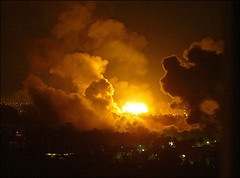
US bombing campaignI tell Harry about how we feared for the retaliation, how we feared how the whole region was going to react. No matter how much everyone hated the Taliban, it was still an attack on a sovereign country. A Muslim country. Would countries in the region now choose sides? Be forced to choose sides? Above all, it would mean that masses of people would be killed. Tens, if not hundreds of thousands would start moving within the country, trying to find refuge. It could possibly cause an exodus into all countries around Afghanistan: Pakistan, Tajikistan, Uzbekistan, Iran,... Working for a front-line humanitarian organisation, I know what this would mean for us: we would go and provide aid, close to the line of fire. I think of all our national staff who is still in Afghanistan.
All of a sudden the band changes beat and a belly dancer starts her act. There is something wrong with this picture… A war has started tonight. A big one. And here we are in a dark bar, watching a belly dancer…
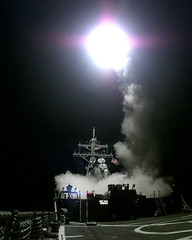
Tomahawk missile launched from a war shipI find no joy, pay for the drinks, say good-bye to Harry, and walk outside. Sitting on a bench near the hotel entrance, I lit a cigarette. I close my eyes, and imagine the infernos of fire, explosions, shrapnel in the black night around Kabul, Jalalabad and Kandahar. All places I have visited in Afghanistan. I can see families trying to seek refuge in their homes. I can see their fear not knowing what is going on, how long it would last, and what this would mean for them, and their livelihood. I can smell their fear even where I was sitting.
I look up. The night sky is clear. I imagine the Tomahawks launched from war ships close by. I imagine war planes rushing overhead, ten miles up in the sky. The pilots looking down at Dubai, this city of light and splendour, as they bank left and turn the direction of Afghanistan.

Postscript.
I was blocked in Dubai for three days. Spent the whole time in my hotel room, on email and telephone, coordinating with my team in Islamabad and with my counter parts in Rome. After three days, the air space was re-opened. I got onto the first plane that flew from Dubai to Islamabad. People were so anxious to get back home, they started a fight while boarding.
One month later, I landed in Kabul. As the Taliban retreated, they suffered quite some losses. People took the turbans from the bodies and threw them up in the trees. The turbans unruffled and for months long strips of shiny turban cloth were weaved in between the branches, floating in the wind.

It made me think of the start of the war and the belly dancer. The same contrast I found in dead bodies and their turbans floating in the wind, dangling from a tree. There is nothing poetic about the horrors of war. I understood what Marlon Brando meant in “Apocalypse Now”.


Pictures courtesy theme.cc (bombing), CNN (Tomahawk), umami.co.nz (Duty free zone)


Continue reading The Road to the Horizon's Ebook, jump to the Reader's Digest of The Road.

Read the full post...

News: NATO in Afghanistan Encouraging Heroin Production?

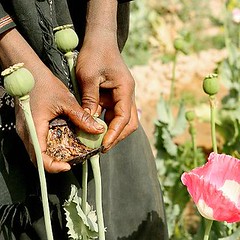
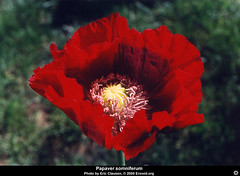
Since decennia, Afghanistan has been one of the main producers of heroin. The plant, the poppy, grows easily, needs little water or care in general, and is easy to harvest: farmers milk opium resin from the plants which is processed into heroin and smuggled.
Opium and heroin has become Afghanistan's runaway export success. At the end of the Taliban reign, the cultivation of poppy was outlawed, and the crops were eradicated, up to the extend that the UN Drug Control Program (UNDCP) had closed its offices in Afghanistan with a note "Job Done!".

Since the fall of the Taliban, the poppy crop soared from 8,000 hectares in 2001 to a record 165,000 hectares last year. The street value of the annual crop is estimated at US$3 billion, representing about 90% of the world's heroin production. An estimated 2.9 million Afghans, 13% of the population, are involved. There are no cartel lords. Western officials believe trade is controlled by 25 smugglers including three government ministers
according to the Guardian.

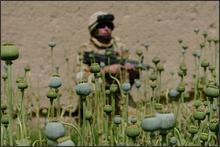
As the poppy cultivation is the main livelihood of so many Afghans, NATO gets a lot of resistance when they assist the Afghan government with the destruction of the crops. During this crop season, the farmers increasingly take up arms against ISAF, according to Time Magazine..

So what to do? According to
"Der Spiegel", NATO is contemplating to legalize the narcotics traffic in Afghanistan... Guess under the motto "If you can not beat them, join them"?.

Fact is that last week, the UK troops broadcasted a message over two local radio stations in Helmand - a region on the border between Pakistan and Afghanistan - stating: "Respected people of Helmand. The soldiers of ISAF and ANA [Afghanistan National Army- ed.] do not destroy poppy fields. They know that many people of Afghanistan have no choice but to grow poppy. ISAF and the ANA do not want to stop people from earning their livelihoods."

That got a few people upset. Not at least the Afghan government. Col Mayo of ISAF admitted the wording of the message was "open to misinterpretation" and said that after complaints from the local governor, Asadullah Wafa, it was removed and an apology issued. I wonder what the apology was like? "Euh..., I am sorry, there was a misunderstanding. We ARE here to destroy your poppy crop!" ?

Maybe next week's version will be "On popular demand from the Afghan people, NATO will now transport the poppy crop, and install an air bridge to the US as a counter measure for the increased Colombian cocaine prices"?. And then Bush could use it as an argument to state "We ARE winning this war against terror! We even quadrupled the Afghanistan export trade figures!". ha! More on Bush's view what "winning means", in the Washington Post.

Sigh. It is not fair. :-( No matter how hard you try, you really can not win them all, right? Maybe the next move would be to bring the Taliban back into power, as at least during their reign, the poppy cultivation was virtually eradicated.
Maybe we should suggest that to ISAF?


Pictures courtesy of AP-Rafiq Maqbool (soldier picture), AFP (poppy harvesting), Eric Clausen (poppy close up). For updated humanitarian news, check out The Other World News.

Read the full post...
.
  © Blogger template The Business Templates by Ourblogtemplates.com 2008

Back to TOP