Showing posts with label sailing. Show all posts

How NOT to moor a yacht. Take 3


With the summer approaching, it is time to switch to another subject. Sailing.

"Master Steve", the instructor who guided me through most of my RYA theoretical qualifications, and brought me up to the level of a powerboat instructor, send me the video link above, shot in the British Virgin Islands by Wind In My Sails.

It is an ode to the "Credit Card Captains", those who have the financial means to charter a vessel, but have no freaking clue what sailing or navigating is all about.

In the past I wrote two similar stories about "Credit Card Captains", witnessed during our previous two trips to the BVI. One was from one from Anegada and an even worse case we witnessed in Virgin Gorda.

Of all the areas I have sailed so far, the BVI has the most dense population of "Credit Card Captains". Most of them, Americans who might never have sailed before, taking a yacht to sea, endangering others and themselves.

Oh well,.. Enjoy the video.

Read the full post...

Picture of the Day: Heading for bad weather

heading for bad weather

A picture retrieved from a presentation by Dr Robert Costanza on ecological economics.

More Pictures of the Day on The Road

Read the full post...

Rumble: Sailing with dolphins

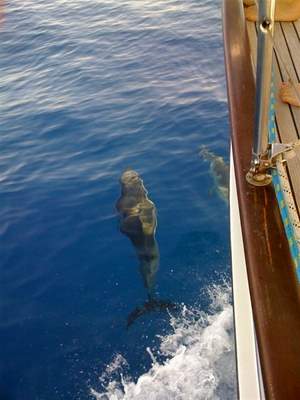
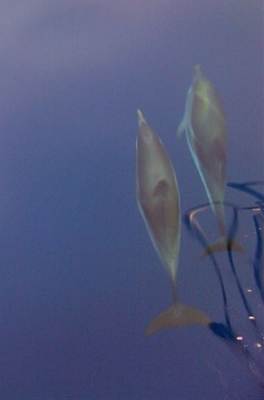
My Friend E went sailing just off the coast of Italy two weekends ago. On the Saturday afternoon she sent these pictures from her iPhone:

sailing with dolphins

I don't get jealous easily, but I can assure you I was at that moment!

More posts on The Road about sailing

Read the full post...

Rumble: We're back!

The family on Anse d'Argent on La Digue (Seychelles)

We're back home in Belgium after one week in Italy, four weeks in the Seychelles, and a couple of days of Italy again.

After the initial shock of landing on a typical Belgian summer's evening (it was 12°C at 7 pm, yak!) after five weeks of living in 25-35°C and finding out they disconnected my mobile phone (Proximus/Belgacom mobile, ha!), disconnected my pandora.be Email account (Telenet, ha!), and that the car had a flat battery, we are unpacking our bags.

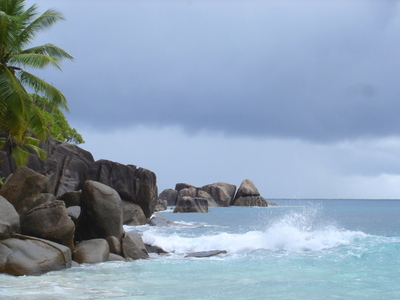
Anse aux Courbes on Mahe (Seychelles)

As we are sorting through the dirty laundry, the shells we collected, the small sea-turtle fridge magnets, the snorkeling fins and masks, our sailing gear, the wooden model ship and painted fish we bought, the memories come back.

Sunday evening I am off again to Rome, and Monday work starts again. Transiting between family, holidays, exotic locations into aid work, I am resisting to start thinking of the crisis in Georgia, famine in Ethiopia and staff evacuations in Darfur. I want the holiday feeling to stay for a some more days, so before going back to battling hunger out of the world, in the next days I will entertain you with some more holiday stories.

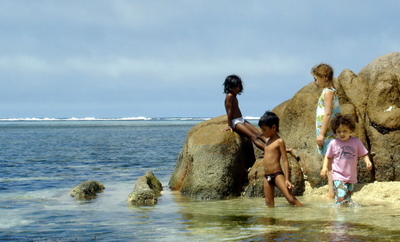
Local kids playing on granite rocks in Anse aux Courbes on Mahe (Seychelles)

Bottom line: The Seychelles is one of the most beautiful countries I have ever been to. Nature and the scenery is postcard perfect (even under the heavy cloud cover we had almost all the time), people are enjoyable and friendly (even though they broke into the boat and stole all of our cash), and the weather is warm and comfy (even though we had plenty of strong wind and rain during our sailing weeks). Oh, and it is expensive. But worth it.

Anse Takamaka in Mahe (Seychelles)


More posts on the Road about the Seychelles.

Read the full post...

Rumble: The fortune we had... (17)

road bay Anguilla

Our anchorage at Road Bay - Anguilla (2007).

Read the full post...

Rumble: The fortune we had... (14)

shell beach Gustavia StBarths

Shell Beach in Gustavia - St.Barths (2007).

Read the full post...

Rumble: The fortune we had... (13)

sandy spit BVI

Sandy Spit at the British Virgin Islands (2006).

Read the full post...

Rumble: The fortune we had... (12)

mustique

Mustique in the Grenadines (2005).

Read the full post...

Rumble: The fortune we had... (11)

pitons stlucia

Our anchorage near The Pitons - St.Lucia (2005).

Read the full post...

Rumble: The fortune we had... (10)

tobago cays

A look from our boat, at Tobago Cays - Grenadines (2005).

Read the full post...

Rumble: The fortune we had... (9)

sailing in the caribbean

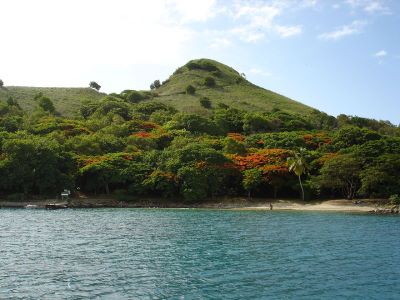
Anchored close to Beef Island - British Virgin Island (2006).

Read the full post...

Rumble: The fortune we had... (8)

sailing in the caribbean 2

Our boat anchored at Anegada - British Virgin Islands (2006).

Read the full post...

Rumble: The fortune we had... (7)

anageda2

A view from the boat, anchored at Anegada - British Virgin Islands (2006).

Read the full post...

Rumble: The fortune we had... (6)

virgin gorda

A view from the top of Virgin Gorda - British Virgin Islands (2006).

Read the full post...

Rumble: The fortune we had... (5)

stlucia

A view at the anchorage off shore from St.Lucia in the Caribbean (2005).

Read the full post...

Rumble: The fortune we had... (4)

the girls on anegada

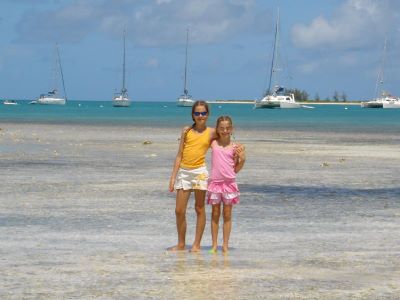
The girls on the reef by the anchorage at Anegada - British Virgin Islands (2006).

Read the full post...

Rumble: The fortune we had... (3)

boat in yerika

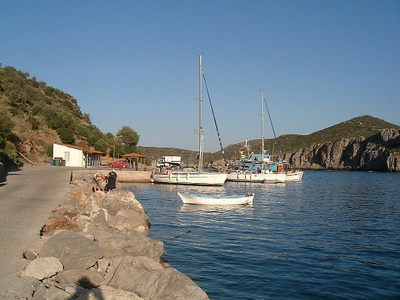
Docked at Yerika in Greece (2004).

Read the full post...

Rumble: The fortune we had... (2)

anchored at dhokos

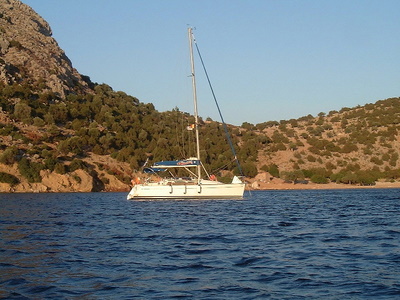
Anchored at Dhokos in Greece, a daylight view (2004).

Read the full post...

Rumble: The fortune we had... (1)

anchored at dhokos 2

Anchored at Dhokos in Greece (2004).

Read the full post...

Rumble: Sailing - not all gold that glitters

The skipper. But a dad first

People sometimes get an idealistic idea about how it is to sail a yacht. True, I love sailing. I love the ocean, the freedom, even just the idea of moving on an endless sea merely pushed forward by wind and tides.

But when I go sailing with the family, it is different. Up comes the endless feeling of responsibility. In our family of four, I am the only one who knows how to sail a yacht. Tine, my wife, knows how to assist maneuvering a yacht in a harbour, and helps me steering the boat against the wind when I raise the sails, and she picks up a mooring buoy like no other, but she does not know how to sail. Our daughters, Lana (now 13) and Hannah (nearly 11), know how to sail a dinghy, but not a yacht.

So my nightmare is "what if something happens to me, while we are under sail"... Imagine for one or the other silly reason, I fall overboard - accidents happen on a yacht -, what then? Or even if it is just when getting into bad weather, where I would need skilled hands?
It is different if you have a crew that knows what to do. As the skipper, you stay on the helm and give simple orders: "Trim the main sail", "reef the foresail", "look up the course to the nearest port"... But when we sail with the family, it is different.
Even though I take every possible precaution to ensure the safety of my loved ones: I have taken every possible course. I have quite some experience in bad weather, in strong tides, sailing in busy commercial shipping lanes, sailing at night, and maneuvering in busy ports. I know how to read weather charts, calculate tides, and all radio procedures. I know first aid, and emergency procedures. I know how to anchor a ship, pick up a man over board, and maneuver in tight quarters. And still, when sailing with the family I always get nervous.

Let me tell you a story how fast things could go wrong.

Back in 2004, we sailed from in the Caribbean from Martinique to the Grenadines. One morning, we lift anchor from Bequia in the Grenadines, to sail to St.Lucia, about 60-70 nautical miles further North. The weather was nice and the forecast was perfect. I made one mistake: I calculated the trip to be a bit shorter if we passed St.Vincent -the next island North of Bequia- via the East, the Atlantic side, rather than the quieter Caribbean (East) side.

When we cut between Bequia and St.Vincent, the weather turned overcast, but the winds and the seas were quite calm. As we sailed past St.Vincent's East side, the wind picked up to about 15 knots, still quite easy, even though I could see some isolated squalls coming our way. I kept an eye on them and changed course regularly to pass in front or in the back of them. As we sailed along, we saw the skies getting darker, and I did not have a comfortable feeling. I put in a reef in the main sail, just in case, but did not get too worried until I saw a real dark squall heading our way, just as we were getting close to the North of St.Vincent.

I ordered the family to put on their life jackets, and clipped the kids with a lifeline onto the ship. I clipped myself onto the lifeline, put the ship on autopilot and went to the bow of the ship to put in the third reef in the main sail. Just as I stood hooked onto the main mast, it started raining, and the wind picked up. Tine dropped some of the main halyard so I could put the reef in the main sail. I got soaked by the spray and the rain. By the time I got back into the cockpit, the wind had picked up to 35 knots, turning and twisting from all sides. It was then I remembered someone warning us of the usual foul weather due to the huge mountain at the North of St.Vincent.

The sea turned into a boiling pot, with waves coming from all sides, spraying over the side of the boat, soaking my crew. We already had our rain jackets on, but it got really cold. The wind gusted from all directions, making it difficult to keep a course and to keep the sails filled, so the boat would hold a steady angle.

The rain gusted down, and the visibility was close to nil. Long had we lost sight of land. I had plotted our course, so I knew we were about five miles off land, but also knew there was no harbour this side of the island. It took probably half an hour until I realized something was wrong. The wind had shifted 90 degrees, and to keep the sails full, I had lost my bearing. The compass and my GPS indicated we were heading straight for land, sailing West instead of North...

I needed both hands at the helm, and told Tine we were getting off course. Once the going gets rough, Tine is all business. Even though I know she is not comfortable in foul weather (that is an understatement), she stood up, and told me calmly "Tell me what to do!". I told her to "take the green rope, put it over a winch clockwise, and to crank it up, until I told you to stop", an order which for an experienced crew would be "pull in the main tight". She did it perfectly. Next came "take the white and black rope, put it onto a winch, open up the clamp of the white rope, and start winching in the white and black rope", a order which would be "pull in the foresail". I revved up the engine, changed the course back to North and headed into the wind.

The wind was howling, the rain came down in buckets, and the waves gushed over the bow of the ship. We continued head-on into the wind, for what seemed an eternity, but in reality it was probably just one hour. The rain came down that violently I could see the dinghy, which we were towing behind our yacht, filling with water to the rim, slowing down the ship considerably. I kept on hoping that the engine would not fail as there was no way we would be able to sail on this course, head on into the wind. But the engine purred like a cat, and after a while the rain became lighter and all of a sudden, the kids shouted "Look there: dolphins!".

That is when I knew all would be ok. Dolphins have always been a token of good luck for me. So it was no surprise that as the pod of dolphins swam alongside the ship, the wind turned again, the rain stopped and the seas calmed down. The squall had passed us, with nothing else but clear skies ahead of us.

I put the ship on autopilot again, and pulled the dinghy closer to the yacht. I just had to heave out the water from the dinghy as it was slowing us down too much. I told Tine to keep an eye on the course, and got ready to jump into the dinghy, knowing if I would miss my jump, there was no way for me to get back onto the ship. So I jumped, heaved all water out of the dinghy, pulled myself onto the ship again, and away we were.

The silver lining of that trip came soon: the seas became dead calm, with a broad side steady wind blowing at 15 knots. I put all sails back up, and trimmed them. And boy, we sailed! With our 35 ft yacht, towing a dinghy, we sailed at 10-11 knots, at a perfect angle, and with perfectly trimmed sails for hours, until we reached St.Lucia.

The strange thing was that the kids had no idea in what danger we had been. The only thing they said "Dad that was exciting, when can we do that again?". Kids!

Some lessons learned:
- Never pass an island in the Caribbean on the Atlantic side.
- Always be prepared for the worse, and hope for the best.
- Be aware of high mountains in the vicinity of where you sail. Often the weather changes near them.
- Better one reef too much than one too little.
- Be prepared, be prepared, be prepared.
- When sailing with kids, make sure they always wear their safety jackets and are hooked onto the boat, in foul weather. You should be able to concentrate on the ship, and not have to worry where the kids are, and what they are doing.
- When things go bad, kids have to get into the habit of following orders without questioning...


More about sailing on The Road.

Read the full post...

Rumble: How NOT to leave a Greek harbour

Our ship, properly anchored, stern to, in Greece

As I explained in a previous post, there is a secret, sarcastic streak in every sailor as he watches other yachtsmen maneuvering in a port or at a mooring...

Back in 2004, we sailed in Greece. It was our first sailing holiday. I took all the precautions Tine, my wife, wanted me to take before she would step onto a yacht with me: I followed the RYA yachtmaster courses, did my practical test in the Solent, and with the family, we took two days of harbour maneuver courses before we left. And to play it really safe, for one week, we had a skipper on board to get us acquainted with Greek waters.

Every day, we would sail from one place to the next, and anchor overnight in small fishing ports. As space is limited in these ports, all yachts are anchored 'stern to': the ship would drop anchor in the middle of the port and reverse with its stern (the back of the ship), onto the quay. A bit of an art in balancing the right anchor chain, and pointing the stern into a free slot on the quay, in between the other anchored ships.

We would always get into port early in the evening, secure our ship, and go for sunset drinks in one of the restaurants or bars on the dock, watching the other ships get into port.

This was always the most fun part of the day, as we could watch the other ships get into trouble as they tried to moor 'stern to'. They would loose anchor, or tangle up their anchor line with those of the ships already at the dock, or worse...

One evening we watched a Dutch yacht who had been trying to anchor already several times, each time loosing the grip of its anchor. After half an hour, he seemed to be giving up, and with its anchor still one or two meters in the water, he drifted downwind onto the ships on the quay. Good enough, for most of the yachtsmen, who were enjoying their evening drink just like we were, to stand up and watch what was about to happen...

The Dutch guy panicked as he saw his ship drifting downwind onto the moored ships, and still with his anchor in the water, he revved up his engine trying to get away from the boats. Tricky to do so downwind, so he ended up in the far corner of the port, steaming full speed right in front of all the other ships.
That was when the real fun started: as his anchor was in the water, it scoped up all the anchor lines from the other ships, and we could see one ship after the other loosing its anchor, pulled by the Dutch ship. The skipper clearly did not know what was going on, and why his ship was almost coming to a halt, so he revved up his engine even more.

The sight was hilarious: there was this one Dutch guy, trying to steam out of the harbour, pulling all the boats nicely moored onto the quay with it. All the skippers around us, started shouting and cursing, racing off to their ship, trying to jump on their yacht to save their boat from crashing onto the quay, while the Dutch guy, not aware of all the commotion he had caused, trying to get out of the harbour, with the harbour master speeding behind him telling him to stop.

What one moment was a relaxed sunset evening, in an idyllic setting, turned into a turmoil of a dozen ships all with a lost anchor, tossed together in one big mess of anchor chain, fenders and shouting. It took hours before the mess was sorted out, and everyone was back in the bar.

The Dutch were not very popular that night!


More about sailing on The Road.

Read the full post...

Rumble: How NOT to moor a yacht - take 2.

our ship, properly moored at The Bitter End Yacht Club, Virgin Gorda (BVI)

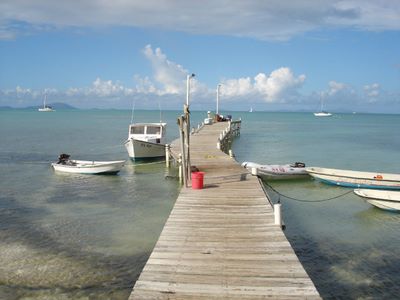
Two years ago, we moored at the Bitter End, in Virgin Gorda – British Virgin Islands. A nice anchorage in which we took one of the outer mooring buoys.

Late one evening, we were sitting on the aft deck, having a drink, looking at the night sky, counting the shooting stars. It was new moon, so the sky was dark. Pitch dark… While watching the sky, suddenly, the corner of my eye caught some movement ten yards from our ship. I pulled myself up, and saw the dark mass of a big catamaran moving silently past us. No navigation lights, no cabin lights, nothing… It was too dark to see if anyone was on deck, but I presumed they were going for a night sail, and had forgotten to put their lights on.

For at least an hour, we watched that ship making all kinds of strange twists and turns. Sometimes it would go even backwards, all without any sails nor lights on.. “Really weird”, we thought, “Wonder what those are up to?”…

It was a few hours later, about 1 am in the morning, we were already in bed, I was awoken by a dinghy racing by and circling around our ship. I got on deck, but could not see very well what was going on. I could only hear voices of two men in the dinghy, with one of them shining a small flashlight to and fro onto the water. During one of the times they passed close to our boat, I could clearly hear one shout to the other: “But I am sure we left it here!”. I did not think much of it. The guys went back ashore, and I went back to bed.

Two hours later, I heard a call on the marine radio: ‘Salvation One, this is Salvation Two’.. “Salvation” is a call sign often used in a rescue operation.. I got curious and listened into their conversation. They were clearly two vessels in a rescue operation, looking for a ship. A catamaran. Apparently I was not the only one listening in, as I heard a fisherman breaking in:
“Are you guys looking for a white catamaran?”
“Euh yeah!”, answered one of the salvation vessels.
“About 45 feet long?”
“Yeah!”
“White hull?”
“Indeed”.
“Well, I know where it is”, the fisherman answered, clearly enjoying himself: “I see it drifting onto the reef, and according to my calculation, it will crash onto it in 15 seconds!”.

There was a weird radio silence that followed.
Half a minute later, the fisherman came onto the radio again: “Ok, you should no longer hurry, it just crashed onto the reef !”.

What had happened? Some guys had moored their catamaran onto a buoy, but clearly not fixed the lines properly. While they were partying on shore, their boat drifted away, by miracle missing all the other boats at anchor, and drifting gaily downwind, towards the reef several miles further.
When the guys came back with their dinghy, they did not find their ship, and warned the authorities. While the drifting vessel missed our boat by ten yards, it had hit the reef bulls-eye.

I guess these guys will take some courses in making knots when flying back home!

UPDATE: I just found this video. Something we witness every day in the Caribbean: a certain nationality typically thinks they can sail a yacht because they went out on the water a couple of times, charters a big catamaran, and then hope for the best.. ;-)

More about sailing on The Road.

Read the full post...
Rumble: How NOT to moor a yacht.

anageda1

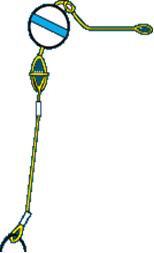
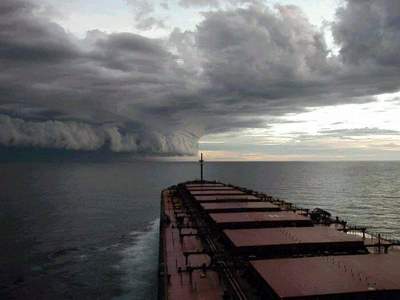
The principle of mooring, “fixing a yacht to a mooring buoy”, is pretty easy: A rope with a loop sticks out of a floating ball. The rope is connected to a chain anchored onto the sea bottom. The skipper approaches the mooring buoy against the wind while someone stands on the bow (the front end of a ship), to grab the loop with a boat hook (a long stick with a plastic hook on it). A rope is pulled through the looped mooring line, and both ends are fixed onto the bow of the ship.
All in all, if well prepared and executed, it takes two minutes to moor a yacht. If well prepared and executed….

There is a secret, sarcastic joy to be found in sitting on deck of your ship at sunset, with a drink in your hand, and looking, judging how well the others are doing, mooring their ship…
When you are on the other side, and you are the one arriving late at an anchorage, you know a lot of more people are watching and judging you. That is the point where the most inexperienced skippers get really nervous: the point where a lot of shouting goes on between the guy at the helm (steering the ship), and the poor person (often his wife), trying to grab the mooring line.

Anageda

Two years ago, we were moored at Anegada in the British Virgin Islands, and watched some Americans (I am sorry, but in the Caribbean, American bareboat charterers are amongst the worst sailors!) approaching a mooring buoy.
It was almost a recipe for disaster: the ship approached the buoy with the wind in their back, a definite no-no in the “yachting for dummies”-course: even if the skipper halts the ship close by the mooring buoy, the wind will push them past the buoy… So we already smelled some trouble, especially as they had three people on the ship’s bow. Tine and I looked at eachother: “Novices!”..

Sure enough, the boat approached too fast. One of the guys hooked the mooring buoy, but the wind pushed the boat forward. The guy who held the boat hook, the long stick with a hook at the end, tried to pull as hard as he could to lift the mooring loop.. Of course, the ship, a good 30 tons of dead weight, moving at 5 mph, would not stop, the wind pushing it gently forward. The only thing the poor chap could do, was, with the hook in his hand, and the mooring buoy at the end of the hook, walk alongside the ship, towards the stern (the back of the ship).

Loads of shouting, and orders flying around… Unfortunately, the guy reached the stern in no time, still pulling onto the boathook like there was no tomorrow, but standing at eh very back tip of the boat, he decided to let go of the mooring ball. Unfortunately, the boathook did not unhook from the mooring ball, and fell into the water.

Loads of cursing of the captain made the guy decide “Oh shit, now I’d better get the boathook!”, so he jumped into the water, to get the boat hook. “Cool stuff”, I thought, “Not only did they miss the mooring buoy, had a boat hook in the water, but they have a man overboard too!”.

It only got better. With one of the crew in the water, the skipper panicked and turned the boat sharply to starboard, forgetting he was still going downwind, in a real busy and crowded anchorage. The boat turned right in front of another moored yacht, so its keel grabbed the mooring line of the second ship. I saw the boat jerking to a sudden halt, pulling on the second ship’s mooring line. Now the ship was dead in the water, the wind pushed the yacht against the second one, and all the crew was ordered to hold off the ship with their bare hands. There they were: all hands on deck holding off a ship pushed by the wind against another boat, one crew in the water, and a captain frantically trying to rev up the engine to get the keel untangled.

To make a long story short, it took them at least half an hour to unhook their keel, by which time, the guy in the water – with the boat hook – got onto the ship.

They went off, with red cheeks, to anchor somewhere far away from all the other yachts. They did not even come on land for dinner, probably avoiding the snickering from the crew of the other yachts who witnessed the whole endeavour.


More about sailing on The Road.

Drawing mooring buoy courtesy RYA

Read the full post...

Rumble: My sailing history

Those of you who have been following this blog for a while, know I sail.

I always wanted to sail, but never found the incentive to really get started.

In 2003, during the Iraq crisis, I was based in Dubai. Work was madness, and we put in very long hours, from 8 am until 11-12 pm every day. We all needed some physical exercise, and discovered several of us were interested in sailing.

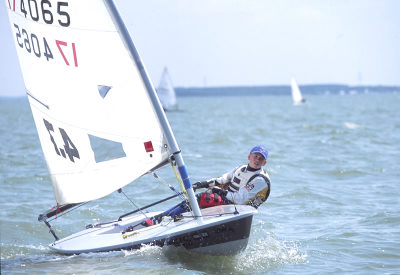
So we took up Laser sailing in Dubai. Lasers are small skiffs, sailed single handed, but ideal to learn how to sail. We took classes with Simon, a young aggressive instructor, who gave us one Laser each. We had an hour of theory and off we went. Lasers are tricky. You don't bend forward fast enough when jibing or tacking, and boingggg.. there comes the boom against your head. You don't trim the sails well, and upside down you go. We competed amongst each other from the moment we rigged up the sails until, eight hours later, we crawled into the bar for a sunset drink. Bruised up, full of scratches, but happy. We found a new hobby!

laser sailing

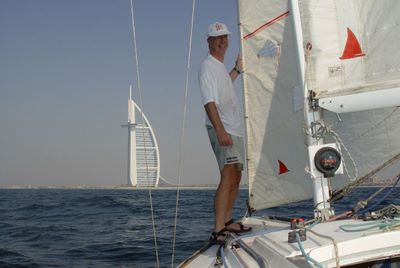
We sailed for one day per week, for several years. Gradually we also took up sailing larger skiffs, Hobiecats and sometimes rented a 25ft day day-yacht:

sailing in dubai

I told Tine, I would like to take the family on a cruising holiday, on a real yacht. She categorically refused to step on a boat with me, until I had the proper certification. Wise decision, it proved afterwards...! I took all RYA courses up to yachtmaster (theory and practical), and even took the powerboat instructors' license. I learned how to navigate, how to plan a trip, manage a boat and crew, give instructions, moor a boat. I learned about first aid, man-over-board procedures, and harbour maneuvers.
Only then, we went yachting with the family. First with a 36 ft in Greece, back in 2004:

greece sailing

The next summer, we sailed on a 36ft for four weeks from Martinique to the Grenadines (See short story). The summer after that, we went for 3 weeks in the British Virgin Islands on a 39 ft.
During my sabbatical, I sailed as crew on a 57 ft from the UK to the Canaries and across the Atlantic, up to the BVI (see these short stories). The same year, we went sailing with the family around St.Martin, on a 36 ft. (See this post)

This year, we will rent this baby, in the Seychelles:

443

She is a Moorings 44.3, a 44 ft monohull, with three cabins, each with a head and shower (something I don't like. The more heads, the more trouble, but...) Overall length of 44ft, beam (width) of 14.5 ft and a draft of 6 ft.
Her engine is 56 HP, and she has tanks for 53 Gal of fuel and 140 Gal of fresh water. She has 880 Sq Ft sailing area and displaces almost 10 tons.

The biggest challenge is that Tine and the kids don't really sail. I mean the kids know how to sail a skiff, but not a yacht. Tine can help maneuvering a boat in a harbour, and help putting the boat into the wind when I need to raise or drop the sails, but most of the sailing, I do single-handedly.
This summer, this is the biggest boat I have sailed single-handed so far. So Tine is a little apprehensive... But we will do ok!


More posts on The Road about sailing

Picture Laser courtesy lasersailing.com. Picture 44.3 courtesy moorings.com

Read the full post...

Doing Good to Others

We reef the sails, as we see the clouds gathering. While we are still sailing in the sun, the darkness packs at the horizon. That is how it goes in the Caribbean this time of the year: sunshine one moment, rain the next. Under the threatening clouds hurrying towards us, we see the white foam on the waves. The wind will pick up soon. We are sailing to Petit St Vincent in the Grenadines. Everyone calls it “PSV”, for short. An island barely one mile in diameter, covered with palm trees and bush. It is not far anymore, maybe another half an hour of sailing. But we don’t not make it in time. The rain catches up with us, and before we know it, we are engulfed in a dense curtain of water gushing down. I studied the pilot book this morning, and know how the anchorage looks like, by heart. The GPS guides me towards the entrance between the coral heads and the beach.

As we steer into the anchorage, we put the kids below deck, drop the sails, and start the engine. Tine goes to the bow, ready to drop anchor. I steer the boat right in-between the other anchored ships. The rain gushes down. Visibility is only ten meters, sometimes even less. We loose sight of the other boats. Even though we motor slowly, sometimes an anchored boat pops up through the curtain of rain, out of no-where it seems, when it is almost too late to avoid a collision. The wind is strong and gusty, shifting often 90 degrees. A sailboat, and certainly one like ours with a short keel, and very beamy – flat wide bottomed – gets easily pushed around by the wind. Once the boat starts turning with the wind, there is no way to stop the momentum. Then you just HAVE to turn.. It makes it difficult to maneuver between anchored boats, all swinging on their anchor chains, in the stormy wind… But we do well, find a proper spot, and drop the anchor in one go. Phew!

It storms and rains the whole night, but the next morning is bright and sunny, revealing the small paradise we are anchored in. Hardly any clouds left. The sea is clear light green-blue, several fishing terns are gliding high up in the sky, without moving their wings. A soft breeze moves through the leaves of the palm trees bordering the beech of bright white sand. Paradise once more.

In the afternoon, while having brunch on the deck of the boat, we spot two young local fishermen in the water, dragging what seems to be a white surf board. I get a bit suspicious as it does not look like they are having fun, rowing wildly with their arms, barely keeping their head above water. Through the binoculars I can see a black thing on their surf board. Maybe a large plastic bag or a net. As a rain squall comes closer, they seem the more anxious to get ashore. It is all a bit weird: what are they doing in a channel between two islands, on a surfboard? I take our dinghy, and motor to them, only to find that there is no surfboard, but they were dragging a small white wooden boat filled to the rim with water. The black thing I saw earlier is an outboard engine they had unscrewed and put inside the boat. “Mista, you help us, mista?”, they ask. I throw them a rope and tow them ashore. They drag their boat onto the beach, crawl onto the sand, and lay on their back, exhausted. Barely waving their hands to thank me.

When I get back to our sail boat, Hannah, our youngest, stands on the bow of our ship, shouting and dancing “My dad is a superhero! Superdad in action! My dad can do anything!..” Lana gives me a hug. “Dad, I am proud of you. The people on the other boats were just watching, but you DID something… Did you those guys give you anything to thank you?” I tell them when we do good to others, somewhere we will be rewarded by something good ourselves..
In the afternoon, when we scuba dive, and find some astonishingly beautiful cone shelves, Lana says “You see, we are rewarded now. We did something good, and now we are rewarded with these beautiful shelves. We will take them with us, and put flowers in them. As a reminder to do good to others!”.

I guess my kids learned a lesson that day.


Continue reading The Road to the Horizon's Ebook, jump to the Reader's Digest of The Road.

Read the full post...
Rumble: End of the Fairy Tale

Well, after St.Kitts, we started heading back. First to St.Barths for two days again (a nice 45 miles sail, with the wind 60 degrees off the bow), followed by a 15 miles broad reach back to Oyster Bay - St.Martin, to return the chartered sailboat.

If you want some kind of challenge in your life, try entering Oyster Bay in a 30 knots wind with a 4 meter swell, and with the main sail up (just in case the engine fails). First of all, even as you enter, you see nothing but huge white foamed waves crashing on the reef, just in front of the marina's entrance.... You have to zigzag between two reefs, blindly following one green and three red marker buoys then sail through a narrow entrance, and drop the main sail in some free space - the size of a handkerchief - in the port...
Anyway, it was fun.

As we are closing this series of holiday posts, here are some last pictures:

Hannah on Road Bay's beach (Anguilla)

The girls on Sandy Island (Anguilla)

View from the breakfast table (Statia)

Read the full post...

Rumble: St.Kitts

St.Kitts and the neighbouring island of Nevis are an independent state since 1983. Their history is somewhat typical for a Caribbean island. They were discovered in 1493 by Columbus, and named Saint Christopher (still the official name for St.Kitts), but only settled in 1623 by the English. The French who landed a few years later, hooked up with the English to massacre the resident Carib Indians, and St.Kitts was divided between the two (then) super powers. Of course they did not manage to co-exist for long, so there were frequent squabbles, culminating in a one month siege of the impressive English fort at Brimstone Hill. Eventually the Treaty of Paris, signed in 1783, returned St.Kitts to the British.
Good for them as both St.Kitts and Nevis have fertile slow-sloping volcanic planes, which made the sugar plantations to most profitable in the region. On top of that, Nevis got known for its natural spas.
Both islands became an independent state in 1983, originally including Anguilla into the federation. The latter was not too happy, and kicked the butts of the the St.Kitts policemen stationed on their island, until they fled, followed by a mock attack on St.Kitts by the handful Anguillan men on a small vessel. Rumour said they were all drunk. The Anguillans continued to make so much trouble that the British finally got fed up and invaded Anguilla in big force, only to be greeted by a few grazing goats and elderly people raising their glass of rum to them: that is what the Anguillans wanted, to be back under British control. Ha, what a joke. And this was not during Middle Ages, this is 1960's. we're talking about!
Back to St.Kitts: Volcanic, so not much in terms of white beaches, but loads and loads of fertile land, so the island is very dense green, with forest and sugarcane. The government owned and controlled all the sugarcane plantations, until 1995, when it was determined market prices would never make sugarcane profitable (again). Since then, the sugarcane has not been harvested, and grows wild amongst dozens of plantation ruins, which make very interesting sights by themselves. Gradually pieces of land are donated to residents for agriculture, but as we drove around the island, still, on most of the "cultivated" land, you see sugarcane. Ten year old sugarcane.
It is a lovely island. Rather poor, but clean, well maintained. A bit of tourism with a few massive (American) resorts (Four Seasons and Marriott, if I remember well), and cruise ship facilities. But tourism is still being developed. The towns still have much of their former shapes and houses, and not too much of the modern malls and cheap mass tourism facilities have creeped in. Oh, there is a well known fish restaurant on the outskirts of Basseterre, the capital, called the Fishman's Warf. To be avoided. The lemon daiquiris were terrible, the fish was grilled dry, and the crab was simply off. The latter smelled like pure ammonium. When I returned it to the kitchen, even the cook could not stand smelling it for more than a few seconds...

Oh, oh, and before I forget it: there is a lovely and relative new small marina in Basseterre, the only decent shelter for storms amongst the island chain of Saba, Statia, St.Kitts, Nevis and Montserrat. Recommended! I hope they can maintain it in high standards as it is an asset for the region.

Oh, oh, oh, and you might have to run around a bit in the port to find the immigration and customs dudes.. The former, we never found, and after three days, we left, without even having officially 'entered' the country...

Read the full post...
Rumble: Statia

We had a lovely 35 miles sail from St.Barts to St.Eustatius (or Statia for short), in a broad reach, averaging 7 to 8 knots in a 25 knot wind.

The Dutch settlers arrived here in 1636 and set up sugar and tobacco plantations, but it was the trade which made the island flourish in the eighteenth century. At that time, over 3,500 ships would visit Statia every year, trading in anything the world traded in, then. Slaves, gold, silk, embroideries, weapons, you name it. For a while it was the commercial center of the Caribbean. Even nations at war would trade with eachother here, with one selling to the Statian traders and the enemy buying from the Statians.
By mistake, Statia was the first ever to give an official canon salute to a rebel American ship in 1776, thus indirectly recognizing the United States as a souvereign state. The English were not amused and it is said this salute to an American ship contributed to the English-Dutch war, during which Admiral Rodney occupied and plundered the island. An amusing anecdote was that he could not find much gold, but observed the Dutch-Jewish settlers sure held a lot of funerals. On Rodney's orders, one of the coffins was opened and they found it was full of gold and valuables: the settlers were burying their valuables. Rodney confiscated all of the treasures on his personal account, and was almost court-martialed for this theft, were it not that at that time, he won a sea battle near Les Saintes, off Guadeloupe. And he was pardoned for his theft.
When he exiled the Jewish settlers to neighbouring St.Kitts, he got suspicous again and had the coats of the prisoners examined. Once again, he found their coats were stuffed with gold...

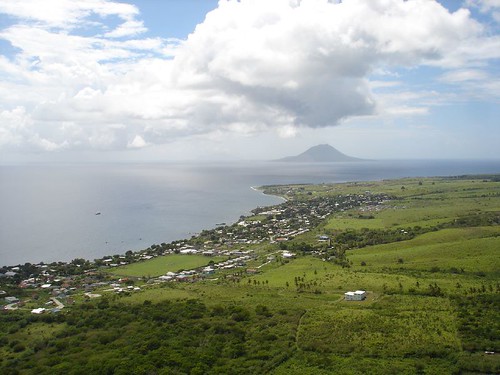
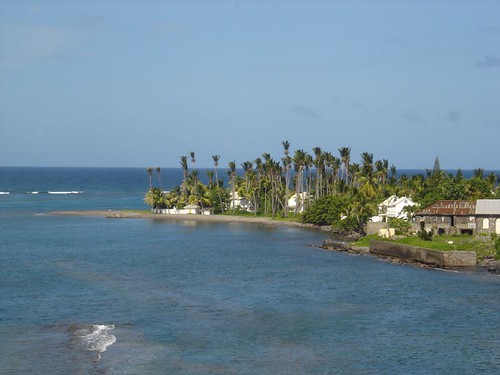
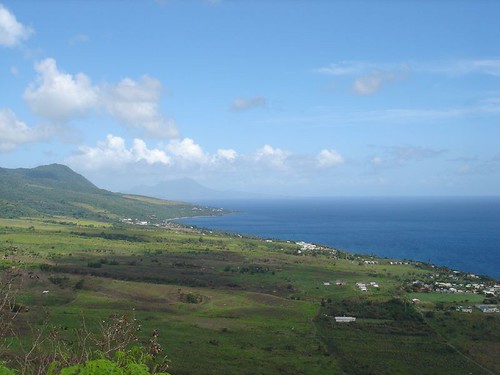
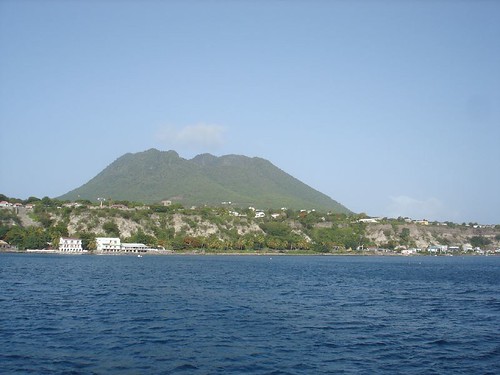
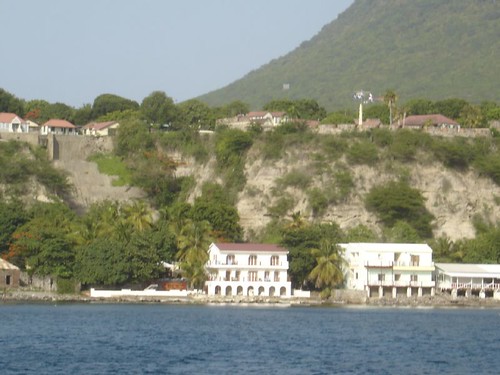
There is only one main village on Statia: Oranjestad, whose lower town used to be the main trading post of the Caribbean, before it eroded and was washed away by hurricanes. In the pictures, you clearly see the dominant volcano, Upper Oranjestad and the lower town, below the cliff. Some walls of the old town can still be seen underwater, just 20-30 meters from the shore, making it an excellent diving and snorkeling area.

Statia is off the beaten track for the tourists. Most come here for the diving, but for the rest, there is not much to do. It is a very laid back island. Very, very laid back. The first evening we were here, we asked which fresh fish they had, and the answer was: "None. All is frozen". We did not think much of it, until the next evening, we asked for fresh fish in another restaurant. Once again, the answer was: "None, all frozen". "But how come", we asked, "there is plenty of fish in the ocean here?". The expat waiter sighed and asked "How long have you been on the island, sir?". "Two days". "And in those two days, have you seen any of the fishermen on the water?", the waiter asked. "No", we said. "Right", was the answer, "To fish means to work. There is a saying here: 'If you see someone working in Statia, he ain't from here'. So rather than fishing, the people here prefer to import their fish frozen from St.Martin.". Go figure.

And somewhere this attitude reflected on the island as a whole. In a positive way: there is no crime, people just go about their business, they are friendly (the more for us, as we speak Dutch!). But also in a negative way: What could have been made into a nice marina, the harbour was just a pile of rocks and a short pier for the tugboats working on the oil tankers. Once you step off the pier, you see rubbish and junk everywhere. People said plastic bags are the island's state flower, as you used to see them flying off the trees everywhere. Once again, a pity.. An island paradise with a lot of junk. Still you could see some beautiful houses. In the end, every island in the Caribbean has its own charm.

Read the full post...
.
  © Blogger template The Business Templates by Ourblogtemplates.com 2008

Back to TOP