Warning! Swine Flu flu prevention leaves white spot on your face

Picture courtesy of my colleague aidworker Paul, blogging at Head Down, Eyes Open. Even though Paul was much more serious about H1N1 in his post. (Sorry Paul...!) Read the full post...

In the time 31 people died of H1N1 (swineflu), 60,000 died of tuberculosis. Reason enough for Prof. Hans Rosling to prove his "news hype"-point by calculating the ratio of news article coverage versus H1N1 casualties.
More on the swineflu hype on The Road.
Video discovered via Infosthetics and @aidworkerdaily on Twitter
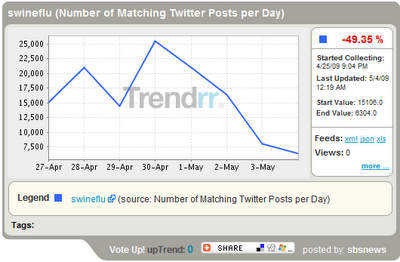
It seems the number of Tweets about swineflu has considerably dropped over the past days. [sarcastic] Until further notice, I guess we will call the swineflu emergency as "over"!
I will update the latest updates still for a another week.
Source: Trendrr on swine flu, with thanks to AidWorker Daily for the tip.

In a previous post, I compared the amount of swine flu (or Influenza A(H1N1) as WHO has decided to call it) and a regular flu. In short, every year, seasonal flu kills 36,000 people in the US. Influenza A(H1N1) has killed 17 people up to the moment I write this (May 2 16:00 GMT).
Seeing the media hype, the traffic peak on social media like Twitter, I had to find out more. Was the fear rounded on real facts or creative inventions? Was it really only a media hype, a blib on the screen of international attention. A bright star or news focus, to faint as soon as another mediaworthy event took place. Like Russian troops deciding to make another weekend trip to an ex-USSR satellite state, the US closing all tax-heavens, Obama making his first trip abroad or the Pope appearing in public with a condom over his head.
So.. Swine Flu (Influenza A(H1N1) -sorry): "Hype or Threat? That Is the Question!"
I googled it, scanned many different news sources, dug into the CDC and WHO sites, and asked colleagues who are 'in the know'.. Information was hard to find, which is a sign by itself. If swine flu was that deadly, details of the actual threat would be all over the media. And they were not. [Hype: 1 - Threat: 0]
Sure, it spreads fast (any flu does), it kills people (any flu does), it transmitted from pigs onto humans (which is not the first time), and WHO raised its pandemic threat levels (not the first time neither).. So what made it exceptional? What other facts can fuel the fear?
Yesterday morning, I was on a bus between the boarding gate and the plane, flying to Belgium for the weekend, and saw a few pages of a newspaper someone had left behind, the business pages from the Daily Telegraph apparently. And there it was: the best summary I could find on the actual threat of swine flu. (which apparently can also be found in Breaking Views)
Swine flu is still an unknown adversary, there's no knowing how it will behave.Robert Cyran
Swine flu has come to stay, but it is unclear how our unwelcome guest will behave. We don't know how dangerous it is or will become, because the virus will mutate. We will simply have to wait and see. In the meantime, it would be wise to brace for multiple waves of market panic in the run-up to the flu season.
The virus has been easily transmitted. The fact that it is occurring in the spring is also unusual - flu epidemics almost always occur in the winter.
The key question is how virulent the flu could be. In Mexico, the virus has displayed an alarming tendency to kill young and healthy patients, most likely from an overreaction by the immune system. Scarily, this is not all that different from the way the 1918 Spanish flu kicked off, eventually killing tens of millions. Cases in the US haven't displayed a similar pattern. It's simply too early to say how dangerous the disease is.
While a new strain of flu is horrible news, there are several reasons to be hopeful. Antiviral medication still works, although that could change as the virus mutates. Unlike 1918, we now have antibiotics to help fight the secondary infections. And, unlike avian flu, there probably aren't inherent problems with vaccine production.
Still, there's plenty to worry about. Swine flu will mutate over the summer, because flu viruses make lots of errors when they copy themselves. And people and animals will also come down with two forms of flu at once, allowing the viruses to swap some genetic material. This could make the virus more deadly and render vaccines made over the summer ineffective by winter. Alternatively the virus could mutate into a perfectly innocuous bug.
The only thing that is clear is that bits of information will surface piecemeal. Some will be true, some false. All will be subject to misinterpretation. Few things are more contagious than rumours and panic on Wall Street.

More on The Road about Swineflu
Picture courtesy Flightstory Aviation Blog
Updated Dec 31, 2009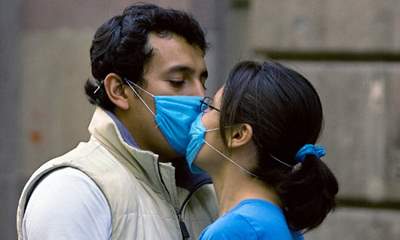
According to CDC (the US Centres for Disease Control and Prevention):
Each flu season is unique, but it is estimated that, on average, approximately 5% to 20% of U.S. residents get the flu, and more than 200,000 persons are hospitalized for flu-related complications each year. About 36,000 Americans die on average per year from the complications of flu. (Full)
It is worth remembering that seasonal flu often poses a serious threat to public health: each year it kills 250,000 - 500,000 around the world. (Full)
As of 27 December 2009, worldwide more than 208 countries and overseas territories or communities have reported laboratory confirmed cases of pandemic influenza H1N1 2009, including at least 12,220 deaths. (Full)
An average of 195,000 people in the USA died due to potentially preventable, in-hospital medical errors in each of the years 2000, 2001 and 2002, according to a study of 37 million patient records released in 2004. (Full)
Updated October 17 2009:
Since I started collecting these maps in April, several are discontinued. It seems the most up to date maps on A(H1N1) are source 3, 6 and 7...
Source 1:
View 2009 swine Flu (H1N1) Outbreak Map in a larger map
Black: Confirmed death
Black with "?": Unconfirmed Death
Red: Confirmed infection
Red with "?": Probable infection
Green: Influenza-like illness
Purple: Suspected case
Source 2:
It Ushahidi is now tracking swineflu.
Update: this map is discontinued
Source 3:
Healthmap is also tracking.
Update: seems to be one of the most up to date maps
Source 4:
The mainstream media are catching on: BBC..
Update: BBC's map is discontinued
Source 5:
WHO's A(H1N1) page mapped with the outbreak timeline also.
Update: This map is was discontinued end May.. :(
Source 6:
You can also try this flu tracker
Update: seems to be one of the most up to date maps
Source 7:
Here are the maps by AirDB
Source 8:
And of course, there are the Wikipedia pages on A(H1N1), though for the latest confirmed figures, I would still refer to the WHO epidemy pages I discused in this post.
Which reminds me... you need to put everything into perspective: how many people die of flu every year, and how many died of swine flu?
Discovered via LifeHacker, UNDispatch and Aid Worker Daily

 Peter. Flemish, European, aid worker, expeditioner, sailor, traveller, husband, father, friend, nutcase. Not necessarily in that order. Peter. Flemish, European, aid worker, expeditioner, sailor, traveller, husband, father, friend, nutcase. Not necessarily in that order. |


© Blogger template The Business Templates by Ourblogtemplates.com 2008
Back to TOP




The Road's Dashboard
Log in
New
Edit
Customize
Dashboard