Shell in Nigeria.
Discovered via Platform London

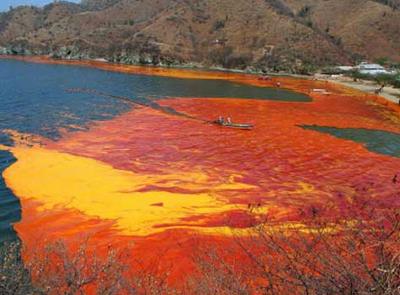
Vogue Italy's August edition frontcovers models in the midst of an oil spill. A shoot by Stephen Meisel, a photographer now infamous for his fashion shoot amongst soldiers in Iraq back in 2007.
In case you are interested:
Kristen McMenamy (...) keeps her skin golden thanks to Self Tan Face Bronzing Gel Tint (to wear alone or with foundation): it takes care of the skin, while giving it a hint of color. Carbon, anthracite, and all of the earthy shades "dress" her eyes: Quick Eyes Cream Shadow, cocoa shimmer, a long-lasting cream eye shadow, worn with brown High Impact Mascara, and her lips feature a nude look. All by Clinique. Tulle dress with beaded embroidery, Ralph Lauren Collection. Rubber necklace, My Sister's Art. Hair by Orlando Pita for Orlo Salon. Make-up Pat McGrath. Fashion editor Karl Templer. Set design by Mary Howard.

Back in 1962, we thought this was good publicity...
Discovered via Boing Boing


A Brown Pelican sits in heavy oil on the beach at East Grand Terre Island along the Louisiana coast.
Picture courtesy Periodismo Humano, AP Photo/Charlie Riedel. Discovered via The Horizon

"Delicate patterns in the sea breaking on Orange Beach, Alabama".
More than 90 miles from the BP oil spill. (Hires)
Check the latest articles on the Gulf Oil Spill (or read the latest via RSS)
Picture courtesy Guardian UK, Dave Martin/AP. Discovered via @mparent77772 and The Horizon.
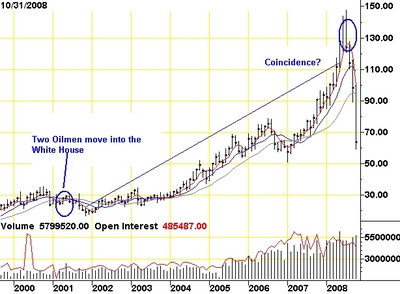
Fact: Oil prices have crashed from about $150 to $50 a barrel in the past months. (Source)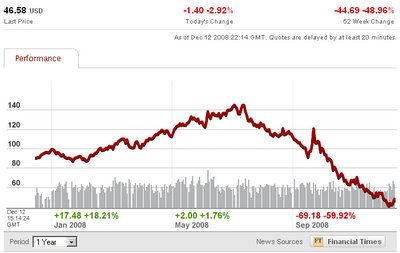
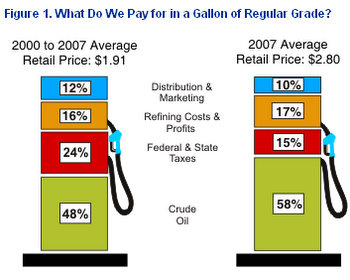
Fact: The price of crude accounts for about 58% of the price of fuel at the pump (Source)
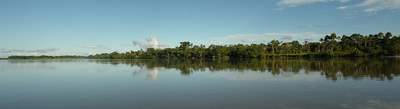
There is more biological diversity in Ecuador's Yasuni rainforest than almost anywhere else in the world. No surprise it is protected as a national park and UNESCO biosphere reserve.
But the Yasuni region also sits atop Ecuador's largest known oil reserve, several hundred million barrels. Oil is the country's most important export. Without petrodollars and petro-jobs the country would likely be even poorer than it already is. No wonder several oil companies are pressuring the government to issue drilling licenses.
Hoping to prevent this from happening, Ecuador's environment minister requests for compensation to keep the oil under the forest, under the form of "CO2" or carbon credits.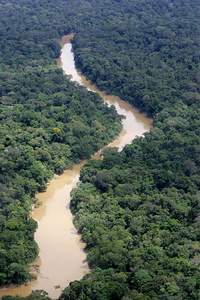 Carbon credits are a way companies and countries have been stimulated to initiate environment friendly initiatives trying to cap global CO2 emissions.
If a country or company pollutes, it needs to ensure it holds an equal amount of "environment credits". CO2 credits can be bought on the international market from companies or countries who 'produce' environmental improvements, e.g. planting a forest.
But no country or company received carbon credits yet, for... "not doing anything" i.e. for keeping "nature untouched". And that's what Ecuador's critics are now claiming: "How can one be paid for not touching nature?"
What then if companies start asking money for not drilling oil in the Northsea, in Kuwait's desert. How about if any country with a tree asks for money not to chop that tree. Or worse, how about any country would ask credits for not starting a lucrative but polluting project?
Ecuador might also venture in more innovative solutions, which probably look more feasible. Projects such as offering a "virtual" carbon credit on the Internet, for anyone to buy. So maybe next month, you can buy your kids a piece of virtual untouched Ecuadorian rainforest. (Full)
More on The Road about environment and pollution.
Picture courtesy AFP
April 8, 2007.
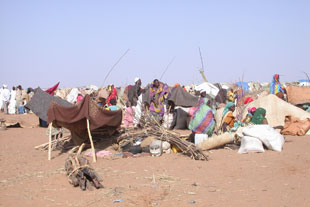 1. Darfur According to the Chinese State Media: "Stable and Natural"
  When last year, the UN Security Council is debated a US draft resolution on the Sudan crisis, based on colliding views whether a genocide is or is not happening in Darfur, the issue of Sudan's oil is became a key factor. If an oil export embargo was approved, China and India would have lost their influence over Sudan's vast oil reserves and a Khartoum regime change would open up these resources to the West. The US is in favour of sanctions (hey I wonder why!), China is against (surprise!).
4. So.. What is the conclusion?
So, what should we conclude? The US has Iraq, China has its Darfur for main oil supplies and everyone should be happy? Or should the conclusion be that if we would use more alternative energy sources, the world would be a better place, not only for the environment, but also for the refugees, terrorism and civil unrest? One thing is for sure: the situation in Darfur is "NOT stable and natural" as the Chinese and Sudanese media reported today... Unless if we all accept an ongoing genocide is "stable", because it has been ongoing since so long, and "natural" as... well... as it is in Africa of course... That's where people kill each other naturally, no?

 Peter. Flemish, European, aid worker, expeditioner, sailor, traveller, husband, father, friend, nutcase. Not necessarily in that order. Peter. Flemish, European, aid worker, expeditioner, sailor, traveller, husband, father, friend, nutcase. Not necessarily in that order. |


© Blogger template The Business Templates by Ourblogtemplates.com 2008
Back to TOP



The Road's Dashboard
Log in
New
Edit
Customize
Dashboard