Showing posts with label South Sudan. Show all posts

So why did the West push for South Sudan's independence?


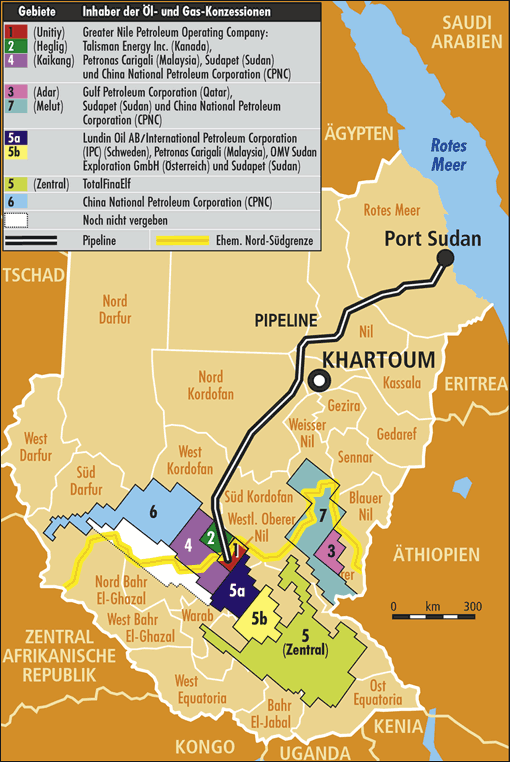
75% of the oil reserve in Sudan, perhaps 6.5 billion barrels, is located in South Sudan (Source).

Since the "second" Sudan war between the North and South started in 1983, an estimated 2 million civilians were killed, and at least 4 million were displaced at least once.

During the war, aid agencies set up one of the largest, most costly and complex humanitarian relief operations ever, "Operation Lifeline Sudan", running a "relief pipeline" from Kenya (and partially Uganda) into the South. An operation which was often criticised as "fueling the conflict".

True or not, I guess "Operation Bulletline Sudan" fueled the conflict much more: While Russia -mostly through proxies- and China -mostly thru "oil-for-bullets" deals- made good business of arms deals with the North, the "West" kept "an extensive arms pipeline" running to the South during the whole conflict.
For years, the world kept their eyes closed, as business was good: selling weapons dearly, and getting cheap oil, I mean, what more can one wish?

This US arms supply to the South continues to run up to this very day, mostly through Kenya, one of the strongest US proxies in the region. Meanwhile, Russia and China continue to supply Khartoum. What will this lead to? An expanded conflict border zone where North and South Sudan dispute oil fields.

Aren't we lucky there is an embargo for selling arms to Sudan?

PS: this map might indicate the oilfields more clearly (Tnx @MFB)

Read the full post...

The LRA: unresolved questions

LRA child soldiers

Lord's Resistance Army (LRA) was founded back in 1987 as an armed opposition against the Ugandan government. At that time they based themselves in South Sudan, but operated mainly in Uganda.

They became mostly known through their numerous abuses and atrocities against civilians, including the abduction, rape, maiming, and killing of defenseless people. They regularly kidnap children to enslave them as child prostitutes and soldiers in there so-called "army".

Since they were pushed out of North Uganda in 2005, the LRA has been terrorizing civilians in the DRC (Democratic Republic of Congo), South Sudan and Uganda, hopping over the borders.

In February this year, the Ugandan army - apparently aided by the US - tried to root out the LRA from DRC. The LRA retreated, killing 900 civilians in the process (Full)

Even just a few days ago, the LRA kidnapped around 135 villagers, including children, during two attacks in DRC's North East. (Full)

I invite you to look at this excellent video, one of the very few interviews ever made with Kony, the LRA's leader.
It stroke me how the LRA seems to be mostly a loosely knit group of bandits, clearly with a wide network of informants, held together by the Thuraya telephone network. There is no clear goal nor ideology behind the LRA. When Kony was asked "why are you fighting?", he answered "for democracy", but it did not go any deeper than that.

Add to these impressions that their overall troop strength is estimated anywhere between 500 and 3,000 soldiers (half of them estimated to be women and children), I am left with only two, but fundamental questions:
  1. How come nobody has been able to smoke out this gang of bandits (wanted by the ICC - International Criminal Court by the way)? In this day and age where technology exists and is routinely used to track the movement of people using satellite phones? Why is there an apparent unwillingness of the international community to make an end to these atrocities, which, to top it all up, continue to contribute to the instability in Eastern Congo, one of the longest lasting conflicts in Africa?

  2. Who supports these rebels? They would not be able to operate without the financial and logistics backing of an entity. What entity? Who would contribute to an instable South Sudan, Uganda and DRC? Khartoum?
Picture courtesy Jacob Gelt Dekker

Read the full post...

Marriage, the Sudan way.

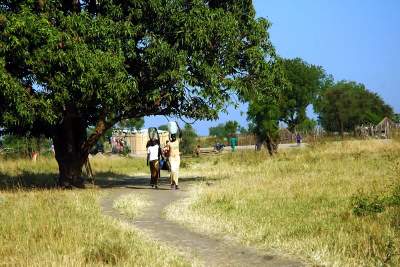
Ladies in Bor South Sudan

Another story by Enrico, a fellow aidworker in South Sudan, who wrote several short stories on The Road.

Late evening, I step out of our compound with a Ugandan colleague for a last (walking) meeting, when we're approached by a man wearing an military uniform, visibly eager to chat with a Kawagia ("white man" in the local language).

Despite their past bellicose nature, the locals here in Jonglei, South Sudan are usually friendly and discrete. After the usual how-are-you question, he uncommonly ventures a bit further by inquiring for my name and my nationality, and abruptly asks:
- “What’s marriage like in Europe?”
- “I beg your pardon?”, I say doubtfully.
- “I mean, do you pay the brides by cow or by cash?”, he specifies.
- “Well, neither of the two.”, I respond casually to hide my amusement
- “So what’s the advantage for the owner of the girl then?”, he replies with a big smile and looks at me as if I’m coming from outer space. He chuckles and as he walks away he turns to my colleague and says:
- “Hey, black brother, you’d better tell your friend how it works!” still smiling and mulling over the funniest thing that ever happened to him.

Picture courtesy Ulrik Pedersen

Read the full post...

Excuses...

Bor South Sudan

Enrico, a fellow aidworker in South Sudan, wrote several short stories on The Road.

He just told me this story:

I was waiting for a convoy to come back from Panyagor to Bor town, the capital city of Jonglei State in South Sudan. The convoy comprising of two 4x4 Landcruisers arrived at the compound. One of the vehicles was badly damaged.
I approached one of the drivers and asked him how the journey was.
- “Very bad”, the driver replied.
- “What happened?”, I asked.
- “A python capsized my vehicle”, the driver continued in half English.
- “How big could it have been?”
- “Very big, indeed”, he concluded and entered his tent.

In French, they say "Les excuses sont faits pour s'en servir"... If you want to find an excuse for something, you can always find one.

Picture courtesy Ulrik Pedersen

Read the full post...

Worrying events...

swat valley refugees

There is always something going on, somewhere in the world, that keeps us, aidworkers, busy. Here is what is on our mind these days:

  • 8,000 Somalis are displaced in one day of fighting around Mogadishu (Full)
  • A rebellion seems to be on the raise in Nigeria (Full) and Niger (Full)
  • Relief agencies still don't have full access to the displaced civilians after the Tamil was defeated in Sri Lanka. (Full)
  • Southern Sudan seems to fall back into violence (Full)
  • ...while in Darfur, the war is flaring up again (Full)
  • Pakistan's offensive in the Swat valley displaced 2.3 million people, with aid agencies scrambling to cope. (Full)
Items discovered via International Aid Workers Today and AidNews.

Picture courtesy Reuters

Read the full post...

As I am leaving Sudan.

bor south sudan

In the past, I published several stories written by Cyprien, one of my friends and colleagues.

Cyprien is originally from DRC but worked with us, based in Kosovo, Pakistan, Afghanistan, Mozambique, Senegal and Sudan. He is about to be reassigned to the Somalia operation and wrote this story reflecting on his time in Sudan. It is both a tribute and an emotional good-bye to a country he got to love during the past years.

As far back as primary school, I heard about Sudan. I do not remember very well in what context, but I am sure it was during our geography courses. Later I learnt more about Sudan over the news. I remember the days when every evening my father used to call me to sit with him and listen to the radio.
Almost, everyday there was news about Sudan then, just as there is today. I can't remember what it was all about, but I remember that the name John Garang was mentioned often.
As I grew up, my interest to Sudan became even greater as I realized that this country was one of our neighbors.

In 2005, when I got an assignment with the UN in Senegal, I hired a driver. During the interview, I requested his papers to learn more about him. In the paper he gave me I could read : " Ethnie (Ethnic group): Soudanais (Sudanese)".
I asked him how come he was of Sudanese ethnic group. This man did not go to school at all, but he gave me a clear answer: "Sudanese is a nationality, but it is also a race, and a ethnic group that migrated from Sudan to the Senegalese coast. These are often the taller and darker people you see in Senegal."
From then on, when they spoke about Sudan, I kept in my mind the idea of a country, a race and ethnic group.

In 2006, there was extensive media coverage on Sudan (or may be it was my feeling), some people talked about something similar to a genocide happening in Sudan. I heard about the Janjaweed militia, about Darfur, about the "South Sudan" issues. I remembered the pictures showing the UN planes flying in the Sudan skies airlifting food aid assistance. I saw the pictures of people suffering, I saw a picture of a child abandoned by its parents, struggling to walk as a wild bird waited for the child to die so it can eat him.
I felt a call to assist. I decided to search for an opportunity to go to Sudan and bring my small contribution.

By February 2007, I joined the Sudan relief operation. As I landed in Khartoum, I could count the few number of trees per square kilometer on the fingers of my hands. The city was brown. Its layout and geometric design reminded me of Islamabad, in Pakistan, where I had lived before.
As I walked the street of Khartoum, I did not feel like I was in a country at war or where ethnic groups were fighting against each other. Khartoum is rather a city where I found Sudanese of all origins and color all leaving together, even though I noticed some jobs were done only by one "category" of Sudanese.

I proceeded to the South days later. I slept in a tent. The only luxury I had was my ventilator which blew fresh air but also new dust. And dusty it surely was in the months of February and March.

In the South, you could find signs of heavy fighting that took place in the recent years, but all was relatively calm and people felt proud to enjoy peace. I travelled across the country and I could see the sign of hopes everywhere. Roads bridges being built, schools opening, some times even under a tree. The WFP Humanitarian Air Service flights which used to be the only ones in the sky, were joined by the commercial flights.

Slowly tents shelters that were used as accommodation by hotels, UN and NGOs were replaced by prefabs, and later on by durable structures. This, to me, was a signal of the progress, and all of this brought me hope about the Sudan that I got to love.

On a bright Sunday of Easter 2008 I went to pray in a local church. The priest started preaching about how to preserve the peace dearly acquired. He linked the suffering of Christ to the suffering of the people of South Sudan. He went to explain how after the suffering, Jesus rose high and enjoys great times at the Right of the Holy Father and he linked it on how south Sudanese are now enjoy life after the sad days.
One thing is missing, he explained: "I have seen hotels and restaurants opening from Juba Bridge (the south side of Juba town) to Gudele (the north side), but I have not seen one kindergarten being built!". "Can we develop a country with hotels and restaurants only? We need to build educational institutions if we want to establish ourselves as a nation", he continued. "I would like those who are in charge of issuing licenses to stop issuing licenses to open new restaurants, bars, and clubs and promote business related to education", the priest concluded.
The audience stood-up and exploded in a huge applause, but it got me to think about the institutional progress in Sudan.

UN agencies, INGO and donors have done a great job in South Sudan, where I have witnessed changes happening at a very high speed. One should be proud and happy for having contributed in a way or another to this, but how much of this progress was durable, and not superficial?

My worries grew bigger over the past months, as I am about to leave Sudan for Somalia. The ICC decided to issue an arrest warrant for the President of Sudan. I will not get involved in mitigating the collateral damage this is likely to have on the peace and development in the South. Specialists have already commented on that.
I will not talk about what will happen to millions of people who were surviving on aid, including food and medical supplies, distributed by the expelled NGOs.

I also do not want to think how much the Sudanese work force will survive with their families in the new global economic recession. A Sudanese friend who runs a car workshop, told me yesterday, both hands in his pocket: "Juba fell into a recession. I need to lay off some of my technicians. There are no more customers coming in anymore since few weeks now." Anybody in South Sudan is feeling business slowed down.

Economic recession, the repercussions of the ICC indictment, the superficiality of the economic development... These are the thoughts I have when I leave Sudan after two years.

Picture courtesy Ulrik Pedersen

Read the full post...

More micro finance loans

susan edward

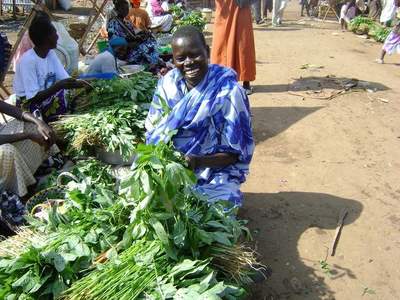
Susan Edward from Juba in Southern Sudan is 28 years old and married to a teacher. She has two children who are in school. Susan sells green vegetables at the market and is requesting a loan to open a shop.

We gave her a micro finance loan of $50.

This is one of the new loans we gave as part of $400 raised at the birthday party of my friend "E", who also wrote this short story on The Road.

"E" preferred not to receive gifts for her birthday, but asked for people to donate to our Change Starts Here project.

Ester was one of the people who stepped forward.

Thanks to Ester and "E", we financed these projects:
- Grace Elunai in Sudan: $50
- "Women in Need" group in Sierra Leone: $100
- Mimania Edward in Sudan: $50
- Susan Edward in Sudan: $50
- Rena Hasanova in Azerbayijan: $25
- Enero Women in Paraguay: $75
- Rubelyn Lumanta in Philippines: $50

Follow the progress of our project on our scorecard

With a big thanks again to Ester and "E"!

Read the full post...

Heading for trouble in Sudan

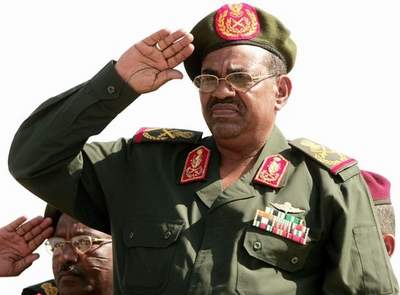
Sudan's Bashir soon to salute to the ICC?

Judges at the International Criminal Court have decided to issue an arrest warrant for President Omar Hassan al-Bashir of Sudan, brushing aside diplomatic requests to allow more time for peace negotiations in the conflict-riddled Darfur region of his country, according to court lawyers and diplomats.

It is the first time the court has sought the detention of a sitting head of state, and it could further complicate the tense, international debate over how to solve the crisis in Darfur.

Ever since international prosecutors began seeking an arrest warrant last year, opponents have pressed the United Nations Security Council to use its power to suspend the proceedings. But a majority of Council members have argued that the case should go forward, saying Mr. Bashir has not done enough to stop the bloodshed to deserve a reprieve.

Many African and Arab nations counter that issuing a warrant for Mr. Bashir’s arrest could backfire, diminishing Sudan’s willingness to compromise for the sake of peace. Others, including some United Nations officials, worry that a warrant could inspire reprisal attacks against civilians, aid groups or the thousands of international peacekeepers deployed there. (Full)

While Sudan still plays down reports on al-Bashir arrest decision for the moment, there was plenty of press in the past months where Sudan claimed indicting their president would risk bloodshed.

And then there is of course the statement of the UN envoy to Sudan saying Bashir's government warned the UN of "serious consequences" for its staff and facilities if the International Criminal Court issues an arrest warrant.
This resulted in the Sudanese government denying such threats (Full), and the UN denying it was to evacuate its staff in view of the upcoming arrest warrants (Full).

All politics and maneuvering... My predictions:
- Sudan will not surrender its president to the ICC
- UN and the powers-that-be will further pressure Sudan
- Masses will come onto the streets in all major cities, attacking UN and NGO facilities, causing the latter to seriously reduce staff.
- Darfur rebels and South Sudanese fractions will see a potential vacuum, and will renew military actions.
- ..causing the Sudanese military to respond more violently than before
- UN and NGOs evacuate
- ...giving either warring fractions enough space to do whatever they want in a free-for-all genocide.
- and by the time all of this is finished with a political compromise, Sudan will have one million people less. And the world will have one more genocide to justify.

But that is just me and my cynical mind, of course.

Picture courtesy AFP/Getty Images

Read the full post...

News: Five WFP drivers killed in Sudan

Food aid distributions in DarfurFive truck drivers delivering food for the U.N. World Food Program have been attacked and killed in Sudan over the past three weeks.
Four of the five were killed in southern Sudan and one was killed in the western Darfur region.
In the latest attack, two WFP-contracted drivers were shot dead in southern Sudan on Monday after returning from delivering food supplies.
Previously, three other WFP workers were killed in Sudan late March. (Full)

More posts on The Road, about Darfur and Sudan.

Update April 18 2008: "Attacks force U.N. to cut Darfur food relief": In the past three and a half months, 60 WFP-contracted food aid trucks have been hijacked in Darfur only. 39 trucks are still misssing and 29 drivers still unaccounted for.

Picture courtesy WFP

Read the full post...

Rumble: Talks with a security guard

A story from my friend Enrico, who works in Bor, South Sudan:

I was leaving the UN compound heading to the office. The security guard who had just opened the gate for me, asked me for a lift into town since his shift was over. He hopped in.
Even though the drive took just 10 minutes, but I felt obliged to keep a bit of a conversation going.

Me: “Have you received any security training?”
The guard: “Yes!”
Me: “Can you give me an example?”
The guard: “How to switch on the security lights”
…
Me: “What would you do if you saw a thief in our compound?”
The guard: It’s like when you hunt a wild animal: stalking and attacking”
Me: “What if he’s armed?”
The guard: “I’m not allowed to use a gun myself, it’s against the rules, but I have the stick I use to kill the snakes at night!”

Read more stories from Enrico about life in Sudan.

Picture courtesy Ulrik Pedersen

Read the full post...

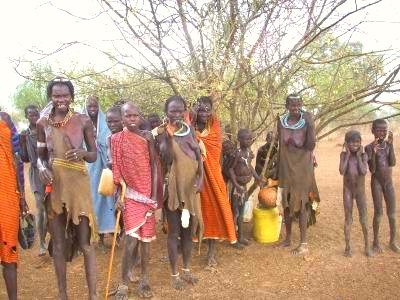
Rumble: Water for the Toposa in South Sudan

Topohsa in South Sudan

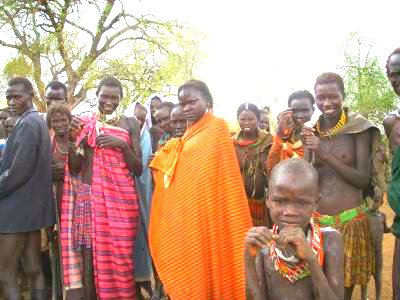
Meet the Toposa people. These traditional herdsmen live in a remote area on the shared borders of Uganda, Kenya and Sudan. Their tribe is called "Karamojong" in Uganda, "Turkana" in Kenya (an area stretching from the Rift Valley to Lokichoggio) and "Toposa" in Sudan (from Lokichoggio to Narus and Kapoeta, in the eastern Juba).

They live the life as it once was. Clothing is optional in their "country". If they have a cloth, serves the whole village, used when travelling outside the community.

Their life is centered in function of their cattle. Their cattle is their life. Traditional diet is cow blood mixed with a sort of cassava.

The family and tribe has a patriarchical system: Toposa men take decisions on behalf of the family or tribes in meetings where women and children are kept at a distance while the men discuss the people’s affairs. Tradition has it that important matters are decided in the early hours of the morning before sunrise.

Toposa in South Sudan

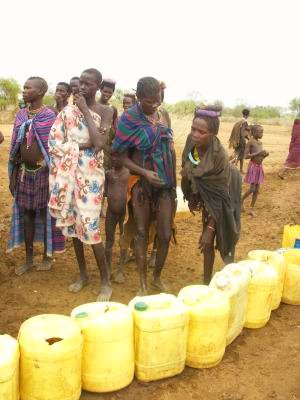
Last year, the Toposa in South Sudan faced drought, cutting not only their water supplies, but also their food production. Only delivering food aid was not enough, so we started trucking in water with the food.
It was clear that a more permanent solution was to be found, to provide them with water, a rare item in the Toposaland.

delivering water to the Toposa

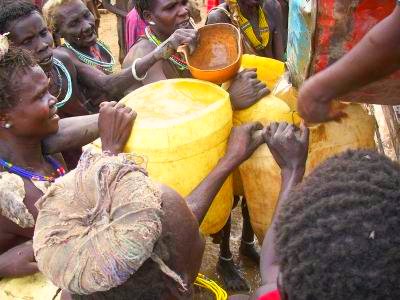
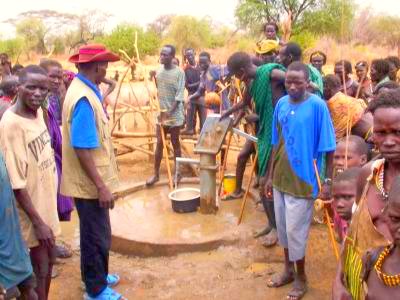
This solution was to dig a bor hole, where they could pump water from an underground well. We trucked in the mechanical pump, and connected it to a small plastic storage tank. A low cost, low tech but also low maintenance solution.

Offloading the storage tank
Installing a pump. Any work is a community affair, so loads of people are interested!
The borhole and pump are operational!

Aid with a permanent impact...

This post was written as follow-up to a previous one: World Water Day: One billion people without clean water.

Pictures courtesy Constance Lewanika (WFP), with a special thanks to Cyprien Hiniolwa.

Read the full post...

Rumble: New Short Stories

My friend "E" and I edited some of the previously published rumbles written by Cyprien, Enrico and herself into eBook short stories. By coincidence, all stories are about life in Sudan, but mostly about life as an aid worker. Enjoy!

This Man... (by "E" herself)
Murphy's Law in Sudan (by Enrico Pausilli)
How Deep Is the Deep Field? (by Enrico Pausilli)
The Pit Latrine? (by Enrico Pausilli)
Twenty-Four Hours in Aweil (by Cyprien Hiniolwa)
The Theory of Relativity (by Enrico Pausilli)
The Forces of Nature (by Enrico Pausilli)
The Perfect Balance (by Enrico Pausilli)
The Driver's License (by Enrico Pausilli)

Remember you can find a introduction and summary of each story in the eBook in the Readers' Digest.

Thanks again for all the good work, E!

Picture courtesy Ulrik Pedersen.

Read the full post...

The Driver's License

During my security briefing in Khartoum prior to my deployment into South Sudan, I was reminded that international staff are not supposed to drive and therefore no local driving licence is required. “Local drivers speak the local language. They know the local driving customs and terrain. They know where to run for help if need be.” This is what I was told. “Fair enough, something less to worry about,” I thought.

A few days later, I arrive in my new Southern Sudan duty station and receive a warm welcome from one of our local drivers…. For the rest of the week, I end up without any drivers. I am the only one in the office who knows how to drive. The nice chap who picked me up from the airstrip seemed to have disappeared and all other drivers are on field missions. I assume the policy “to always use a driver” was more of a “general guideline”. “Maybe I should start thinking of a driving licence. Just in case…”, I think.

It is a thought that recurs when one of the young drivers comes back from his walk-about. I ask him why he had disappeared for a week without permission:
- “Nothing special.” he tells me, “A chap wanted to marry my younger sister, but couldn’t afford the dowry of 35 cows we’d negotiated. So, he decided to kidnap my sister. My family and I chased them up. We –euh—‘renegotiated’ the dowry and they’ll soon be married,” he concludes, nodding with a satisfied smile.
- “So, do you have more unmarried sisters?” I ask.
- “Three more” he says.
- “Good for you. That is a lot of cows!”, I compliment him
As I walk away, I am thinking to myself: “I really, really need to get me a driving licence!”.

The next time I visit the regional capital, Juba, I fill in the application for a local driving license.
- “Not a problem, sir!” says our Juba head driver. “You only need to pass an eye test!”
He takes me to a place which looks nowhere like a hospital or even a place where they practice medicine... He explains this is where eye tests are carried out. A middle-aged lady takes me to an empty room. Our head driver and the lady exchange a few words in the local language. She fills in a form, stamps it and gives me the receipt.
- “Let’s go, sir!”, the head driver announces abruptly.
- “How about my eye test?” I protest.
- “It’s all done, sir! She looked into your eyes and didn’t see anything wrong.”

A few days later, I am the proud owner of a legal Sudanese driver’s license. Now I can drive legally, while my drivers are out chasing their future brothers-in-laws.. Procedures are followed, my eyes are fine and life is good.


Story by Enrico Pausilli. Edited by “E” and Peter Casier
Pictures courtesy Ulrik Pedersen


Continue reading The Road to the Horizon's Ebook, jump to the Reader's Digest of The Road.

Read the full post...

The Perfect Balance

Finding the right balance in life is so difficult to achieve that some people choose it as their sole undertaking in life. A common mistake made by many, though, is to think that the perfect balance is an absolute concept. It is not. The perfect balance is a moving target. That goal differs depending on where you live, what you do,.. Working in a remote location in South Sudan, today was one of those days where I felt that target was further away for me than ever.

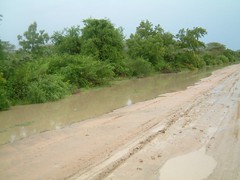
Here is the deal: I am in charge of a humanitarian operation that covers an area in South Sudan which is five times the size of Denmark. The country is amazingly challenging with little or no infrastructure, and plenty of insecurity. Luckily, things only turn real bad during the rainy season. Unfortunately, the rainy season lasts an average of eight months a year.

The very few roads we have here are then impassable. The airstrips turn into mud and thus, become unusable. The country becomes one big swamp. It gets so bad, that one long sunny period is what most South Sudanese pray for. For those waiting for food aid and other relief items, it makes the difference between life and death. The floods destroy harvests and paralyze the little commerce that shyly emerges during the dry season. The conditions are so bad that some areas become impenetrable islands, with its inhabitants isolated for weeks on end. As a humanitarian worker it is already bad enough that you can not reach those in need, stuck on one of those “islands”. But it is even worse if you happen to be there during one of those rain storms. And you become one of the “Islanders” yourself…

This environment makes “finding the perfect balance” or rather “finding any form of balance” a daily challenge. Let me describe to you what happened today: “One day during the rainy season in Bor, South Sudan.”
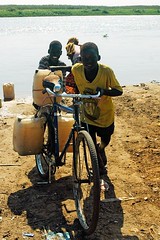
You start your day by taking a radio call from one of your food monitors out in the field, informing you the airstrip where we were to pick her up is not landable. And that she runs out of food supplies and water.

Another staff member calls in via the radio, asking for a tractor to rescue his vehicle stuck in the mud a hundred kilometres from his final destination.

While organizing help for the teams in the field, one of your staff kindly reminds you that he hasn’t been paid for the past two months which is quite common in a place where banks do not exist. His gentle reminder is accompanied by a look of annoyance from your security guards, who are still waiting for their new contracts and never miss an opportunity to remind you how good they really were with those AK47 machine guns before the South Sudan peace treaty was signed.

The worry for your life becomes second priority when a kind man tells you there are only five drums of fuel left to run the vehicles and generators, without which your operation will stop. This reminds you, you should really start working on finally getting your administration, finance and human resources assistants recruited. If you could find some time to start the process.

Ten minutes later, a Director General from one of the nearby ministries drops by your office asking for tents so he can relocate his flood-affected family to higher grounds.

While still keeping a smile and dealing with some of these adversities, you are suddenly reminded of an urgent need to go to the bathroom. The nearest latrine is two kilometres from your office, though.
“Never mind” you think, “Lunch time is few hours away. I will go then.” Meanwhile you stay away from fluids. Especially from the murky river water someone poured into the office water dispenser. *%$$£ !

That is about the time, you hear shooting in the vicinity of the office. As the UN security area coordinator responsible for the security of all staff, you are compelled to “do something”. Not too sure what, though.

By 11 am, you remember the landlord wants to kick you out of your current office premises. And the governor wants to turn your best warehouse into a prison. Meetings must be held!

Just as you realize there is no vehicle to go for lunch (or the latrine!), you remember it’s Friday and your weekly reports are due.

While you try to forget the urgency of nature’s call, you are reminded by e-mail to do a bit of planning for the next food distribution. You are trying darned hard to figure out how on earth you are going to recruit forty people needed for that. Without administration, HR or finance assistants to help you out….

Before you know it, you realise it’s already six pm and mosquitoes will soon start looking for you. Then again, you remind yourself that as a humanitarian worker, suffering is part of the job. So you shrug and look one more time at your e-mail inbox trying to figure out which of the last fifty unread message deserves your attention.

Three of them catch your eye as the red exclamation marks indicate their high-priority. You open them up and they read:

  • “The time for submission for the peer support focal point is due today”.
    You think this would be ideal work for your HR assistant. If only you had one….
  • “The deadline for the UN Online Training Module on Prevention of Harassment, Sexual Harassment and Abuse of Authority in the Workplace is due by the end of the month and is mandatory for all staff.”
    You are glad that somebody reminds you of these important topics often overlooked by operational people. But then you remember that 60% of your staff is always in the field, distributing food in remote locations where even radio connectivity is a luxury. Let alone electricity or computers. So how can they do the training, which is only available online on the Internet? And what happens to the estimated 30% of your staff who only speak a local dialect, which unfortunately is not amongst the five United Nations’ official languages of the “Harassment Module”. And the remaining 10% of your staff are stuck in the mud of the rainy season somewhere waiting for you to pull them out.
  • “Next year’s budget submissions are due tomorrow.”
    You know that you’ll never make it and without it, you know you are doomed.
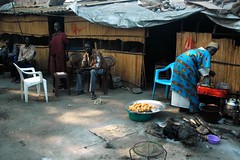
Your driver reminds you it is 8 pm and he is never been paid overtime. His calling awakens your bladder and reminds you of the curfew. You need to get going. You are cheerful, though, because tonight at least you have a driver. You get a lift to your living compound and are welcomed by a call for dinner. Ugali and beans. Again. You look at the food, take your plate to your tent, sit down and force down a few bites. You switch on your laptop, the custodian of hundreds of unread messages. Soon the frogs’ choir and bats hitting your tent imply that midnight is near… Yawn… You stand up and stretch.

Wait! One more message to read. Your wife and kids remind you how much they miss you and that your place is at home, in Rome, with them. You are about to reply, telling them that your supervisor asked you to postpone your leave due to an unplanned emergency but that would be too much in one day.

Just after midnight, you switch off the light and promise yourself that the following day you’ll figure out the meaning of all this… And that you will soon find “a better balance”.


Story by Enrico Pausilli, edited by “E” and Peter Casier
Pictures courtesy Ulrik Pedersen


Continue reading The Road to the Horizon's Ebook, jump to the Reader's Digest of The Road.

Read the full post...

The Forces of Nature

In most parts of the world, people have learned how to curb the forces of nature. However, there are still places where this has not taken place yet.

Recently, I was invited by the Government of the State in South Sudan I work in. The Governor reminded everybody that a good administration should always follow a bottom-up approach and that consultations should take place in the “bomas”, the small grass root communities, first. Then, in the counties and finally, at the state level where the final consolidation is done.

After pausing for an instant, he looked around the table and noticed that the commissioner, the ministers and the general directors were all from the capital city.

The governor then said “Well, there are always exceptions and our State is one of those. Due to the floods caused by the heavy rains, large parts of the country are still isolated and everyone has problems travelling to and from the capital. This is why WE are using a top-down approach.”

Story by Enrico Pausill, edited by “E” and Peter Casier
Picture courtesy Ulrik Pedersen


Continue reading The Road to the Horizon's Ebook, jump to the Reader's Digest of The Road.

Read the full post...

The Theory of Relativity

As a Masters student, I often wondered about the possible applications of the Theory of Relativity in real life. Now fifteen years later, while sitting at my desk as the recently appointed head of our office in South Sudan, I understand.

A young man came to me with a request for a salary advance at the end of another day in the ‘deep field’ - a day full of nuisances and challenges. The form bore two signatures, which gave me some reassurance the request had gone through some initial screening process. I asked him for his name and what he did for WFP. The answer didn’t come immediately, so I repeated my question. After some seconds of hesitation, he uttered a few words in Dinka, the local language. Being Italian, I had no difficulty in using my body language to make him understand to come back with an interpreter which he did.

His name and function though, did not match those on the form. I asked the translator, one of the two signatories, why the name on the form was not the same name as that provided by the young man.
- “Well, because that’s his brother’s name”, the interpreter replied.
- “And where is his brother?” I queried.
- “He deceased a couple of months ago!” he said.
- “This is not a family position” I growled, “We only employ people through a selection process based on competencies and relevant work experience. Ask him how he was hired..”
- “Well, he inherited his brother’s family so he took his brother’s job to maintain them.”
He certainly had a point and I was about to mellow out.
- “So, what type of contract have you been given, my son?”
Without hesitation the interpreter offered the answer:
- “None!”

I held my breath for a moment, thought to answer, but could not but smile. I closed my laptop and called it a day.


Story by Enrico Pausilli, edited by “E” and Peter Casier
Picture courtesy Ulrik Pedersen


Continue reading The Road to the Horizon's Ebook, jump to the Reader's Digest of The Road.

Read the full post...

Twenty-Four Hours in Aweil.

I landed in Aweil, South Sudan on the afternoon of April 20. The landing strip is located in the middle of the village, joining the two sides. When there is no aircraft, the landing strip is a soccer field where kids play football while watching their cows. It is also where trucks from Kisangani and Kampala offload their cargo, filling the strip with cycling villagers and smaller trucks. Before landing the pilot flies over the strip at low altitude to chase away any living creature. Once this warning is given and the "airport" is vacated, the pilot then comes back to land.

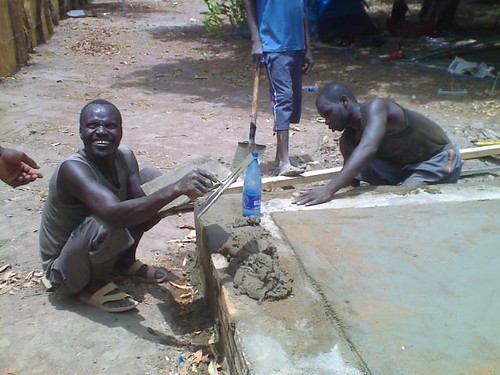
I have twenty-four hours in Aweil to build a concrete base for the office satellite communications dish. This system enables us to cut down the communications costs dramatically, so I really have to get it up and running before the plane picks me up again. And I only have one day to do it. The challenge is to find casual laborers to help me build the concrete base. The rest of the work, I can do by myself.

After hiring a dozen of them who resign minutes after they have taken the job, I am introduced to these Darfur refugees who accepted my terms and conditions: work through the night until the concrete base is done, load the gravel, the bricks, the iron rods and transport them to the site. They take the job.

We work from 14:30 and complete the work the next day at 03:00 in the morning. At 08:30 we continue, plastering the bricks. This is when I take a picture of this man. This daily labour is a refugee from Darfur. He has little or nothing. Not even a home. He lives in a camp. He worked through the night and still, he smiles. It is comforting to see this smile.


A smile from a man with barely nothing, but his heart

When I pay them in the evening, they look at me like someone who just gave them an award or a present. And yet, the salary is their right. They are thankful while yet they did ME a favour!

I leave wishing I could be more of help to them another day. I realize this is what I enjoy about working in this part of the world. In all of my actions, I get the chance to see its immediate impact on the people, on the beneficiaries. I will never regret having chosen to work here. Here I get what a big salary or a promotion cannot give me: the feeling that I have been of help to a human being.


Story and picture by Cyprien Hiniolwa (Camp Juba, Southern Sudan).
Edited by “E” and Peter Casier


Continue reading The Road to the Horizon's Ebook, jump to the Reader's Digest of The Road.

Read the full post...

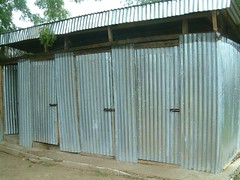
The Pit Latrine

When everything else is lacking, the bare necessities are really bare. Those coming from relatively developed countries have forgotten a human being needs only the very bare necessities. One of those is a proper toilet with a flush. I always loved camping, but camping for a living and especially in a non-tourist resort has never been my dream. The best you can find as a humanitarian worker in most places in South Sudan is a tent. The lucky ones have the type where you can simply walk rather than crawl in after a long and tiring day….. And a pit-latrine. What’s wrong with a tent and a pit latrine? Nothing, if it wasn’t for some small details.

According to Murphy’s Law, your tent always ends up a good twenty metres from the latrine. A distance that can reach a hundred metres depending on Murphy’s degree of concentration. At night, once you’ve decided you cannot hold it in anymore, you start summoning all your energy and courage to overcome the many obstacles separating you from the latrine. You often wonder whether it wouldn’t be less painful to simply forget about it and have a good shower the next morning.
At any rate unlike you, mosquitoes and many other unknown creatures love your tent.

So getting out of it, without being bitten to death, is the first obstacle. Obviously, this doesn’t come without stress since your tent’s zipper is usually broken and you don’t want any unwelcome tenants to swamp in. When you are lucky, you haven’t forgotten your torch so you can proceed to your ultimate destination without the further frustration of having to fiddle with that damned zipper again to get back into your tent.

The second barrier is the snakes. That is, when you have a properly fenced compound where bigger animals cannot enter as in this part of the world a lot of animals still move around freely and undisturbed. If your journey proceeds without unpleasant encounters, you can finally open the door to the pit latrine. Since you have at least another ten competitors for the same latrine, you always walk the last five metres praying that nobody else has had a similar pressing need and you won’t have to wait in the dark for fifteen minutes.

At this point, the inexperienced, the optimistic and the careless might think that all their troubles are over.. Or at least, 50% over since the return journey is still awaiting. The rest, though, know that the worst fear is yet to come: the encounter with the Hole!

You start imagining that some disgusting slimy creature has chosen this unusual place as its den. In those moments, you are still tempted to go back to your tent with your business unfinished. However, after a few seconds of realism and the pressure from your bowels, you decide to lower your trousers and get it over with.

Every night, the average humanitarian worker over here in South Sudan dreams of his or her own toilet where they can read the Sunday Times undisturbed! How basic dreams can be…

Story and pictures by Enrico Pausilli.
Edited by “E” and Peter Casier


Continue reading The Road to the Horizon's Ebook, jump to the Reader's Digest of The Road.

Read the full post...

How Deep Is the Deep Field?

BorFor us, aid workers, there is this magical term: the “Deep Field”. It stands for those locations where the real relief work is done. But the “Deep Field” is relative, depending on where you stand. Here I was, leaving our headquarters in Rome for my new assignment in Bor, South Sudan. A place I learned to know as the “Real Deep Field”. How deep can one go, though?

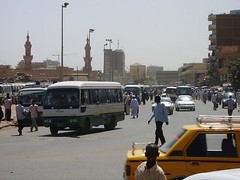
Just before leaving our Rome, I met a colleague who’d just come back from a “field” mission. “Where to?” I said. “Khartoum” he replied. Khartoum, an as-if non-family duty station, is considered by the UN to be an adverse place, bad enough to make you earn the famous hardship allowance. Khartoum, with its international airport, renowned university and air-conditioned houses and shops, is indeed considered a daunting destination by most HQ colleagues waiting for their reassignment. For me, Khartoum was just the first of two transit points on the way to “The Real Deep Field”: my final destination and the frontier to civilization.

Once I reached Khartoum, the perspectives rapidly changed. Colleagues based in Khartoum felt privileged to be there and looked down upon their unfortunate colleagues who had been chosen for Juba, my second and final transit point and its sub-offices. A colleague from Khartoum confessed to me that he jokingly used “A mission to Bor” as a powerful ‘threat’ with his staff: “How bad could Bor be?” I wondered. Khartoum wasn’t that bad, after all …

JubaThe flight to Juba was pleasant and without surprises. Juba, the capital of South Sudan and one of the three WFP coordination centres in the area, had a more “familiar field look”: a poorly developed place, with loads of challenges. But still a place where the bare necessities could be found. Half of my colleagues were still living in tents. Offices were housed in air-conditioned containers. There was no local infrastructure, rough hygienic conditions and a volatile security situation. But all types of food, drinks and a bit of night life were available. In my first few days in Juba, I felt this was the level of isolation and hardship I was ready to tolerate.

At the mention of the word “Bor”, most colleagues in Juba squirmed, compassionate enough not to unveil the final surprise but kind enough to give me some indispensable tips that would prepare me for what was yet to be revealed. Despite it all, I was quite anxious to go to Bor and was still a bit optimistic that at least something was going to be good. Well, my optimism was soon to be betrayed.

When I reached Bor, I felt this was the end of the “known world”. This must be the “Real Deep Field”, I thought. The office, located in a compound on the west bank of the White Nile, did not comply with any of the standing security and operational standards. Food, sanitation and basic living conditions were a mere illusion. I really felt depressed.

Within 24 hours however, I discovered a new world. This was not the “Deepest Field” yet: Bor, is the capital city of Jonglei state, the vastest of the ten South Sudan states, five times the size of Denmark. Bor has its own governor, ministers, a parliament, a police force and a local market where a few basic items could be bought. Those excluded fruits, vegetables and cleaning material, though. It also has a wannabe all-weather airstrip and a hospital run by Doctors Without Borders (MSF).

All of this wasn’t enough to brighten my spirits until I spoke to one of our field monitors. She was about to go on one of her usual food distribution missions with ninety kgs of luggage. “What are you carrying?” I asked. “A tent, clothes, gum boots, water, basic food for thirty days, charcoal and a few other indispensable items.” she replied. “Why food for thirty days if you are going on a 3-day mission? And what are you doing with the gum boots?” I said. “Well, during the rainy seasons the areas where we operate get flooded. So sometimes, the plane cannot land for weeks and the gum boots are essential to walk in those swampy areas, although sometimes the water reaches more than one meter.” Then I noted she did not have any means of communication and that her tent had holes.

So after all, maybe Bor isn’t the “Real Deep Field!”

Story by Enrico Pausilli, edited by “E” and Peter Casier
Pictures courtesy Ulrik Pedersen and Ben


Continue reading The Road to the Horizon's Ebook, jump to the Reader's Digest of The Road.

Read the full post...

Murphy's Law in Sudan

Everybody knows Murphy’s Laws, but nobody imagines how applicable they are in South Sudan. If something can go wrong, it will go wrong and in the most unlikely way with the worst possible consequences.

Here you are in the bush. Finally, your one week holiday has arrived and you can go back home to see your family. You get into the car and after a little difficulty you manage to insert the worn-out key. The engine is running, but the car is not moving. Gee, a flat tyre. And of course, the spare is flat as well! You control your murderous instincts and get into a second vehicle.

It is raining. No, it is pouring. The road is very muddy and slippery. The pickup slides all over the road. You get out of the car to engage the axle lock on the front wheels. After ten minutes, you are soaked, but you can’t get the lock engaged.You have not given up hope yet, so you engage the 4-wheel drive, and drive the best you can. The worst that can happen is that you end up in a ditch. You can’t give up. You really want to get out of that place. You keep driving at 10 mph.

You finally get to the airstrip, step into the sheltered area and wait. The sky is dark and heavy. Rain pours down. The plane is late and you swear. The airstrip looks wet but “landable” to you… Or maybe you’re just being optimistic. You wait, until you hear the pilot’s crackling voice on the HF radio, announcing the approach from the plane. You look up at the sky and start believing again that a God does really exists. After a couple of unsuccessful landing attempts, the plane turns around and disappears at the horizon. “Airstrip unlandable”, says the pilot over the radio…..

You are depressed, exhausted. You sit down on an empty fuel barrel and think of quitting this job once and for all. Then you think of the people you are helping…and your mortgage. All of a sudden, you come up with a brilliant idea: There is a road that can take you to the next airstrip. If the weather is not too bad you can still make it. It is only 5 hours’ drive. The road though is on security level-4 and requires a military escort, but not all is lost. It is Friday and halfway, there is a scheduled convoy that you can join.

You start driving and keep wondering whether you are still sane to travel in these weather conditions on a security level-4 road, but you drive on. Two more hours later, you finally reach the convoy meeting point. The convoy should be there by noon. You wait and wait. The convoy is not there. Still, you are hopeful…. Three hours later you are told the convoy has been cancelled. The next one will be on Monday!

You drive back for three hours. Get into your tent and sit on your bed, with the rain gushing down on the canvas. Everything is damp. You feel miserable and hope for a better day. One without Murphy following you around.

Short story and picture by Enrico Pausilli
Edited by “E” and Peter Casier


Continue reading The Road to the Horizon's Ebook, jump to the Reader's Digest of The Road.

Read the full post...
.

  © Blogger template The Business Templates by Ourblogtemplates.com 2008

Back to TOP