Picture of the Day: Shot and Charred

A charred bulletproof vest lays in the burnt-out UN Kabul guesthouse, which was attacked last week. (Full)
More Pictures of the Day on The Road.
Picture courtesy Peter Nicholls/The Times Read the full post...
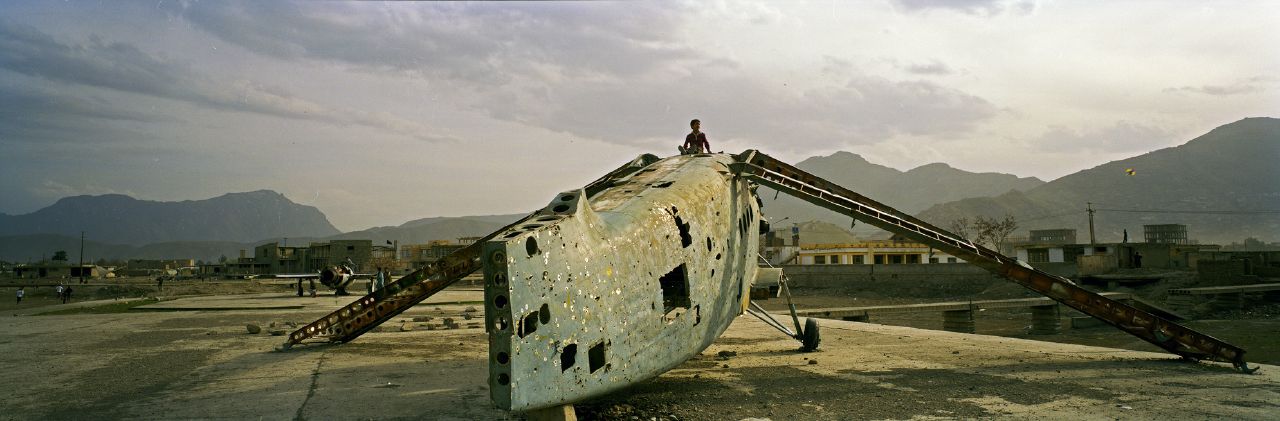
Kabul. The Afghans pronounce it with a long, closed ‘o’, making it sound like ‘Ko-obel’. Most of the a’s are pronounced like an ‘o’ here. Ko-obel. Kabul. It is afternoon. The late-summer sun descends low over the horizon, giving the yellow scenery a golden glow with long exotic shadows. During this time of the year, the temperatures are nice. Really enjoyable. In between the battering dry heat of summer and the biting cold of the long winters, are those short periods which tourist brochures would define as a ‘moderate Mediterranean climate’. The tourist brochures for Kabul must date back to the fifties and sixties most likely.
We are sitting on the stairs of Kabul airport, facing the tarmac looking over the airstrip. Kabul International Airport. There are a bunch of us, all relief workers and reporters. Two from a Pakistani camera crew for the Deutsche Welle, a tall blond Danish demining expert, an Australian water drilling expert from Unicef, a Bangladeshi seed expert from FAO and myself. We are waiting for the UN plane to pick us up. And the plane pretty much has its own time schedule, defined by the “Chaos Theory” dominating Taliban air clearances, weather patterns and the number of people getting stuck at immigration each time the plane lands.
Immigration. The Immigration Counter… All speaks straight to the core of one’s imagination. The airport is heavily damaged. Probably already since twenty or thirty years. Traces of shrapnel and grenade explosions. Bullet holes in windows and walls. Some of them nicely lined up as maybe one of the last Russian soldiers emptied his AK47 while sinking through his knees, shot in the back of his head, spraying the bullets in a nearly perfect curve over the wall. War graffiti. As if saying ‘Alexander was here’, and ‘Alexander was here and never left’. ‘Sacha’ for his friends. ‘Alexej’ for his wife, who will never see him alive again. ‘Alexander was here’, 20 odd bullet holes in a row. The last ones disappeared in the ceiling, where most of the off-white square cardboard tiles have gone and one can see the building skeleton through the aluminum frames of the false ceiling. Cables run left and right in metallic gutters, now rendered useless as it has been many years since Kabul International Airport had its last spark of electricity.
That is probably why everything is so quiet. It calls for religious silence. Respectful silence. Or are sounds just absorbed in the vast empty space which is now left of the airport? It seems people do speak more softly, move more discretely through the different parts of the airport which are now nothing more but ‘remains’. The remains of the rubber belt which once delivered luggage. Torn up, cuddled up in a corner. Remains of counters, half removed, half torn apart. The most inspiring I found the remains of the mechanical displays above the check in counters, and the large display in the entrance hall. You know the kind which click-clack showing the flights, one small metal plate for each letter. What was the last regular flight which left Kabul International Airport? The flight 1203 at 10:15 to Tblisi, it says in Cyrillic on check-in counter 5. I am sure it is counter 5, but the display is dismantled, and two wires stick out of the metallic tube. Wonder if it was shot off or someone just took it with him. Maybe one of the last Russians leaving here has it on display in his living room in St.Petersburg or Kiev, as a war trophy: a plastic yellow square with the black number ‘5’ on it. Would any of his friends believe this was the ‘5’ of the Kabul check-in counter ‘5’, leaving for Tblisi at 10:15 somewhere in a dark past?
Through the entrance hall windows, you gaze onto the main space in front of the airport, filled with rubble. Stones, sprouts of yellow-dry grass. A shot-down primitive watch tower made hastily of metal rusty frames, probably once was the seat of the referee at the tennis club at the Kabul Intercontinental. In the corner, on top of a pickup truck, a guy leisurely rests his arm over a heavy machine gun, bolted onto the roof of the car. Some low scrubs of trees survived the third year of drought, and decades during which people had other priorities than the esthetics of the vegetation at the airport entrance.
Some Taliban officials sit outside the door of ‘Gate 2’, through which we came. One of them, I recognize. He has a turban with Scottish tartan squares, and a sleeveless vest over his long traditional coat and pants. He has the most amazing friendly blue eyes. Many Afghans have. Or green. Many have a light skin and ‘European’ features. My guy talks German, I remember. ‘Der UN Pilot has kein Uhr’, he smiles at me pointing at the sky. ‘The UN pilot does not have a watch’. He is a hydraulic engineer, and studied in East Germany many years ago. He traveled around a fair bit of the world, and right now, he is a ‘Taliban’, watching over the immigration procedures at Kabul International Airport. He cracks some jokes with the custom officials while putting his thumbs in the small watch pockets of his sleeveless jacket, once a part of a stylish Western suit.
 He shouts a few words at the two Taliban guards, who are laying on their side on an iron bed frame on the side of the stairs, a bit further up. They are young men in their late teens or early twenties. In deep brown traditional clothes, with a dark gray-brown turban. All their turbans have one long end hanging down from the back over their shoulder up to their waist. Rather attractive. I honestly bet you it will come up one year in the ‘haute couture’ shows of a fashion designer in Paris. Their AK47’s loosely lean against their shoulders. - of the Taliban soldiers that is, not of the Paris models. -. Many of these guys live, eat and sleep with their gun. It looks like it is part of their dressing code, almost part of their body. Most of them actually grew up with their gun, to help protecting their tribe, their herd, their family, and now their nation. The gun is worn out, no more varnish on the wood pieces. The dark spray paint on the metal parts, is rubbed off by the constant handling. But like an old car, it is probably a reliable piece of machinery.
Golden yellow, golden brown, like a picture on a postcard. Remains of summer, a beautiful early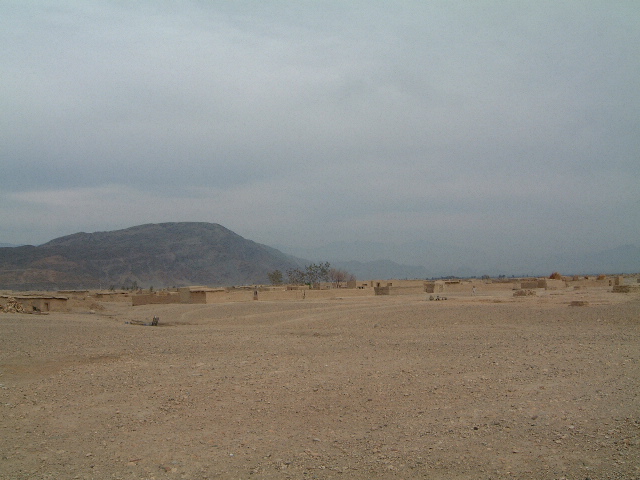 fall evening. The mountain range around Kabul is dry. Not a single tree, just some yellow bushes. ‘Amazing’, says the demining expert. I agree. While sitting on the stairs right at the apron, we have a 180 degree sight of the landing strip, taxi runways and hangers around the airport. With the dry yellow mountains, under the fading yellow sun, with small yellow dust devils whirling up small yellow tubes of sand and dust here and there, in between the wrecks of literally hundreds machines of war. Shot down, missed the runway, blown up, or just dumped and stripped of spare parts. MIL-8 Russian helicopter gunships with big dark ragged edged holes in their light yellow and green camouflaged side. Pieces of old artillery and tipped over radar equipment. Antonov and Ilhutsin cargo planes sticking their tail or wing in the air. Hangers with caved-in roofs, with crashed fuel and supply trucks underneath their vast concrete weight.
Three Boeing 727’s from Ariana, the official Afghan national airline, have their cockpit windows covered with a large cotton sheet, and their engines are closed off with red orange shutters. These are the last remains of the Afghanistan national fleet. They still fly within the country, but maintenance and spare parts becomes a pain. The sanctions do not allow the import of plane parts, nor do they allow international commercial flights. A few times per year, one international Ariana flight is allowed to transport children for treatment in Frankfurt, if I remember well. I met the German orthopedic surgeon who accompanies the children on these trips. Was it Frankfurt or Munich? A long flight, he said. And adventurous! But a good opportunity to have maintenance done on the plane while on the ground in Germany.
This is a magical moment. Italian opera music with a full mezzo-soprano voice plays in my head. ‘In Pace’ by Sarah Brightman. Try it, and then picture this scene from what will once have to be part of a movie: ‘In Pace’, ‘In Peace’ playing with nothing but the soft wind on the background, the camera makes a slow, very slow panoramic 180 dgrs pan. A gracious gesture of cinematographic perfection, starting at the left from the hangers and the few MIG fighters left intact, over the yellow specks of grass in between the runways, slowly over dumped or crashed Russian trucks, helicopters, planes sticking out of the low scrub bushes like a mechanical war grave yard, all covered with the yellow dust. The camera moves over the tarmac and in between the soprano voice, the microphone picks up the very remote and soft roar of the white Beechcraft UN aircraft approaching. The camera pans slowly over the old Ariana Boeing 727, with the edge of the cotton window cover sheet softly waving in the wind. The camera slowly slowly zooms out to show the emptiness of the apron, the voidness of the airport, the absolute acknowledgement of existence and persistence in this war torn airport, in this war torn capital city of this warn torn country, which is the center of a war torn region, terrorized by draught and the playing field of the big international powers-that-be.
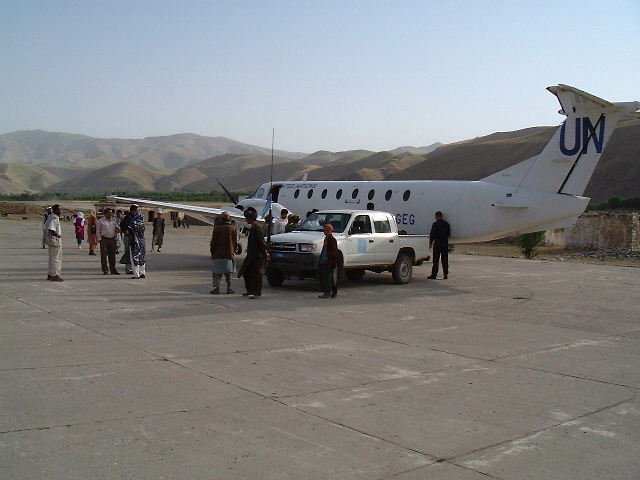 The camera zooms out, and from the left of the screen, one can hear a noise. Weet-..-weet. Very softly but sharply. Weet-..-weet. A repetitive metal squeak. Slowly. And as the camera continues to zoom out, a Taliban with his Khalashnikov over his shoulder, on an old Chinese bicycle rides into the left of the picture. Weet..-..weet. He has a bundle of hay on the back of his bicycle as he slowly cycles off the runway, over the apron, between the parked MIGs, the Ariana planes, and the taxi-ing UN plane. And at his own pace, the cyclist moves out of the picture, but the sound, you can still hear for a while. Weet-..-weet-..-weet. The plane neutrals the pitch of its propeller blades and shuts off the engine. (I always found that an appealing noise) ffffff-rrrrr-wwaaaaaaattt.. And before we know it, the plane has integrated into the yellow scenery, of a perfect afternoon in Kabul. The soprano voice fades out, and so does the picture. In Pace. In Peace…
Exactly one week later, at almost exactly the same time of day in Kabul, the first plane crashed into the World Trade Center.
In the introduction to the eBook, I wrote about the decision to quit my managing job in a large corporate firm and to do something completely different with my life. Back then, in 1993, I swore NEVER to be a manager again. I wanted life to be simple. 9 to 5! Set off on a job with a clear perimeter and targets, so it was easy to measure how I performed. Being a technician (again) during my first missions to Africa, made life much simpler for me: either the installed equipment worked or it did not.. Much easier than work as a manager where deliverables are greyer and objectives more obscure..
Somewhere along the road, I must have done something wrong, as 10 years later I ended up as the director of the Dubai office... I was probably the only director running around in Tshirt, safari pants and sandals in the office. I did keep a suit in my locker, though, just in case a government official showed up for a meeting.
One day, I put my suit on for the deputy minister of Agriculture from a Western country, and his entourage. Often these meetings are pretty boring, explaining what we do, have a cup of tea, shake hands, take a picture and basta-cosi.... Half an hour, an hour max..
But this deputy minister got intrigued by our organisation and how we do our work, so the conversation was pretty lively and entertaining. At a certain point, we branched off talking about our personal experiences in 'remote places'.. We ended up talking about Afghanistan. My guest said he just finished reading a novel about Afghanistan, and how he appreciated it. He promised to send it to me.
I thought "Right, heard that before!". But, surprise surprise! A couple of weeks later, this book appeared in the mail together with a nice cover letter by 'my deputy-minister' saying "It is a compassionate read and one I thought you might appreciate as much as I did."
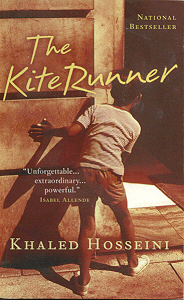
Well, he was right. It is the best book I read in years: 'The Kite Runner', by Khaled Hosseini.
Mr Hosseini is a Kabul born physician, currently living in California. His first novel tells the story of Amir, an Afghan boy, who is - like many Afghan boys - fascinated with kiting.. You need to know kiting is a Real Serious Thing in Central Asia.
The story follows the life of Amir through the dying years of the Afghan monarchy, the Soviet invasion, the challenging years living in exile, the Taliban era. The main thread is Amir's relationship with his father, and the feeling of guilt towards his friend and servant, Hassan. It is about coming to terms with mistakes from one's youth and the feeling of guilt. The story sucked me into its intriguing plot like a detective novel does.
Very well written.. I wished I could write so well, but then 'He Does It so Much Better Than Me!".
So I guess this is at least one advantage of being a manager: you meet people who recommend you interesting books!
Enjoy this book. More of my favourites, you can find in my online library.
More recommended books from The Road.
 Afghanistan, three days after the defeat of the Taliban.
 aircraft of all kinds. Two guys in local attire, riding four-wheel motorbikes, guided the plane to its parking space on the tarmac. When we got out, onto the tarmac, we went over to say hi. “Where are you guys from”, someone asked, as their short blond hair showed they were no locals. “I cen’t tell ya’, said one, in an obvious Texan accent, with a radio labeled ‘USAF’ (US Air Force) strapped onto his belt.. Hmm..
 autumn day with an absolutely clear blue sky above naked mountains topped with snow, which presided over a bright yellow desert valley. The litter of the relics of years of war were the only signs of civilisation amongst the void of sand and dust: old Russian-made tanks and artillery, shot to pieces and half-buried in the ground. In several places, the road was bombed or a big hole in the asphalt, with a wreck in the ditch alongside, reminded us that this was a heavily contested piece of land, fought over for twenty-odd years amongst countless warring fractions. The last battle took place only three days ago, between the Taliban and the Northern Alliance troops.
 of this emergency operation. Against all odds, and under the continuous threat of bombing and military reprisals, they had kept moving and distributing massive amounts of food for the needy. A short visit to the WFP warehouse proved the point of how real the risks had been to all of them. The staff there described with pride how they had loaded food as the military installations all around the warehouse were bombed. They showed us bags of shrapnel collected after the bombings. Many pieces of metal and debris had come through the tin roof and walls.
 Hotel where our radio repeaters were installed. They all went off-air weeks ago. We found that, for safety reasons, the hotel staff had dismantled the radios, masts and antennae. All the bits and pieces were still there. But now came the next problem: as the UN flight to Kabul had had limited luggage capacity, I had not been able to bring my toolboxes. With some ingenuity and a Leatherman, we put all the pieces together again and flicked the switch: the two repeaters came alive with a soft hum.
 ahab, my local counterpart, started discussing with him in Pashtu. They kept on pointing at me, at the sky, the town, and a handheld radio.. The commander finally got into our car and we drove to the second peak of “TV mountain”. I gasped for a moment, as we stepped out into a magnificent scenery. We stood, at an altitude of 2200 meters, under a clear blue sky, with B52 bombers still circling overhead, leaving white trails behind them. Kabul with its buzzing activity lays hundreds of meters below us. We looked at the horizon and at eachother as walked onto the roof of a building with a round concrete roof. It used to be an air traffic beacon, and now featured a hole from a massive bomb in the exact center of it. I remembered the video shots of the precision bombing from fighter planes, I had seen on CNN.
 nd repeated what he heard on the other… A manual retransmission of messages.. ‘The commander says their radios have interference, can you solve it?’, translated Wahab. I looked on the roof at their antennas. They were too close. It took me fifteen minutes to shorten the bamboo poles supporting the antennas and to separate them. Interference solved. The commander smiled satisfied, and slapped my back and we shook hands in agreement. “This is the place.”, I smiled at Wahab.
 This is a re-edit from an article previously written with by C.Hurford
 Peter. Flemish, European, aid worker, expeditioner, sailor, traveller, husband, father, friend, nutcase. Not necessarily in that order. Peter. Flemish, European, aid worker, expeditioner, sailor, traveller, husband, father, friend, nutcase. Not necessarily in that order. |


© Blogger template The Business Templates by Ourblogtemplates.com 2008
Back to TOP


The Road's Dashboard
Log in
New
Edit
Customize
Dashboard